
As the financial year comes to an end, accountants across the UK are gearing up for one of the busiest times of the year: reviewing reports, checking records and making sure everything adds up. It’s a tough time but it’s also one of the most important in keeping finances tidy.
Year end closing is the process of finalising a company’s accounts at the end of the financial year. It involves reviewing, reconciling and confirming all income, expenses and balances before preparing financial statements and tax returns.
For accountants, small firms, and business owners, this is when the numbers tell the real story of the year. Every invoice, receipt, and report needs to be in order so the results reflect the true financial position. Doing this well not only helps meet HMRC requirements but also gives a clearer view of where the business stands and how it can grow next year.
In this blog, we’ll explore what year end closing means, the key steps involved, common challenges accountants face, and how Equallto helps firms manage the process more efficiently.
What Is Year End Closing?
Year end closing is the process of wrapping up the company’s financial records for the year. It means confirming that every income and expense has been recorded correctly, and all balances make sense.
The aim is to create a final, accurate set of financial statements — the balance sheet, income statement, and cash flow report. Once those are ready, the books for that year are officially closed. No more entries, no more edits.
In practical terms, this is when accountants get to measure progress and prepare for what’s next. It helps firms identify trends, make better forecasts, and plan future tax or cash flow strategies.
Understanding the Year End Closing Process
The year end closing process is not just about generating reports. It’s a methodical process that ties together every part of the accounting cycle. In many firms, this stage of year end accounting brings together reconciliation, reporting, and tax preparation in one coordinated effort.
It usually includes:
- Reviewing and cleaning up ledgers
- Matching and reconciling bank accounts
- Recording adjusting entries for items such as depreciation or accruals
- Preparing the final financial statements
- Getting ready for tax filing
Each step needs focus and good time management. It takes both skill and consistency to make sure the year ends with clear and accurate accounts.
The Year End Closing Process — Step by Step
If you want your year end close to go smoothly, follow these practical steps. They work whether you are an independent accountant or part of a larger firm.
1. Review All Transactions
Start with a complete check of your general ledger. Look through income, expenses, and journal entries to ensure they’ve been posted in the right accounts. This is the time to fix small things that might have been missed earlier – like miscategorised invoices or incomplete entries.
2. Reconcile Bank Accounts
Compare your internal cash and bank balances with your actual bank statements. Any mismatch should be investigated. It could be an unrecorded payment, a double entry, or a client payment that hasn’t cleared yet.
3. Confirm Accounts Receivable and Payable
Run through customer and supplier lists. Chase overdue invoices, clear pending supplier bills, and make sure the ledger reflects the real situation. Accurate payables and receivables are essential for honest reporting.
4. Make Adjusting Entries
Record adjustments such as depreciation, accruals, and prepayments. These ensure income and expenses are recognised in the right period, not just when cash moved.
5. Check and Value Inventory
If your client holds stock, do a physical count and compare it to what’s on record. Update the value where needed and account for any lost or damaged items.
6. Review Fixed Assets
Check all the assets your client bought or sold during the year. Make sure they’re recorded correctly in the books. Update depreciation if needed and confirm that each asset is listed under the right category.
7. Prepare Financial Statements
Bring everything together in the main reports — the profit and loss account, balance sheet, and cash flow statement. Compare the numbers with last year to see if anything looks unusual. If something doesn’t seem right, look into it before finalising.
8. Do a Final Review
Run a trial balance to check that everything matches. It’s helpful to have another accountant or team member review the accounts, as they might spot something you missed.
9. Lock the Period
Once satisfied, close the books for that year. This prevents accidental changes and secures the data for reporting and tax filing.
10. Roll Forward for the New Year
Carry over balances, open new ledgers, and set your budgets. A quick review meeting at this stage helps identify what went well and what could improve next time.
Common Challenges in Year End Closing
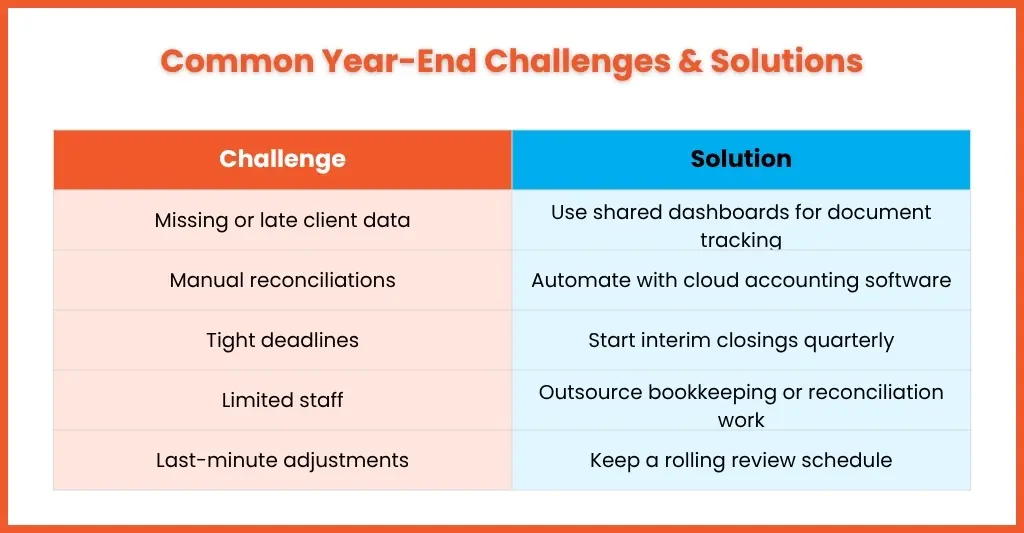
Ask any accountant what makes year end difficult, and you’ll hear the same themes.
- Missing or late data – Clients sometimes submit records just days before deadlines.
- Tight timelines – Handling several clients while meeting submission dates can stretch teams thin.
- Manual work – Spreadsheets still dominate in many firms, leaving room for human error.
- Limited staff – Smaller practices may struggle to manage everything without extra help.
- Last-minute adjustments – Discovering an error close to submission can throw off the whole schedule.
Most firms face a mix of these challenges every year. The key is not to eliminate pressure entirely but to manage it better with structure and preparation.
Best Practices to Simplify Year End Closing
With a few smart habits, accountants can make this process far less stressful.
1. Start Early
Do not wait until the last few weeks. Begin reviewing ledgers and gathering documents well before the end of March or April. The earlier you start, the fewer surprises you’ll have.
2. Keep Records Tidy All Year
Regular monthly checks mean fewer issues later. When data stays organised throughout the year, the final close feels much easier.
3. Use Technology to Automate Tasks
Automation can take care of reconciliations, recurring entries, and depreciation schedules. It saves hours of manual work and reduces errors.
4. Schedule Interim Closings
Try doing a smaller close every quarter. It gives you a head start and spreads the workload evenly across the year.
5. Improve Team Communication
Set up a shared checklist or workspace where everyone can track progress. Whether you are working with clients or an internal team, visibility keeps things on track.
6. Outsource When Needed
Many firms now bring in external help during the year end rush. Outsourced accounting partners can handle reconciliations, ledgers, and report preparation so your team can focus on reviews and client discussions.
How Equallto Simplifies Your Year End Closing
At Equallto, we know the year end period can test even the most experienced accountants. Our back-office support is designed to make this time more efficient and far less stressful.
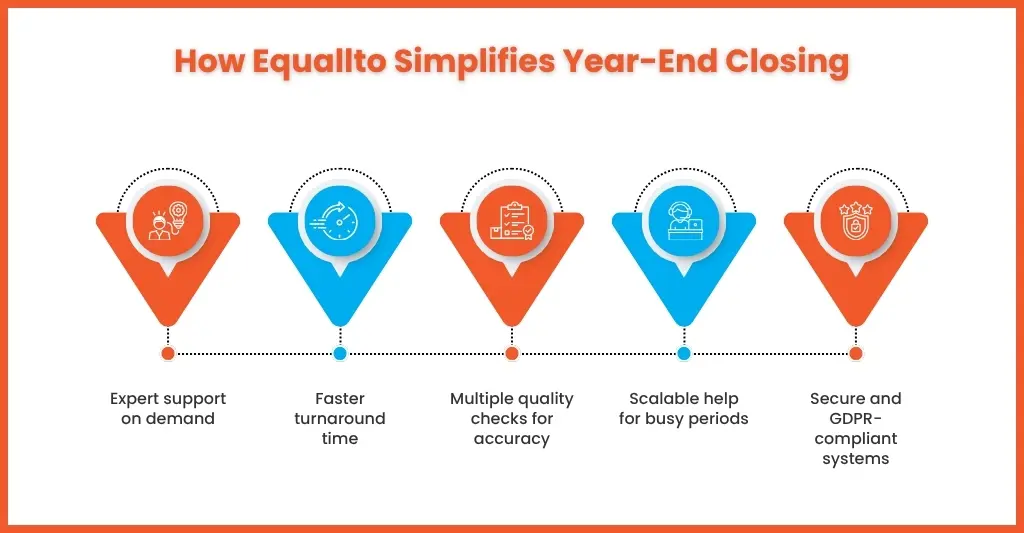
Expert Support When You Need It Most
We work as an extension of your firm, taking care of reconciliations, adjustments, and reporting. You decide the level of help you need, and we handle the rest with accuracy and confidentiality.
Saving Time and Reducing Costs
Firms that work with Equallto often see faster turnarounds and lower administrative costs. Your team can stay focused on client service while we manage the background work.
Accuracy You Can Trust
Every report goes through multiple checks before it reaches you. We follow clear workflows that ensure compliance with UK accounting and HMRC standards.
Flexible and Scalable Help
Whether you need a few extra hands during busy periods or complete year end assistance, our services scale to fit your workload.
Secure and Confidential Processes
We treat client data with the highest level of care. Equallto follows strict GDPR guidelines and uses secure, encrypted systems for all document handling.
Collaborative and Transparent Workflow
We integrate with your existing software and communication tools. You always have full visibility into progress and results, without needing to manage extra systems.
Partnering with Equallto gives firms the reliability and flexibility they need during the most crucial time of the year.
FAQs — Year End Closing Essentials
Can outsourced accounting teams handle my year end close securely?
Yes, Equallto keeps your client’s data safe through encrypted systems and tightly controlled user access. And every single one of our engagements comes with a confidentiality agreement to protect your clients’ data.
How long does the year end closing process take?
It depends on the size of your business. For a small firm, it might be a matter of days, but for large firms handling multiple clients, it could be as long as two or three weeks. The better shape your records are in, the quicker it goes.
How can automation help in speeding up year end closing?
It reduces the mind-numbing repetition that comes with manual work, and makes a big difference in getting reconciliations right the first time and speeds up reporting.
What documents are we going to need for year end closing?
You will need to have your ledgers, invoices, payroll records, bank statements, asset registers and tax documents in order – all in one place, preferably a month or so before the year ends, to avoid any nasty delays.
What are the key UK deadlines for year end filing?
UK companies usually have nine months after their year end to file accounts with Companies House, and 12 months to file the CT600 Corporation Tax return with HMRC. Aligning your financial year end with the UK fiscal year (31 March) helps streamline compliance.
Conclusion
Year End Closing is one time of year that can be a major headache, but also an incredible opportunity to get a real handle on how your business is doing, and with the right support it’s not as painful as it needs to be. In fact, when done properly it can bring a real sense of clarity to start the new year off on the right foot, plus give you the confidence to keep on going.
And amongst accounting firms and solo practitioners, Equallto can make a huge difference in managing this process smoothly – it all comes down to having the right tools and expertise to make the job as efficient as possible.
With a focus on accuracy, secure systems and reliable support we can get your year end close wrapped up in no time. If you want to make your experience with the year end workload as hassle-free as possible, get in touch with our team today and discover just how much of a difference our accounting support can make.
Ready to streamline your year end process? Contact Equallto today and experience how our accounting support can make your year end closing effortless.
