
Most small to mid-sized accounting practices in the UK feel stretched. Deadlines never really stop. Month-end blends into year-end. Evenings disappear faster than planned.
Many accountants say the same thing. They enjoy the client work, but the routine tasks take over. Bookkeeping clean-ups, reconciliations, payroll checks, VAT reviews. Important work, but time-consuming.
This is where Outsourced Accounting and Bookkeeping Services come in. Not as a replacement, but as support. Used properly, outsourcing helps accountants stay in control while easing pressure. In this blog, we look at how outsourcing works, the real benefits, the risks to watch for, and why more UK small accounting firms are choosing this route.
Key Takeaways
- Outsourced accounting and bookkeeping services allow UK accounting practices to handle more client work without hiring, covering bookkeeping, payroll, VAT, management accounts, and year-end
- The 7 main benefits are: reduced daily pressure, more client time, cleaner bookkeeping, easier month-end and year-end, fewer errors, flexible capacity, and better work-life balance
- Outsourcing combined accounting and bookkeeping is typically more cost-effective than an in-house hire once salary, NI, pension, training, and software costs are included
- The right provider should have strong UK accounting knowledge, HMRC compliance experience, secure data handling, and clear communication
- Equallto works as an embedded partner within UK accounting practices — not as a separate vendor — handling back-office work under your brand
What Are Outsourced Accounting and Bookkeeping Services?
Outsourced Accounting and Bookkeeping Services involve delegating core financial processing tasks, including bookkeeping, reconciliations, payroll, VAT preparation, management accounts, and year-end support, to an external specialist team, while the accounting practice retains full client responsibility and control.
This usually includes bookkeeping, reconciliations, payroll processing, VAT preparation, management accounts, and year-end support. The work follows your processes, deadlines, and standards. These services also help mid to small-sized accounting firms stay aligned with HMRC record-keeping requirements, which outline how long accounting records must be kept and what needs to be maintained for VAT and tax purposes.
For many small to mid-sized accounting businesses, outsourcing is simply a way to cope better. It allows firms to handle more work without hiring full-time staff or working longer hours.
Key Benefits of Outsourcing Accounting and Bookkeeping
The seven key benefits of outsourced accounting and bookkeeping services for UK practices are: reduced daily administrative pressure, more time for client advisory work, cleaner and more consistent bookkeeping, easier month-end and year-end processing, fewer compliance errors, flexible capacity during peak periods, and improved work-life balance for practice owners and staff.
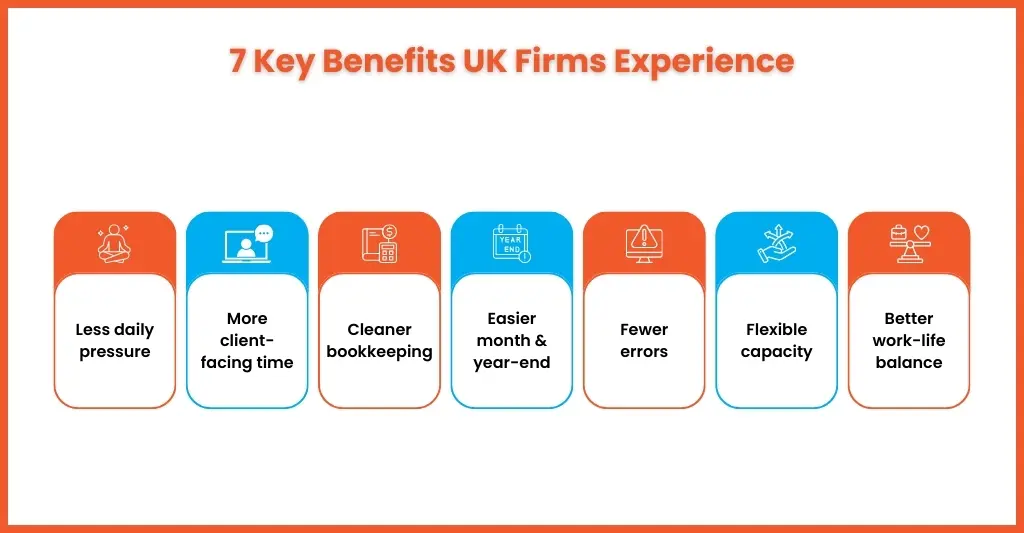
1. Less daily pressure
Routine work is shared, which reduces stress during busy weeks.
2. More time for clients
Accountants spend less time fixing records and more time advising clients.
3. Cleaner bookkeeping
Regular support keeps ledgers up to date instead of fixing issues later.
4. Easier month-end and year-end
Work is spread out, so deadlines feel manageable.
5. Fewer errors
Specialist teams handle accounting tasks every day, which improves accuracy.
6. Flexible capacity
You can scale support up or down without changing your team.
7. Better work-life balance
Evenings and weekends are not always taken up by catch-up work.
When outsourcing works well, it feels like extra hands inside your firm.
How to Choose the Right Outsourced Accounting Provider
Choosing the right outsourced accounting and bookkeeping provider requires evaluating six criteria: their experience working specifically with UK accounting practices, their HMRC and Making Tax Digital knowledge, the clarity of their communication model, their data security standards, the simplicity of their onboarding process, and their ability to scale as your practice grows.
1. They should work with accountants
Avoid providers who try to replace your role. You stay in charge.
2. Strong UK knowledge
They must understand UK accounting rules, VAT, payroll, and deadlines.
3. Clear communication
You should know what is being worked on and when it will be finished.
4. Secure data handling
Client information must be protected at all times.
5. Simple processes
Clear workflows reduce mistakes and rework.
6. Ability to grow with you
Your needs will change. Your partner should adapt easily.
When outsourcing feels like a partnership rather than a service contract, it delivers real value. This is how Equallto works alongside small to mid-sized accounting practices.
Common Challenges and How to Overcome Them
Risks and Challenges to Be Aware Of
Outsourcing can cause issues if not set up properly.
- Work quality may drop
- Communication may slow down
- Data security can be a concern
Example:
A firm outsourced bookkeeping without clear instructions. The work came back late and needed rechecking.
Example:
Another firm faced VAT errors because the provider lacked UK experience.
How to Overcome These Challenges
These risks can be reduced with the right approach.
1. Agree on processes early
Clear instructions prevent confusion later.
2. Keep regular check-ins
Short weekly updates avoid surprises.
3. Use shared systems
Cloud tools improve visibility and control.
4. Start small
Test outsourcing on limited tasks first.
5. Choose a partner who understands accountants
This avoids constant explaining.
Example:
One firm started with reconciliations only, then expanded to payroll.
Example:
Another firm used shared dashboards to track progress in real time.
Cost Expectations for Outsourced Accounting Services
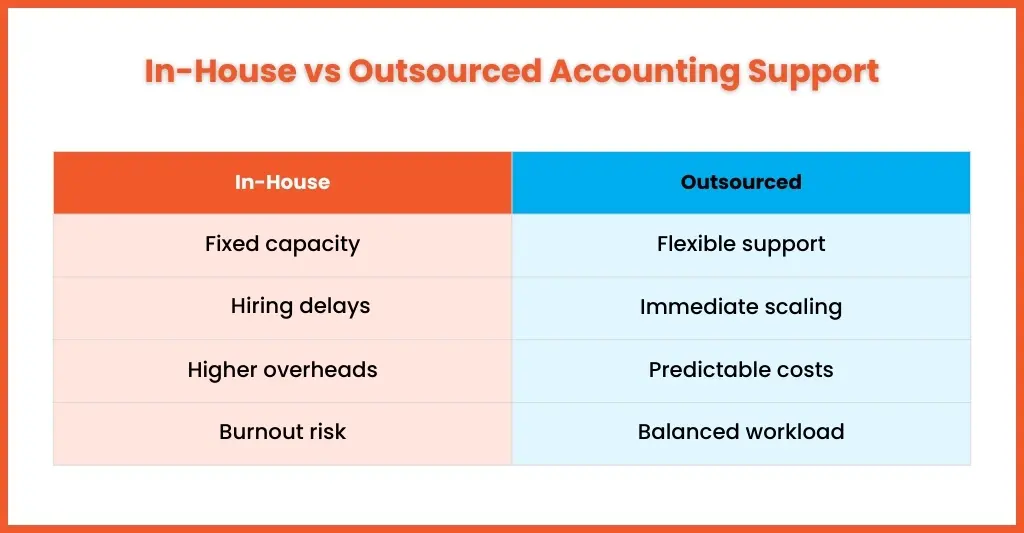
Outsourced accounting and bookkeeping services in the UK typically cost between £200 and £800 per month for small to mid-sized accounting practices, depending on transaction volume, number of clients supported, payroll size, and reporting complexity. This is consistently more cost-effective than an in-house hire: a qualified bookkeeper or junior accountant in the UK costs £28,000–£35,000 per year in salary alone before employer NI, pension, training, and software.
Pricing depends on transaction volume, payroll size, reporting needs, and deadlines. There is no one-size-fits-all figure.
Outsourcing bookkeeping is often cheaper than hiring an in-house accountant once salary, training, software, and management time are considered.
Outsourcing is especially useful when:
- You do not need a full-time accountant
- Work peaks at month-end
- You want cloud accounting without managing it
- You need better reports
- You want to reduce compliance risk
Many small accounting firms choose to outsource routine work to reduce the risk of errors that can lead to penalties under HMRC compliance requirements, especially around VAT submissions and payroll reporting.
Future of Outsourcing Accounting and Bookkeeping Services
More UK small accounting firms are now treating Outsourced Accounting and Bookkeeping Services as a normal part of how their practice runs. What started as a way to handle overflow work has become a long-term approach to managing workload and capacity. Small to mid-sized accounting businesses are realising that doing everything in-house is no longer the only way to stay competitive.
The future of Outsourced Accounting and Bookkeeping Services is less about cost saving and more about stability. Shared teams allow work to continue smoothly during busy periods without putting constant pressure on internal staff. Better systems mean work is visible, tracked, and easier to review. Calmer workflows reduce last-minute fixes and long working hours. When outsourcing is used thoughtfully, it supports growth without exhausting the people doing the work.
Over time, firms that build outsourcing into their operating model are likely to be more resilient. They can take on new clients without rushing recruitment, adapt to changes in demand, and maintain consistent service quality. For many UK accountants, Outsourced Accounting and Bookkeeping Services are becoming less of a temporary solution and more of a foundation for sustainable growth.
People Also Ask
How do I choose the right outsourcing provider?
Choose an outsourced accounting and bookkeeping provider that works specifically with UK accounting practices, holds strong HMRC and Making Tax Digital knowledge, operates secure data handling processes, assigns you a dedicated point of contact rather than a shared support queue, and can demonstrate experience with your existing accounting software, such as Xero, QuickBooks, or Sage.
What are the main benefits of outsourcing accounting services?
The main benefits of outsourced accounting and bookkeeping services are reduced administrative pressure on in-house staff, more time for client advisory work, cleaner and more consistent financial records, easier month-end and year-end processing, fewer compliance errors, flexible capacity during peak periods, and improved work-life balance for practice owners — without the overhead of permanent recruitment.
How much does outsourcing accounting services cost?
Outsourced accounting and bookkeeping services in the UK typically cost between £200 and £800 per month for small to mid-sized practices, depending on transaction volume, services required, and the number of clients supported. This is typically more cost-effective than an in-house hire when salary, employer National Insurance, pension, training, and software costs are fully accounted for.
Is outsourcing suitable for small accounting firms?
Yes — outsourced accounting and bookkeeping services are particularly well-suited to small accounting firms because they provide access to qualified professional support without the commitment and cost of a permanent hire. Small practices benefit most from the flexibility to scale capacity up during busy periods and scale back when demand reduces, without any recruitment process.
Will I lose control of my clients?
No. Outsourced accounting and bookkeeping services are designed to support your practice from behind the scenes — your practice retains the client relationship, your branding, and all decision-making. The outsourced team works to your processes, your standards, and your deadlines, acting as an invisible extension of your team rather than a separate visible supplier.
Conclusion
Outsourced Accounting and Bookkeeping Services help UK accountants manage workload without losing control. They allow small to mid-sized accounting practices to focus on clients while routine work runs smoothly.
Outsourcing works best when it supports accountants rather than replaces them. When done right, it brings balance, consistency, and space to grow.
Equallto works exclusively with UK accounting practices as an embedded outsourcing partner — not a generic service provider. With structured workflows, dedicated account managers, secure data handling, and no long-term contracts, Equallto is designed to fit around how your practice already works.
Equallto works inside small to mid-sized accounting practices in the UK as a long-term partner. By combining structured workflows with human support, Equallto helps accountants reclaim time, reduce pressure, and build sustainable practices.
