
Many small accounting firms across the UK are feeling the pressure of rising staff costs, tighter margins, and increasing compliance work. According to recent industry reports, more than 40 per cent of UK accounting practices now use some form of outsourced support to manage bookkeeping and back-office tasks. This shift is not about cutting corners. It is about protecting capacity and maintaining service standards.
The benefits of outsourcing accounting and bookkeeping are becoming clearer for small firms that want to grow without overstretching their internal team. Outsourcing gives access to trained professionals, structured systems, and predictable costs while allowing partners to remain focused on clients.
In this blog, we’re going to delve into the benefits of outsourcing accounting and bookkeeping, why a growing number of small accounting firms are opting for this approach, when to consider it, and how to pick the right outsourcing partner in the UK.
Why Small Firms in the UK Outsource Bookkeeping and Accounting
Many small accounting firms do not begin with the intention of outsourcing. It often starts with pressure. A team member leaves. A new VAT deadline overlaps with year-end work. Hiring takes longer than expected. Gradually, outsourcing becomes a practical solution rather than a strategic experiment.
Industry reports suggest a growing percentage of UK accounting practices now use external bookkeeping or accounting support in some form. Not because they want less control, but because they want more stability.
Control overheads without hiring staff
Hiring sounds straightforward until you calculate the full cost. Salary is only part of it. There is pension, holiday cover, training, and supervision time. For many small accounting firms, outsourcing offers flexibility without permanent payroll commitments.
For example, a small accounting practice with 80 bookkeeping clients may not need a full-time hire. But it may need consistent support. Outsourcing fills that gap.
Handle more clients without overload
Growth is positive, but it can stretch a team quickly. As client numbers increase, bookkeeping work increases with it. External accounting support allows a small accounting firm to accept new work without pushing staff to burnout.
Many partners notice this first during VAT quarters. The workload spikes. Outsourced help smooths the pressure.
Access trained accounting specialists
Outsourced teams usually work only on accounting and bookkeeping tasks. That focus brings experience. A small accounting practice gains access to people who already understand reconciliations, management accounts, and reporting standards.
This is one of the practical advantages of outsourcing accounting and bookkeeping. You are not starting from zero with training.
Meet HMRC deadlines with confidence
Late submissions create stress. Whether it is VAT, payroll, or year-end accounts, deadlines do not move. With structured external support, a small accounting firm can manage filings more calmly. Confidence grows when there is backup in place.
Free partners from bookkeeping tasks
Many partners did not start their small accounting firm to review bank reconciliations at 9pm. Yet that often happens. Outsourcing routine bookkeeping releases time. And that time usually goes into client meetings, advisory conversations, or business development.
Grow beyond compliance work
Compliance work keeps the lights on. Advisory work drives growth. Outsourcing bookkeeping support gives a small accounting practice space to focus on higher value services. Over time, this shift changes the direction of the firm.
Support during busy filing periods
January self-assessment season. Company year ends. Payroll changes. These periods stretch internal teams. External bookkeeping support acts as a buffer. It keeps standards steady even when volumes rise.
Improve efficiency with better systems
Outsourced teams often use structured workflows and cloud accounting software. A small accounting firm benefits from these systems without building them internally.
This is another clear benefit of outsourcing accounting and bookkeeping. Better process without internal disruption.
Top 7 Benefits of Outsourcing Accounting and Bookkeeping
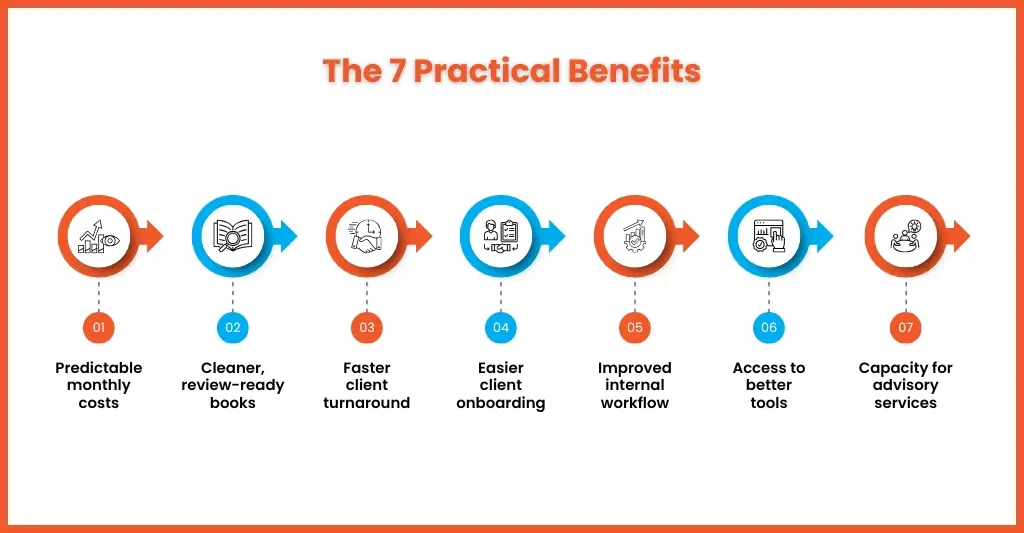
The benefits of outsourcing accounting and bookkeeping are not only financial. They influence workflow, team morale, and long-term planning. Here are the top 7 benefits:
Predictable monthly operating costs
Internal hires bring fixed commitments. Outsourced finance support can scale up or down. For a small accounting firm, this flexibility makes budgeting easier. Costs align more closely with workload.
Consistent quality and review ready work
When bookkeeping is handled by a focused external team, records are often cleaner. Review time reduces.
Many small accounting practices notice that year end preparation becomes smoother once routine bookkeeping is structured properly.
Faster client turnaround times
Capacity affects speed. With additional accounting support, work moves through the system more quickly. Clients appreciate shorter waiting times. Reputation improves.
Ability to onboard more clients confidently
Growth feels risky when internal workload is high. With outsourced accounting and bookkeeping support, a small accounting firm can accept new engagements more comfortably.
The benefits of outsourcing accounting and bookkeeping become visible at this stage. Growth no longer feels like pressure.
Improved workflow and process organisation
External teams usually operate with clear checklists and review points. Over time, these processes influence the small accounting practice itself. Internal organisation often improves as a result.
Access to modern tools and reporting systems
Cloud accounting tools, reporting dashboards, and automated reconciliations are common in outsourced environments.
A small accounting firm gains exposure to these systems without additional hiring or internal training programmes.
More capacity to develop higher value services
When bookkeeping is handled externally, partners regain time. That time can be invested in advisory work, cash flow forecasting, and client strategy discussions.
In the long term, this may be the most important benefit of outsourcing accounting and bookkeeping.
Outsourcing is not about stepping back. It is about strengthening the delivery structure behind the scenes.
When Should a Small Firm Consider Outsourcing Their Finance Function?
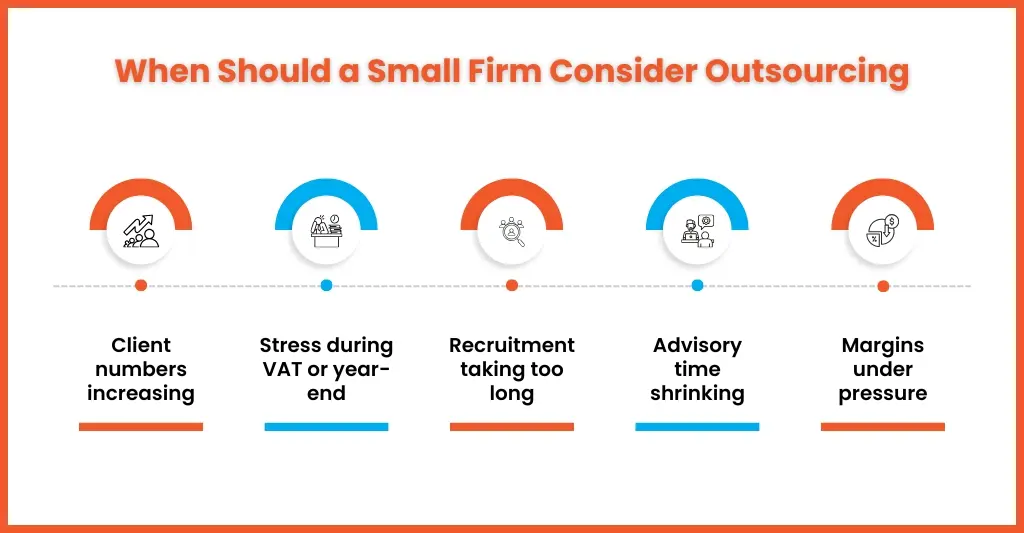
There is rarely a single trigger. It builds gradually. A small accounting firm may notice partners working longer hours. Recruitment may take months. Deadlines might feel tighter each quarter.
If growth is slowing because capacity is limited, it may be time to explore outsourcing accounting and bookkeeping support.
Common signs include:
• Increasing client numbers without new staff
• Regular stress during VAT or year-end deadlines
• Difficulty finding experienced bookkeepers
• Limited time for advisory services
• Rising operational costs affecting margins
Outsourcing does not remove control. It changes how work is delivered while the small accounting practice remains fully responsible.
Choosing the Right Outsourcing Partner in the UK
The benefits of outsourcing accounting and bookkeeping only materialise if the partner is right. Not all providers operate in the same way. A good fit supports your small accounting firm’s standards and client expectations.
Experience working with UK accounting practices
A provider familiar with UK accounting standards understands VAT, payroll, and Companies House requirements. This reduces errors. Experience shortens the adjustment period.
Strong understanding of HMRC compliance standards
Compliance sits at the centre of every small accounting practice. The outsourced team must understand reporting deadlines and regulatory requirements of HMRC. Confidence in compliance builds trust quickly.
Clear communication and responsive support
If communication is slow, problems grow. A reliable outsourcing partner responds clearly and consistently. Your small accounting firm remains the client facing advisor, so responsiveness matters.
Secure data handling and confidentiality controls
Financial data must be protected properly. Secure systems and GDPR awareness are not optional.
Ability to integrate with your existing software
Most small accounting firms already use cloud platforms. The outsourcing partner should work within those systems. This avoids unnecessary disruption.
Transparent pricing with no hidden charges
Clear pricing prevents friction later. One of the advantages of outsourcing accounting and bookkeeping is cost clarity. Unexpected charges weaken trust.
Dedicated team structure and continuity of staff
Continuity improves efficiency. A consistent team becomes familiar with your clients and workflow. This supports smoother delivery over time.
Scalable support as your practice grows
Growth should not require a full structural reset. The right partner scales support alongside your small accounting firm. That protects long term expansion.
People Also Ask
What are the main benefits of outsourcing accounting and bookkeeping for small firms?
Most small accounting firms notice reduced pressure first. Costs are easier to manage, deadlines feel calmer, and partners gain back time. Over time, the benefits of outsourcing also include better quality and steadier growth.
Is outsourcing secure and GDPR compliant?
It can be, as long as the provider follows proper data protection standards and secure systems. Always check how information is stored and accessed before starting a partnership.
Will I lose control of my finances if I outsource?
No. Your small accounting firm stays responsible for client relationships and final approvals. The external team helps with delivery behind the scenes.
How much does outsourcing typically cost?
Costs differ based on workload and service scope. Many small accounting firms prefer flexible models tied to volume instead of fixed salary commitments.
Can outsourcing help my small accounting firm grow?
Yes. With routine bookkeeping handled externally, capacity increases. This often allows firms to develop advisory services and confidently accept new clients.
Conclusion
The benefits of outsourcing accounting and bookkeeping are practical rather than theoretical. They appear in reduced workload pressure, steadier processes, and improved client delivery.
For many small accounting firms, outsourcing begins as a solution to capacity strain. Over time, it becomes part of a stronger operational structure.
Equallto works alongside small accounting firms as an extended operational team. We work quietly in the background to help small accounting firms stay on top of their workload. With structured accounting and bookkeeping support, it becomes easier to maintain quality without stretching your team too thin. If your small accounting practice is starting to feel the strain, this could be the right time to look at a more reliable and flexible way of working.