
In-house accounting vs outsourcing: which is better in 2026? For most small UK practices, a hybrid model works best. Keep client-facing, review and advisory roles in-house, and outsource high-volume work such as bookkeeping, payroll processing and VAT preparation. In-house gives you control but costs more per head. Outsourcing adds capacity quickly without new headcount or recruitment delays.
Small practices are rethinking how they staff compliance work. Making Tax Digital for Income Tax became mandatory on 6 April 2026 for sole traders and landlords with qualifying income above £50,000, hiring is still slow, and employer National Insurance has been 15% since April 2025.
The question of in house accounting vs outsourcing has never been more relevant. Do you hire your own full-time team, work with external experts or find a mix of both?
In this blog we explain what each model means, the pros and cons and help you decide which approach works best for your firm in the in house accounting vs outsourcing debate. Whether you run a growing UK accounting practice, work as an individual or manage a small business you’ll find practical insights to make the right decision.
Key Takeaways
- Hybrid is the safest default for small practices: partners and reviewers stay in-house, repeatable processing goes to a partner.
- Hiring costs more than the salary. Employer National Insurance is 15% above £5,000 per employee in 2026/27 (HMRC).
- Capacity is the real pressure. 73% of firms in a June 2026 survey said they are turning away work because they can’t find staff.
- Best to outsource: bookkeeping, payroll processing, VAT preparation and year-end support. Best to keep: client relationships, review and sign-off.
- Check before you sign: UK GDPR compliance, a written scope, turnaround times and who signs off the work.
What is In House Accounting?
In-house accounting means having your own team handle all financial and accounting tasks from within your firm. This includes bookkeeping, payroll, VAT filing (in line with HMRC requirements), tax returns, and management accounts.
It’s a model that offers direct control and close collaboration. Your accountants work closely with your partners, understand your firm’s processes, and are available for quick discussions when needed.
However, keeping an in-house team also means higher costs from salaries and training to software and office space. It’s a good choice for firms that prefer oversight and consistent day-to-day contact but may not suit those looking to scale quickly.
The tax side is easy to miss. For the 2026/27 tax year, employers pay 15% National Insurance on each employee’s earnings above £5,000 a year (HMRC, rates and thresholds for employers 2026 to 2027). On a £40,000 salary, that is £5,250 on top of pay, before pension, software and training. Payroll is often the first function small practices hand over, and our payroll outsourcing service is built for that.
What is Outsourced Accounting?
Outsourced accounting is hiring an external partner or specialist firm to do some or all of your accounting. It could be as simple as bookkeeping or as strategic as having a full finance function outsourced. Your firm keeps responsibility for the client relationship and the final sign-off.
Outsourcing has taken off across UK accounting as firms look to save money, tap into skilled people and make use of modern accounting tools. It frees you up to concentrate on your clients and on growing the business, while specialists take care of the routine accounting work, accurately and in line with HMRC compliance requirements.
Capacity is the bigger driver now. A June 2026 Global Accounting Talent Index survey of 500 accountants across the UK, Canada, Australia and the US found that 73% say their firms are turning away work because they can’t find qualified staff (Accountancy Today, 22 June 2026).
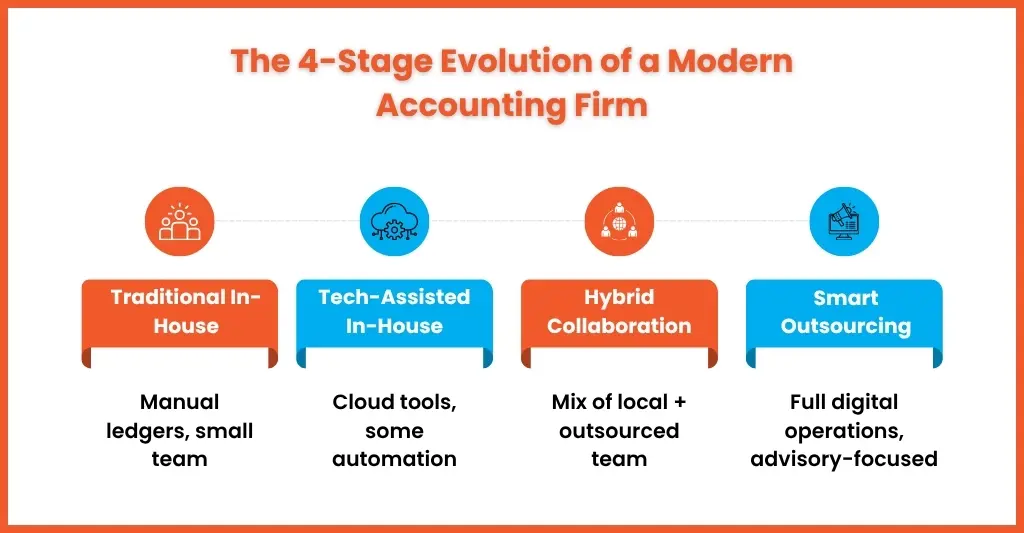
Many firms now combine in-house and outsourced support to get the best of both, keeping control while staying flexible. This approach is becoming more common when comparing in house accounting vs outsourcing.
What is the Difference Between In House Accounting and Outsourc,ing?
The main differences are cost structure, capacity, control and compliance. In-house gives you direct control at a fixed cost. Outsourcing gives you flexible capacity at a variable cost.
| Factor | In-House Accounting | Outsourced Accounting |
| Cost | Higher, includes salaries, benefits, and office costs. Employer NI is 15% above £5,000 per employee (2026/27). | Variable: you pay for the scope and volume you agree. |
| Expertise | Limited to your team’s skills and experience. | Access to a wide pool of experts and specialisations. |
| Scalability | Harder to expand quickly during busy periods. | Easily scalable based on workload. |
| Technology | You buy and maintain software yourself. | Outsourcing partners provide modern, ready-to-use tech. |
| Control | You manage everything directly. | Shared control, with structured updates and reporting. |
| Compliance | Requires ongoing training for your staff to keep up with HMRC guidelines | Managed by specialists who stay current with HMRC rules. |
| Flexibility | Fixed costs and staff levels. | Flexible, affordable, and easy to adjust. |
What are the Pros and Cons of In House Accounting?
In-house accounting gives you control, consistency and fast decisions, but it costs more and gets stretched at peak times. Here are the main pros and cons.
Pros
Control: You can see everything and make decisions instantly.
Team Connection: The team knows your firm’s culture and works with leadership.
Access: Easy to talk about issues or make changes on the fly.
Cons
Cost: Salaries, benefits and software subscriptions can be expensive, and employer National Insurance adds 15% above £5,000 per employee.
Limited Expertise: A small team may struggle with complex or specialised accounting areas.
Scaling Issues: Managing peak workloads like year-end or the new quarterly Making Tax Digital cycle can be stressful without extra help.
What are the Pros and Cons of Outsourced Accounting?
Outsourcing gives small practices extra capacity, specialist skills and a flexible cost base. The trade-off is less day-to-day oversight, and your results depend on the partner you choose.
Pros
Cost Savings: You only pay for what you need, no hiring or training costs.
Specialised Knowledge: Outsourced accountants work across industries, bringing more experience and insight.
Flexible and Scalable: You can scale up for busy periods or special projects.
Better Tools: Outsourcing firms use advanced accounting technology that keeps data secure and up to date.
More Time for Growth: Less admin means you can focus on clients and business development.
Cons
Less Direct Oversight: You rely on structured communication rather than face to face management.
Coordination Delays: Different time zones or communication gaps can sometimes slow responses.
Quality Depends on Partner: Choosing the wrong firm can impact consistency and trust.
With the right partner, these risks are manageable. Agree the scope, turnaround times and review process in writing before any work moves across.
Which is Better for Your Practice: In House Accounting or Outsourcing?
For most small UK practices, a hybrid model beats going fully in-house or fully outsourced. Keep partner-facing, review and advisory work in-house, and outsource the repeatable, high-volume tasks.
The truth is, there’s no single answer when choosing between in house accounting vs outsourcing. Every firm has different needs, but small practices tend to feel the capacity squeeze first. It helps reduce costs, gives access to skilled accountants, and makes it easier to manage extra work during busy times without worrying about hiring or training new staff.
The talent market backs this up. ACCA’s AB magazine reported in September 2025 that 48% of practitioners in the Accounting Talent Index (169 firms in the UK and Australia) said the shortage is worse than three years ago, and 44% had seen pay costs rise to cope (ACCA AB magazine).
Outsourcing is also flexible. You pick how much help you want, ask for more when it’s busy and cut back when it isn’t. Your team doesn’t get bogged down, and they can spend their time on clients.
More and more firms are going hybrid. The people who deal with clients stay in-house, and the repetitive, time-eating jobs go outside: bookkeeping, VAT returns, management reports. Clients still get someone they know. You still get the speed, accuracy and lower cost of outsourcing.
A simple way to split the work:
| Type of work | Best fit |
| Client relationships, advisory and partner-level review | In-house |
| High-volume bookkeeping, VAT preparation, payroll processing | Outsource |
| Seasonal peaks: year-end, Self Assessment, quarterly MTD updates | Outsource or hybrid |
| Specialist or one-off projects | Outsource |
| Final sign-off and quality control | In-house |
FAQs: In House Accounting vs Outsourcing
1. Is outsourcing cheaper than in-house?
In most cases, yes, once you add up what a hire really costs. An employee comes with a salary, employer National Insurance of 15% on earnings above £5,000, a pension contribution, software and training, and you pay all of it whether or not there’s enough work to fill their week. Outsourcing makes that cost variable, tied to the scope and volume you agree. For a small practice, that makes budgeting a lot more predictable.
2. When should you outsource accounting?
Consider it when your workload is growing faster than your team can keep up, or when you need specialist skills but can’t justify a permanent hire. The usual triggers are year-end pressure, a bookkeeping backlog, increased Making Tax Digital volumes, or trouble recruiting. A sensible way in is to hand over one repeatable function, like VAT preparation or payroll, and extend the arrangement once you’re happy with the quality and turnaround.
3. What are the risks of outsourcing accounting services?
The main ones are poor communication, blurred accountability, weak data protection and uneven quality. You can keep these in check by picking a partner that complies with UK GDPR and HMRC requirements, putting the scope and turnaround times in writing, and keeping review and sign-off in your own team’s hands. It also helps to ask for references from firms of a similar size before you commit.
4. What should I consider when deciding to do in-house or outsource?
Weigh up four things: the full cost of a hire, including employer NICs; the expertise you can realistically recruit; how much extra capacity you need at your busiest times; and whether you can maintain the technology and security yourself. If you value flexibility and want extra capacity without a long hiring process, outsourcing or a mix of both tends to suit small practices best.
5. What are the 4 key things to consider before outsourcing?
First, compare the potential savings with what a hire currently costs you. Second, look at data security, including UK GDPR compliance and a data processing agreement. Third, check how reliable the provider is on turnaround times and accuracy. Fourth, agree how day-to-day communication and escalation will work. It’s also worth starting with a short pilot on a single function, so you can judge the quality before moving more work across.
Conclusion: Finding the Balance That Works for You
Choosing between in house accounting vs outsourcing isn’t always a clear-cut decision. Each option has its own strengths — in-house teams offer control and familiarity, while outsourcing brings flexibility, scalability, and cost savings.
For many growing UK accounting firms, outsourcing can be the smarter choice. It helps reduce expenses, boost efficiency, and free up time to focus on clients and growth.
Equallto is a UK accounting outsourcing partner for accountancy firms, based at The Techno Centre in Coventry and powered by Corient. We support bookkeeping, payroll, VAT returns, management accounting and year-end accounts, with no long-term commitment.
Discover how outsourcing can help your practice grow with confidence.
Book Your Free Consultation with Equallto Today.
