
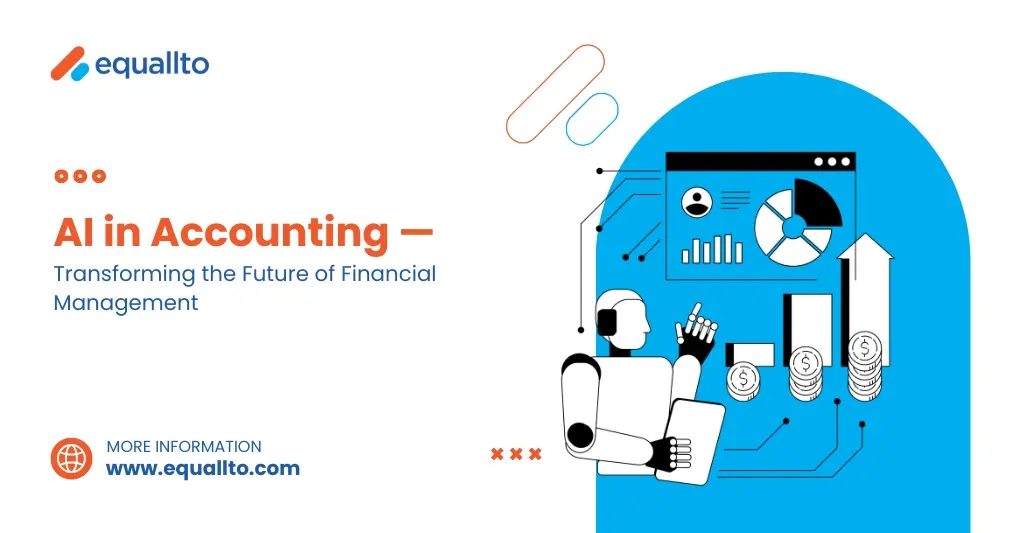
Artificial Intelligence has moved far beyond being just a trendy idea. It’s quietly changing how accountants handle their daily work. Reports that once took half a day to prepare now take only minutes, and the results are often more accurate. AI in accounting is steadily reshaping how small firms, solo accountants, and business owners across the UK manage their finances.
AI in accounting uses smart tools that can take over repetitive jobs like bookkeeping, data entry, and cash flow forecasting. It gives accountants the time to focus on things that really matter: advising clients, reviewing performance, and helping businesses grow. It’s not just about automation. It’s about working smarter, spotting trends faster, and making financial decisions with confidence.
In this blog, we’ll break down what AI in accounting actually means, how UK firms are using it, some real examples, and how Equallto can help you adopt AI smoothly without the confusion or heavy cost.
What Is AI in Accounting?
AI in accounting means using intelligent systems to take care of the manual work accountants have done for years. These systems can read invoices, match transactions, analyse data, and even notice when something looks off in the numbers.
Behind the scenes, they utilise all sorts of ‘machine learning’ and ‘pattern recognition’ stuff – cutting edge tech that gets smarter with every bit of data you give it, so the more information you upload the better it gets at picking out trends and raising a flag on potential problems.
A simpler way to think about it is that instead of having to manually enter every single detail, you’ve got a tool that already knows the drill and checks its own work as it goes. the end result is far fewer errors, reports generated a lot faster, and a whole lot less tension as deadlines start looming.
And the best part of all? The fact that accountants can finally get on with the stuff that really matters – like actually helping clients come up with a plan, make some smart projections, and make informed decisions instead of just slaving away crunching numbers.
How to Use AI in Accounting

AI isn’t some futuristic concept anymore; it’s already being used by thousands of accounting firms in simple, practical ways. Here’s what that looks like in real life:
Automated data entry
Instead of typing receipts one by one, AI software can scan and post them directly into your accounting system.
Invoice management
The system can flag duplicates, spot missing details, and even track payment statuses.
Forecasting
AI analyses previous figures to predict cash flow, helping firms prepare for what’s coming next.
Compliance monitoring
AI tools watch for odd transactions or gaps in documentation before they become compliance issues.
The more repetitive the task, the more AI can help. This gives accountants space to do what humans do best — think critically, solve problems, and advise clients. It’s not about replacing accountants; it’s about giving them better tools.
Artificial Intelligence in Accounting — UK Case Studies and Examples
Across the UK, many accounting firms have already started using AI in accounting, and the difference has been remarkable.
Take, for instance, a mid-sized London firm that introduced AI-based invoice scanning. They used to spend two full days every month processing client paperwork. Now, the same task is finished before lunch — with barely a single correction needed.
Up north, a Manchester practice adopted an AI reconciliation tool. It automatically matches receipts and payments, cutting their manual checks by almost 80%. The result? The team spends their time reviewing meaningful data rather than combing through spreadsheets.
At Equallto, we’ve seen first-hand how AI can completely change the way firms handle their workload. By combining automation with experienced human review, we help firms deliver faster reports, cleaner books, and more reliable financial insights — without the pressure.
Future of AI in Accounting — What Lies Ahead for UK Firms
The future of AI in accounting is looking bright, especially for firms that are willing to adapt early.
We’re already seeing new technologies merge. AI is starting to connect with blockchain, creating financial records that are traceable, secure, and nearly impossible to manipulate. Advisory services are also changing — instead of waiting for month-end reports, AI can now generate real-time dashboards showing profit, cash flow, and spending trends.
For UK firms, this means a chance to move from reactive accounting to proactive strategy. Those who embrace AI now will save time, cut costs, and gain insights that help them guide clients more effectively.
In short, the firms that grow with AI will be the ones setting the pace — not trying to catch up later.
How UK Accountants Can Get Started with AI
Introducing AI doesn’t have to be overwhelming. In fact, most firms start small and build from there.
Here’s a practical way to approach it:
Start with one task
Pick something simple like bank reconciliation or invoice entry. Once you see results, expand from there.
Involve your team
People are more comfortable with new tools when they understand how they work. A little training goes a long way.
Choose tools that play nicely with others
If you already use Xero, QuickBooks, or Sage, look for AI tools that connect easily to avoid workflow headaches.
Get a partner you can trust
At Equallto, we help firms set up, test, and manage AI tools that actually fit their daily operations.
The aim is not to replace your current systems — just to make them work faster and smarter.
Benefits of Using AI in Accounting
When accountants talk about AI in accounting, the first thing they mention is time savings — but that’s only the start.
Here’s what firms usually notice after they’ve made the switch:
Cleaner data:
Automation reduces the chance of small mistakes turning into big issues.
More time:
With repetitive work off their plate, teams can focus on clients instead of admin.
Better insight:
AI turns raw data into patterns and trends that are easy to understand.
Simpler compliance:
Deadlines are easier to meet when reports are generated instantly.
Happier clients:
Accountants have more time to offer advice rather than chase figures.
At Equallto, we’ve seen how these benefits translate into real growth. Firms work more efficiently, deliver faster, and build stronger client relationships — all while staying confident in their numbers.
Challenges of AI in Accounting
Like any new technology, AI has its hurdles. But with a bit of planning, they’re easy to manage.
Data security:
Sensitive financial data must stay protected. Always choose AI tools that meet GDPR standards and use encryption.
System integration:
Not every program works together straight away. Having support during setup helps avoid delays.
Team confidence:
Some staff may feel uneasy about relying on automation. Training and open discussions can build trust quickly.
Every challenge is manageable if you take a steady, structured approach. That’s where Equallto comes in — helping firms bridge the gap between traditional accounting and modern, AI-powered systems.
Best AI Tools for Accountants in 2025

There’s no shortage of smart tools out there, but a few have proven especially useful for accountants:
Dext (formerly Receipt Bank):
Great for scanning and recording receipts automatically.
Xero and QuickBooks AI features:
Excellent for automated reconciliation and smart transaction matching.
Fathom:
Ideal for performance tracking and financial forecasting.
MindBridge Ai:
Helps auditors detect unusual patterns and potential risks in large data sets.
Vic.ai:
Speeds up invoice processing and approval workflows.
Picking the right tool depends on your firm’s size and client needs. Equallto works with firms to identify and integrate solutions that make a measurable difference without disrupting daily operations.
FAQs — AI in Accounting
Will AI replace accountants in the future?
No. AI just takes care of repetitive and time-consuming jobs, so accountants can spend more time on advice, planning, and analysis — things that need real human judgment.
What are the main benefits of using AI in accounting?
AI saves time, reduces mistakes, and makes work more accurate. It also gives accountants better insights to help businesses make smarter decisions.
What does AI mean for accounting?
It means using smart tools to handle financial data, automate daily work, and prepare accurate reports more quickly.
What is the future of AI in accounting?
AI will keep improving speed and accuracy. In the near future, it’ll allow accountants to track finances in real time and use AI-powered tools to give better business advice.
Is AI safe for handling financial data?
Yes, as long as firms use trusted tools that follow GDPR rules and keep data encrypted — just like the systems used at Equallto.
Key Takeaways
- AI in accounting is turning the whole way firms in the UK handle their finances on its head.
- The ones who get on board with AI first gain a real advantage in accuracy, speed and getting to the bottom line – and that’s the stuff that impresses clients.
- The goal isn’t to replace what accountants do, but to make their lives a whole lot easier and the work they do a whole lot more impactful.
- Equallto helps firms adopt AI safely, effectively, and without unnecessary disruption.
AI is already reshaping the accounting world. If you’d like to see what it could do for your firm, reach out to Equallto today — and take the first step toward smarter, simpler accounting.
