

Accounting and technology have become inseparable for UK practices in
Automation handles data entry and reconciliation. AI flags errors and categorises transactions. Cloud platforms give clients real-time visibility. Making Tax Digital has made digital record-keeping a legal requirement rather than an option. The question for most practices is no longer whether to adopt these technologies — it is which to adopt first and how to do it without disrupting existing client delivery.
The latest accounting technology has created a level playing field for small accounting practices, making scaling up possible without quality compromise. Still, about 15% of practitioners are finding it difficult to adapt to these new advances in accounting technology. This shift isn’t about keeping up with trends; it’s about staying relevant, efficient, and profitable in an increasingly digital accounting profession.
This guide covers the key accounting and technology trends shaping UK practices, the practical benefits and real challenges of adoption, and a clear sequence for implementing technology without overwhelming your team.
The Rise of Accounting Technology in Modern Firms
Accounting technology is an umbrella term used for tools, software, and systems used in the accounting profession. With practices facing increasing challenges in managing tight deadlines, talent shortage, client demand for quick services and growing compliance requirements, accounting technology has turned into a lifesaver for practices with small teams.
Which Accounting Technologies Should UK Practices Prioritise First?
Not all accounting and technology investments deliver the same return. For most small and mid-size UK practices, the highest-impact starting points are automation of bookkeeping and bank reconciliation, followed by MTD-compliant cloud software, then AI-assisted error checking. Larger practice management platforms and analytics tools deliver more value once the foundational layer is in place.
The sections below cover each technology area in detail. If you are looking for implementation guidance on a specific tool category, jump to the section most relevant to your current pressure point.
Key Accounting Technology Trends Shaping 2025–2026
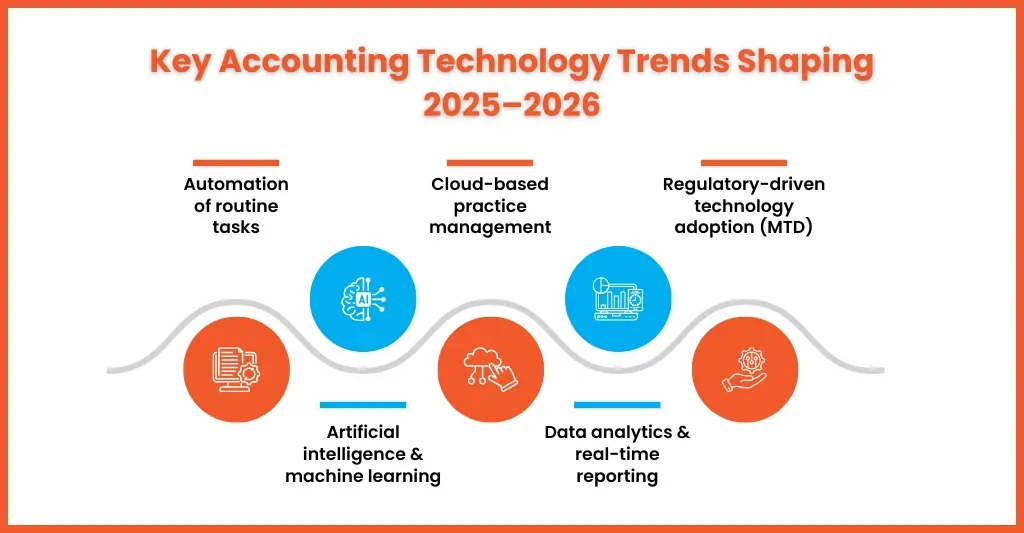
As we have said above, the trend of accounting technology will continue in 2026, and some of the key trends to watch out for are:
Automation of Routine Tasks
Automation has already taken on a significant amount of accounting tasks, such as bank reconciliations, invoice processing, and data entry. Accounting firms have already reported a time saving of up to 30 to 40% and this will go up with more bookkeeping tasks being automated. Through automation, you can free up your staff for more high-value work.
Artificial Intelligence and Machine Learning
AI in accounting have taken centre stage when it comes to detecting errors, spotting fraud, and categorising transactions. Instead of the misconception gaining ground of replacing accountants, AI and ML have equipped accountants by becoming their powerful eyes for spotting errors, thus increasing accuracy and reducing risks.
Cloud-Based Practice Management
Almost all clients these days are pushing their accounting firms to adopt cloud accounting software for better real-time collaboration and transparency.
Data Analytics and Real-Time Reporting
Clients are no longer interested in just raw historical numbers; they want an analysis of what those numbers mean. Modern accounting technology has turned those numbers into insights. These insights have helped clients with future planning, making them highly relevant.
Regulatory-Driven Technology Adoption
Making Tax Digital for VAT already applicable and now MTD for Income Tax in the coming years. This makes digital record-keeping and submissions mandatory rather than optional, accelerating technology adoption across UK practices.
Benefits of Embracing Accounting Technology
Accounting technology has become increasingly relevant to many small accounting practices because it has made their work easier. It has achieved that through numerous important benefits. Some of those are:
More Efficiency and Accuracy
Traditional manual processes like manual entry and reconciliations have only consumed more time and are error-prone. However, with the help of the latest accounting technology, accounting practices are completing the task within a few minutes. Accounting tech has made it possible to save time and ensure accurate financial records are made.
Streamlined Financial Reporting
Innovation in accounting technology has made streamlining of financial reporting possible. The latest version of accounting software can gather data from multiple sources and prepare reports with a few clicks. It has allowed firms to concentrate on analysing the data and providing insights to their clients.
Increased Data Security
Many of your clients are worried about cyber attacks these days, and accounting firms have found accounting technology valuable in protecting their clients’ data. Tech innovations in this area include:
- Advanced encryption methods
- Multi-factor authentication
- Secure cloud storage solutions
All of these features provide a higher level of protection for sensitive financial information.
Financial Insights in Real-Time
Waiting for financial updates for months is now a thing of the past. With the help of technology, accounting practices are now able to get data in real-time, thus helping in providing clients with real-time insights.
Remote Collaboration and Accessibility
Remote working with your clients is possible thanks to cloud accounting software. Using cloud accounting software, you can now get access to documents and cooperate with your clients remotely. It will give you the flexibility to service your clients across geographical limits.
Challenges and How to Overcome Them
Latest accounting technology has brought immense benefits for accounting practices, but it also has its share of thorns. While these thorns are few compared to the benefits, it is important to take note of these challenges to be better prepared.
Integration Complexity
Integrating new tech with existing systems can be full of hurdles and time-consuming, leading to disruptions. However, it can be tackled by simultaneously upgrading the existing system.
Skill Gaps
New accounting tech will need new skills to operate, which your existing staff will lack. By upskilling them or by partnering with a specialised outsourcing bookkeeping services, you can bridge the skill gap.
Costs
Get ready to spend considerably for acquire the latest accounting technology to be future ready. The costs, including software licenses, hardware upgrades, and training, will strain your budget but, in the long run, give you rich dividends.
Data Security
More technology means potential vulnerabilities in data security and privacy. Only special emphasis on advanced encryption methods, multi-factor authentication and secure cloud storage solutions will protect your client’s sensitive information.
Regulatory Compliance
The accounting industry is subject to strict regulatory requirements. Your job is to ensure compliance with local regulations to avoid legal issues.
How to Implement Accounting Technology in Your Practice
To implement the latest accounting technology in your practice flawlessly, you will need to follow the steps below.
Do a Technological Assessment
Evaluate your technical capabilities and identify areas that need improvement. Also, check your practices capabilities to adopt new technologies and your client needs.
Develop a Plan
Finalise a plan that considers your goals and resources, and focus on investment in areas that are pressing for your practice and your clients.
Invest in Training
Train your accounting staff to use the latest accounting tech. This includes both technical training and soft skills development to adapt to changing workflows and client expectations.
Outsourcing with Professional Service Providers
Partner with a professional outsourcing accounting service provider who has the expertise and talent in operating these accounting tech tools and get their personalised support. Through them you will get access to the best tools and will help in streamlining the implementation process.
Maintain Strong Communication with Clients
Always keep your clients in loop about the upgradation of technology and its benefits. Such transparency will help increase trust and demonstrate your commitment towards innovation.
Real-World Use Cases of Accounting Technology
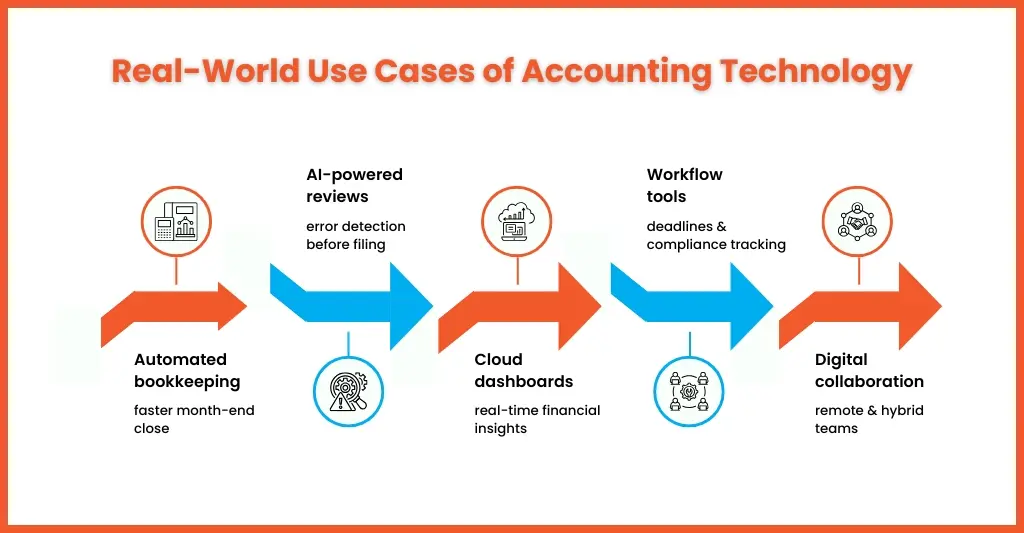
Here are some key real-world use cases that show how accounting technology is improving efficiency, accuracy, and client service:
Automated Bookkeeping Reducing Month-End Close Time
In the past accountants used to spend a lot of time on reconciling accounts, reviewing transactions, and ensuring that everything balances correctly. However, automation of bookkeeping has speed up the process
AI-Powered Reviews Flagging Errors Before Submission
AI has turned into a valuable tool, especially in detecting errors. AI tool can scan through multiple records in less time and pin point on discrepancies, missing data, or anomalies, which might go unnoticed. This has not only reduced the time spent on manual reviews but also ensured error-free records when filing.
Cloud Dashboards Giving Clients Real-Time Financial Insights
Cloud dashboards are providing clients with a user-friendly interface on which they can view their financial data, track their financial performance and check key metrics. This increases transparency and helps your clients in informed decision-making.
Workflow Tools Tracking Deadlines, Approvals, and Compliance
Workflow tools have helped in ensuring essential tasks are done on time, approvals are obtained, and compliance with regulations is maintained. It sends automatic reminders and task tracking to ensure nothing slips, reducing the risk of missing deadlines.
Digital Collaboration Enabling Remote and Hybrid Teams
Digital collaboration tools enable accountants to work seamlessly with clients and colleagues, regardless of location. Document-sharing, video conferencing, and real-time collaboration platforms enable teams to stay connected and collaborate on financial data.
FAQ — Accounting and Technology
What is the impact of automation on accounting?
Automation has made a pretty big dent in the amount of time UK accounting practices spend on tedious stuff like manual data entry, bank reconciliations, and invoice processing – cutting that down by an estimated 30-40%, as far as industry surveys have suggested. And that means more of their trained staff are freed up to do higher-value work that actually adds value to clients; and they can pick up more clients without having to take on more staff, which is good news for the bottom line. Other good news is that automation has also cut down the number of mistakes that get made in routine tasks, which means the records submitted to HMRC are more accurate as a result.
Is AI replacing accountants?
No way. AI is just changing what accountants do rather than replacing them altogether. All those boring, high-volume tasks like categorising transactions, spotting errors, and checking data are the kind of things that AI tools are increasingly good at. Which in turn lets accountants focus on the things where they really add value – the advisory stuff, the long-term planning, the tough compliance work, and building relationships with clients. What’s most at risk are practices that fail to get on board with AI, rather than those that are embracing it.
What is the future of accounting technology?
The future lies in intelligent automation, real-time reporting, integrated systems, and advisory-led services powered by data and digital tools.
How has technology made accounting easier?
Accounting software has reduced the need for manual data entry, thus reducing errors and saving precious time on repetitive tasks. It makes real-time financial reporting possible and enhances client service by improving response time and advisory services.
Conclusion
The influence of the latest accounting technology is the present reality of the UK accounting world and will keep shaping the future of accounting practice operations. Adopting this technology is important, but we also understand that its potential to disrupt the operations of your small practice and stretch your teams. In such situations, you can take the expert of outsourcing providers and this is where Equallto steps in.
We combined our experience in the latest accounting technology with experienced human support. The result of this combo is enabling practices in streamlining their operations, managing their compliance, and scaling up without compromising on quality or control. If you are looking to transform your practice into a future-ready one, then Equallto should be the best choice.
Get future-ready by connecting with us while staying focused on clients and growth.
