
When outsourcing payroll, UK accounting practices should check the provider’s HMRC/RTI compliance record, data security certifications (ISO 27001, GDPR), dedicated team structure, software compatibility, and transparent pricing. The right partner reduces PAYE penalty risk, protects client data, and scales with the practice without the cost of hiring in-house payroll staff.
Payroll mistakes are more common than many small accounting firms realise. HMRC penalties for late RTI submissions and PAYE errors continue each year, and even one incorrect filing can cause client frustration. For a small accounting practice handling multiple payrolls, the pressure is constant.
Many firms are now asking what to consider when outsourcing payroll because the workload has quietly grown heavier. National Insurance changes, pension compliance, and wage updates have added layers of complexity. At the same time, recruitment costs have increased.
In this blog, we explore what to consider when outsourcing payroll, why it matters for UK small accounting firms, the benefits, the risks, and how to move to a safer payroll model without disrupting clients.
Key Takeaways
- Late RTI/FPS filings cost £100–£400 per month depending on employee count, plus a 5% penalty if more than 3 months late (HMRC, GOV.UK Compliance Handbook).
- Employer costs have risen sharply: National Insurance moved to 15% in April 2025, and the National Living Wage rises to £12.71/hour from 1 April 2026 (GOV.UK).
- The right partner should hold ISO 27001/GDPR-compliant data security, a named dedicated team, and transparent per-employee pricing.
- This guide is one part of Equallto’s payroll series — see the full Payroll Management Guide for the complete 7-step process and tool comparison.
- A short parallel-run pilot before full transition is the single most effective way to catch errors before they reach clients.
What Is Payroll Outsourcing and Why It Matters for UK Practices
Payroll outsourcing means transferring payroll processing tasks to an external specialist team while the small accounting firm remains in control of the client relationship. It can include PAYE calculations, Real Time Information submissions, auto enrolment administration, statutory payments, year-end reporting, and payroll queries. The outsourced team works in the background as part of your extended delivery structure.
Real Time Information (RTI) is HMRC’s system requiring employers to report PAYE data every time employees are paid, rather than once a year — it is the reporting standard every payroll provider must comply with.
For a small accounting firm, payroll is often steady but time-consuming work. It demands accuracy, tight deadlines, and up to date legislative knowledge. Outsourcing removes the administrative weight while allowing the firm to stay client-facing. Instead of spending hours on payslip processing, partners can focus on advisory conversations and growth planning.
Why does this matter for UK practices in 2026? Because payroll legislation does not stand still. Rates change. Rules evolve. Client expectations rise. When reviewing what to consider when outsourcing payroll, the real question is how to protect compliance while freeing capacity.
What Are the Key Benefits of Outsourcing Payroll for Accounting Firms?
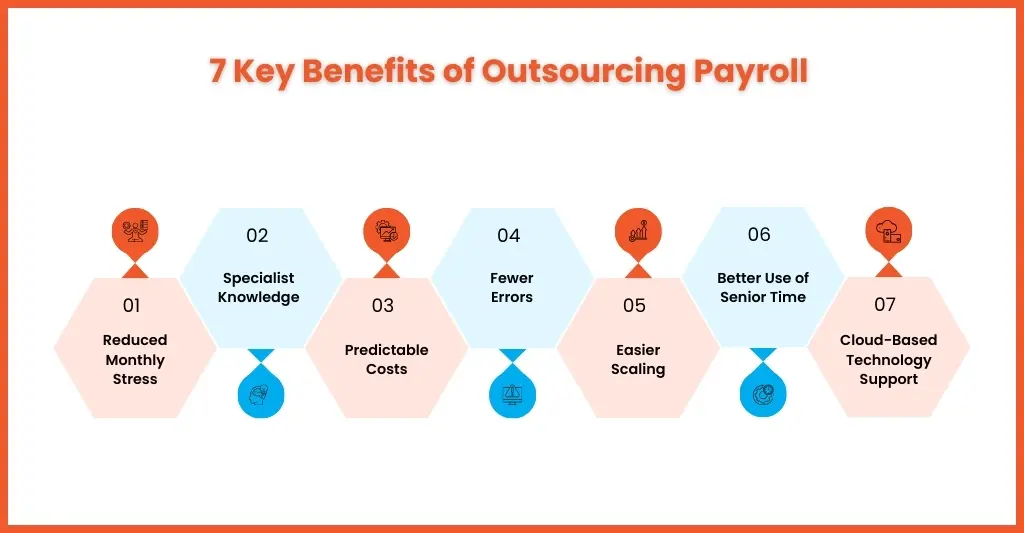
Outsourcing payroll benefits accounting firms mainly through fewer errors, predictable monthly costs, easier scaling, and freeing senior staff from routine payslip checks.
For many small accounting firms, payroll starts small and gradually becomes a strain. What was once manageable becomes a monthly stress point. Outsourcing creates breathing room. It replaces reactive processing with a more structured system.
Below are the Key Benefits of Outsourcing Payroll:
1. Reduced Monthly Stress
Payroll deadlines arrive whether you are ready or not. A dedicated payroll team ensures submissions are made on time, reducing last minute pressure inside the small accounting practice.
2. Access to Specialist Knowledge
Payroll involves PAYE codes, statutory sick pay, maternity calculations, and pension contributions. Having experienced specialists reduces the risk of misinterpretation.
3. Predictable Costs
Hiring from within involves salary commitments and training costs. When looking at the factors to consider for outsourcing payroll, the ability to adjust costs is often a key factor.
4. Fewer Errors
Structured review processes improve accuracy. That protects both your clients and your reputation.
5. Easier Scaling
If your client base grows, payroll volume grows with it. Outsourcing allows a small accounting firm to scale without immediately recruiting.
6. Better Use of Senior Time
Partners should not be checking payslip calculations at 9pm. Outsourcing frees senior time for advisory and client meetings.
7. Stronger Technology Support
Most payroll providers operate cloud-based systems that allow reporting access and workflow tracking.
Outsourcing payroll does not remove responsibility. It redistributes operational workload in a controlled way.
What Should You Consider When Outsourcing Payroll for Accounting Firms?
When outsourcing payroll, review the provider’s UK compliance experience, data protection standards, team structure, communication channels, software compatibility, pricing transparency, turnaround guarantees, and long-term growth fit before signing.
Before signing any agreement, small accounting firms must look carefully at what to consider when outsourcing payroll. Payroll affects client trust directly. A poor transition can undo years of relationship building.
Here are the most important areas to review.
1. UK Compliance Experience
Does the provider fully understand HMRC requirements and RTI submissions? Ask how they stay updated with legislative changes.
2. Data Protection Standards
Payroll data includes National Insurance numbers and salary details. Confirm GDPR compliance and secure storage protocols. Ask specifically whether the provider holds ISO 27001 certification — the international standard for information security management — since this is now the baseline credential leading UK payroll bureaus carry.
3. Dedicated Team Structure
Continuity matters. A rotating support desk can create confusion. A stable team builds familiarity.
4. Clear Communication Channels
Payroll queries can be urgent, so confirm how communication will work day to day. Clear response times and a named contact help protect your small accounting firm’s reputation.
5. Software Compatibility
Ensure the provider is experienced with your existing payroll systems. Smooth integration reduces manual work and avoids unnecessary disruption. Ask by name whether they support BrightPay, Sage Payroll, Xero Payroll, QuickBooks Payroll, or IRIS Payroll — naming the exact software avoids a costly re-platforming exercise mid-year.
6. Transparent Pricing
When assessing what to consider when outsourcing payroll, pricing clarity avoids future friction. Understand exactly what is included.
7. Turnaround Guarantees
Payroll deadlines are strict and leave little room for delay. Confirm clear cut off times and reliable processing timelines to protect your small accounting practice.
8. Long Term Growth Fit
Will the provider grow with your small accounting firm? Payroll support should strengthen your operational model. If you are still weighing outsourcing against hiring in-house, our in-house payroll vs outsourcing comparison sets the two options side by side.
Choosing correctly turns payroll into a stable service rather than a stress point. Equallto supports small accounting firms with structured payroll delivery while allowing the firm to remain fully client facing.
What Are the Risks of Outsourcing Payroll, and How Do You Mitigate Them?
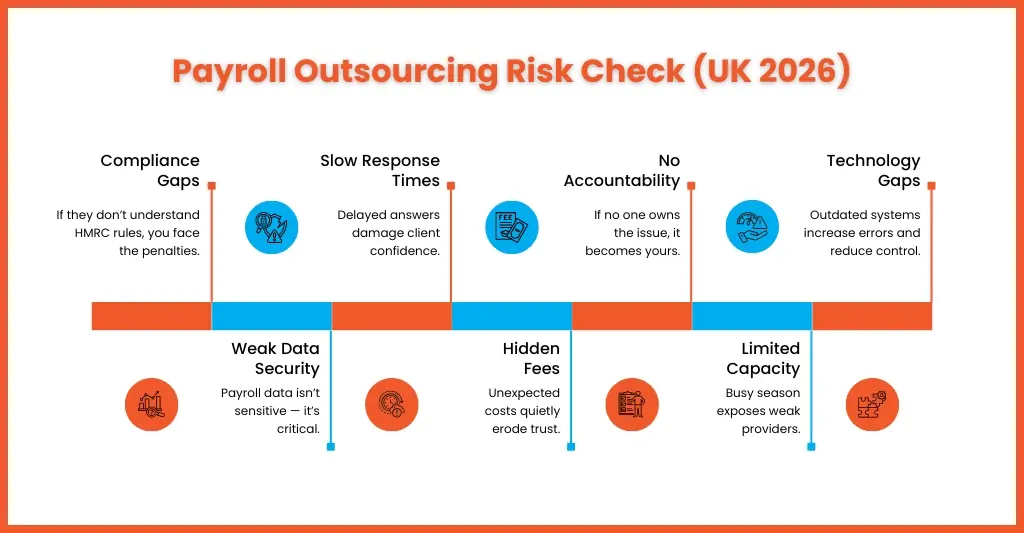
The main risks of outsourcing payroll are compliance errors, weak data security, slow response times, hidden fees, and lost accountability — all of which are mitigated by due diligence and a clear SLA before signing.
Below are common risks when firms fail to properly assess what to consider when outsourcing payroll.
1. Inadequate Compliance Knowledge
A provider unfamiliar with UK payroll rules increases the risk of filing errors. Even small mistakes in PAYE or RTI submissions can result in penalties. In the end, your small accounting firm carries the responsibility in the client’s eyes.
2. Weak Data Security
Sensitive payroll information must be protected at all times. National Insurance numbers, salary details, and personal records require secure systems. Any data breach can quickly damage client trust.
3. Slow Response Times
Payroll queries are often urgent and need quick clarification. If responses are delayed, clients become frustrated. Your small accounting firm may appear disorganised even if the delay is external.
4. Hidden Fees
Unexpected charges can create tension with both you and your clients. Some providers add fees for amendments or urgent processing. Without pricing clarity, trust can weaken over time.
5. No Accountability
When there is no named contact, issues can move between teams without resolution. This creates confusion and inconsistent service. Clear ownership is essential for reliability.
6. Limited Capacity
Some providers struggle during busy periods such as month end or year end. Resource gaps can lead to delays in processing. This directly affects the service standards of your small accounting practice.
7. Technology Gaps
Outdated systems often increase manual work and the risk of errors. Limited reporting tools reduce visibility and control. Weak technology can slow down your entire payroll process.
To mitigate these risks, carry out proper due diligence. Ask direct questions. Request process documentation. Review service level agreements carefully. A short pilot phase can also help test service quality before full transition.
Most importantly, remember that what to consider when outsourcing payroll includes risk assessment. A cautious approach protects your small accounting practice.
How to Transition Payroll Outsourcing Smoothly
A smooth payroll transition means documenting current processes, cleaning employee data, telling clients early, clarifying responsibilities, running one parallel payroll cycle, and scheduling regular reviews after go-live.
A careful transition prevents disruption. Payroll cannot pause. Planning makes the difference.
1. Document Current Processes
Before passing anything on, take time to review how payroll currently operates in your small accounting firm. Write down key deadlines, approval points, and any small changes you usually make to ensure nothing important gets lost in the transition.
2. Clean Up Employee Data
Check employee records thoroughly before moving to a new provider. Outdated tax codes, incorrect addresses, or missing pension details can lead to unnecessary problems once processing starts.
3. Communicate Early with Clients
Inform clients about the change early instead of after it occurs. A simple explanation of how payroll will continue to run smoothly helps maintain trust in your small accounting practice.
4. Clarify Responsibilities
Clearly define who is responsible for what from the beginning. Decide who approves payroll, who manages changes, and who addresses queries so there is no confusion later.
5. Run Parallel Testing
Process one payroll cycle alongside the new provider to confirm calculations and submissions are accurate. This extra step gives your small accounting practice confidence before fully switching over.
6. Schedule Regular Reviews
Set up regular check in meetings to review performance and resolve any issues early. Ongoing monitoring ensures payroll quality remains consistent as your firm grows.
When handled properly, the transition strengthens the small accounting firm rather than disrupting it.
People Also Ask
What questions should I ask a payroll outsourcing provider before signing a contract?
Ask about compliance knowledge, data security measures, turnaround times, pricing clarity, and team structure. Specifically, ask which payroll software they support, whether they hold ISO 27001 certification, what their guaranteed cut-off times are, and whether you’ll have one named contact rather than a rotating support desk — vague answers to any of these are a warning sign.
Is payroll outsourcing compliant with HMRC requirements in the UK?
Yes, provided the partner follows RTI and PAYE regulations. Always confirm their compliance procedures. Responsibility for late or incorrect filings still ultimately rests with the employer of record, so ask the provider to confirm in writing how they track submission deadlines and who covers any HMRC penalty caused by their error.
What is the cost of outsourcing payroll in the UK?
Payroll outsourcing costs depend on employee numbers and complexity. Many providers charge per employee per month. Typical UK pricing runs roughly £3–£15 per employee per month, with the lower end covering basic processing and the higher end including pension administration, statutory payments, and dedicated support — see our full payroll outsourcing cost guide for a detailed breakdown.
Can outsourcing payroll reduce errors?
Yes, structured review systems often reduce calculation and submission mistakes. Providers typically run a second-person review or automated validation check before submission, catching the kind of manual keying errors that cause the majority of HMRC penalty notices for small firms. See our guide on reducing payroll errors for the specific checks to put in place.
Will my small accounting firm lose control over clients?
No. With the right model, you remain the main advisor while the payroll team works in the background. The outsourced team processes payroll under your firm’s name and review, meaning clients continue to see you as their accountant — the provider is invisible to the end client unless you choose otherwise.
Conclusion – Making the Right Decision When Outsourcing Payroll
Deciding what to consider when outsourcing payroll is not simply about cost reduction. It is about protecting compliance, safeguarding data, and creating operational breathing space.
For small accounting firms, payroll should not become a monthly source of stress. It should be a stable service delivered with confidence.
Equallto works alongside small accounting firms as an extended support partner. By combining structured payroll processes with operational support, Equallto helps firms free up time, reduce pressure, and focus on client growth.
If your small accounting practice is reviewing what to consider when outsourcing payroll in 2026, now is the right time to explore a model built for stability and growth.
