
HMRC wage raid payroll checks are going to get intensified this year, and that’s a reality check you need to give to your clients. As a practice handling the payroll of your clients, it’s your responsibility to alert them about HMRC inspection of their payroll with little or no warning. If their records aren’t accurate, it can lead to penalties, backdated payments, and reputational risk.
Let’s understand this risk in an easy way.
A small hospitality business in the UK was running payroll in-house. Everything looked perfect, their employees were being paid, payslips were generated, and taxes were submitted on time.
Then one morning, HMRC gave a surprise visit.
Within days, the business discovered:
- Incorrect National Minimum Wage calculations
- Missing payroll records
- Inconsistencies in employee hours
The result?
- Fines, back payments, and a lot of stress.
The issue wasn’t intentional non-compliance but the lack of structured payroll processing structures.
According to HMRC data, thousands of businesses were investigated for payroll and wage compliance issues, particularly around the National Minimum Wage (NMW). It was discovered that 389 employers from across the UK were failing to pay workers the minimum wage to tens of thousands of workers. A total of around £12.6 million in penalties was recovered from them on top of the repaid wages.
As an accounting practice handling the payroll of your clients, it’s your responsibility to ensure your clients do not fail in this compliance.
For that, we have prepared this guide in which we will cover:
- What HMRC wage raid payroll checks actually involve
- Why inspections are increasing
- Common triggers and red flags
- How to stay compliant
- And how outsourcing payroll can significantly reduce your risk
What Is an HMRC Wage Raid Payroll Check?
HMRC wage raid payroll checks or payroll inspections are surprise visits made by HMRC to your clients or to check their pay records, contracts, and PAYE returns to ensure employees receive no less than the National Minimum Wage (NMW) or National Living Wage (NLW).
These visits happen without any advance notice and the goal of these checks is to see whether payroll records match what has been reported to HMRC.
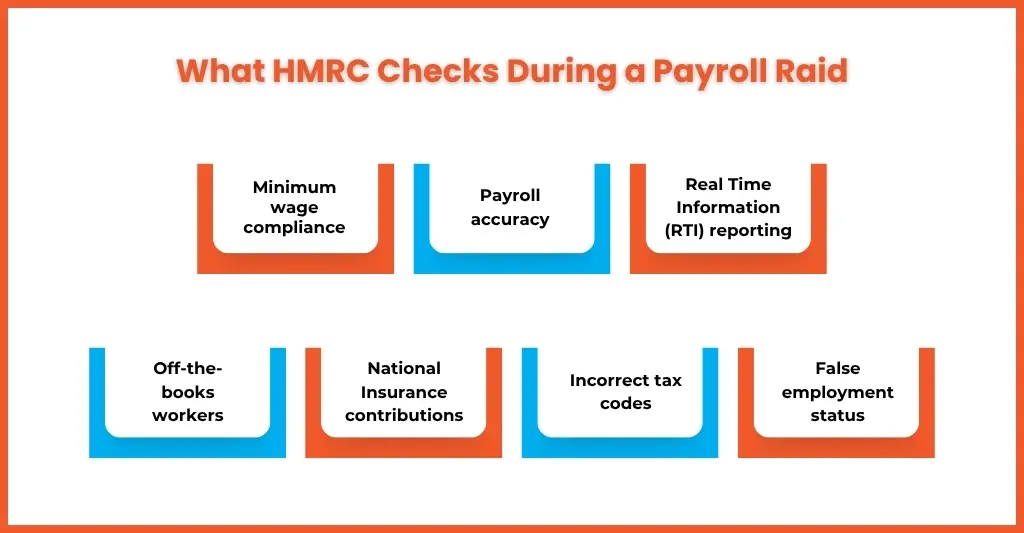
Under these checks, the following things are scrutinised:
- Minimum wage compliance
- Payroll accuracy
- Real Time Information reporting
- Off-the-books workers
- National Insurance contributions
- Incorrect tax codes
- False employment status claims
Why HMRC Payroll Inspections Are Intensifying in 2026
The increase in HMRC wage raid payroll checks or payroll inspections is not a sudden decision. As automation increased and the pay structure became complex, errors started happening. HMRC’s goal is to ensure that employees are paid on time and in line with the law.
Recent incidents have made HMRC more proactive in payroll inspections. Let’s understand them.
Focus on National Minimum Wage Compliance
According to HMRC, around 389 employers in the UK were found to be underpaying their employees, which was negatively impacting around 60,000 workers. HMRC recovered around £12.6 million in penalties from these employers on top of the repaid wages.
To ensure such non-compliance does not happen again, HMRC is actively conducting wage raid payroll checks to ensure compliance.
Increased Digital Monitoring
With real-time information (RTI) submissions and the Making Tax Digital expansion towards Income tax. HMRC will have better access to data and will be able to monitor payments and spot discrepancies within hours.
Government Crackdown on Non-Compliance
The UK government has increased efforts to:
- Identify underpaid workers
- Companies that file late payroll submissions
- Find out businesses that previously received penalties
- Emphasis on complaints from workers
HMRC has started naming and shaming businesses that pay wages below the national minimum wage standards. The message is clear: Payroll compliance is now under constant scrutiny.
What Triggers an HMRC Payroll Inspection?
Most of the HMRC wage raid payroll checks are triggered when the regulator notices specific warning signs.
These warning signs are:
Inconsistent PAYE Submissions
When frequent errors or irregularities are noticed in the RTI submissions, it will immediately raise a red flag among HMRC officers and make your client a target of frequent checks.
National Minimum Wage Risks
In recent years, HMRC has found many businesses not following the national minimum wage rules completely.
HMRC found out issues like:
- Unpaid working hours
- Incorrect deductions
- Misclassification of employees
Employee Complaints
HMRC will conduct surprise checks on your client if any of their disgruntled employees report their payroll issues directly to HMRC. Therefore, it is important for you to resolve any queries raised by the employees at the earliest and to the satisfaction of the employees.
High Staff Turnover
Frequent hiring and leaving of employees will raise the suspicion of HMRC that your client’s employees are unhappy and leaving their jobs, and raise the risk of a surprise check to verify the reasons.
Sector-Based Risk
Some of your clients will be under greater chances of frequent inspections by the HMRC, if they are from industries like:
- Hospitality
- Retail
- Construction
How an HMRC Wage Raid Payroll Check Works: Step-by-Step
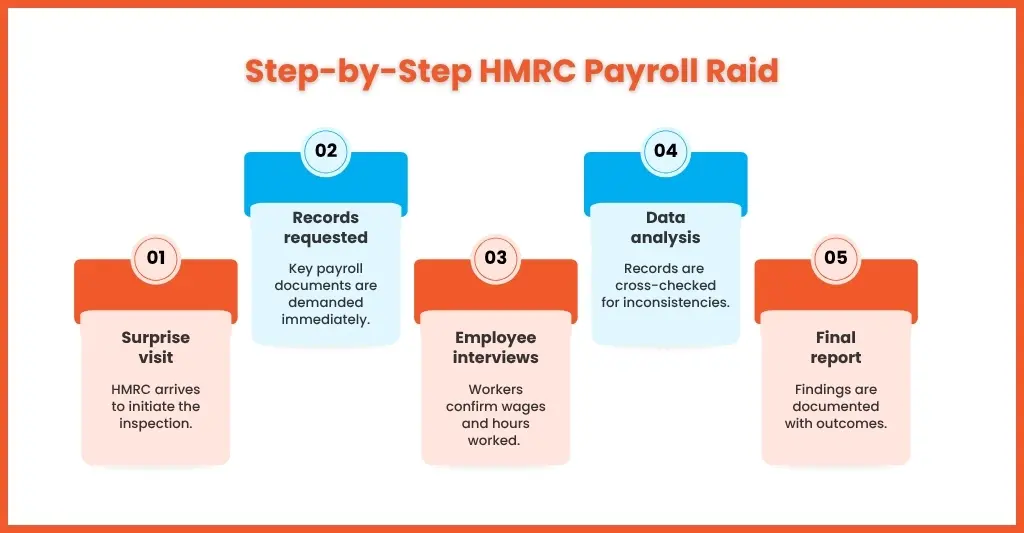
Keep your clients ready for HMRC wage raid payroll checks all the time, and make them aware of what to expect during an inspection.
Step 1: Surprise Visit
HMRC might send a notice or conduct a surprise visit to your client. They will introduce themselves and communicate with your client about the purpose of their visit.
Step 2: Request for Records for Reviewing
The HMRC officers will request certain documents for review. These documents are:
- Payroll records
- Employee contracts
- Payslips
- Timesheets
Step 3: Discussions with Employees
Their employees will be interviewed directly by the HMRC to confirm:
- Hours worked
- Wages received
Step 4: Data Analysis and Crosschecking
HMRC will start reviewing the documents to check:
- Wage calculations
- Tax deductions
- Compliance with NMW rules
Step 5: Outcome
The outcome will be presented to your client with a written report outlining any discrepancies or violations.
Penalties for Failing a Payroll Check
Failing the HMRC wage raid payroll checks can have serious consequences for your clients and your practice. Those consequences are:
Financial Penalties
The penalty is 200% of the underpayment for each worker, with a minimum charge of £100 per notice and a maximum charge of £20,000 per worker, along with payment of backdated wages.
Public Naming
Recently, HMRC published 389 names of employers who were underpaying their employees, apart from recovering £12.6 million in penalties from them.
Reputational Damage
The penalties and public naming will not only damage the reputation of your client, but they will also create trust issues among their employees. Since your accounting practice is handling the payroll of your clients, it will badly reflect on your credibility and will break the trust of your clients.
Your Employer Rights During an HMRC Visit
Your clients are entitled to certain rights during the inspection by the HMRC. These rights are:
- Asking for identification and requesting an open explanation for the purpose of their visit.
- Keep your trusted accountant at the location.
- Keep a record of each question, document presented, and answer provided.
- Ask for a reasonable time to provide documents.
Payroll Compliance Checklist: Stay HMRC-Ready
“Prevention is better than cure”, it’s a proverb that is applicable not only to health but also to keep your clients protected from compliance trouble. The following steps can help avoid being on the HMRC minimum wage investigation list.
Keep Accurate Records
HMRC will be especially interested in the payroll records of your client; it’s your responsibility to have proper payroll records of the last six years, which include payslips, timesheets, and contracts.
Regularly Audit
Conduct frequent payroll audits of your clients to find out mistakes before the HMRC finds out.
Use Good Payroll Software
It’s even more important to get the best payroll software that is compliant with the latest MTD requirements so that no non-compliance occurs, and pay levels are adjusted automatically.
Keep Up With Wage Laws
In April 2026, the National Minimum Wage and National Living Wage will increase, giving a pay rise to around 2.7 million workers across the UK, including apprentices. If the rate update is delayed, then your client will face fines, and you will lose your credibility.
Teach Your Clients HR and Management Staff
Everyone who deals with payments or timesheets should know about wage laws, deductions, and how to stay compliant.
How Outsourced Payroll Reduces Your HMRC Risk
These days, many small accounting practices are finding the compliance associated with payroll very time-consuming and complex, increasing the chances of errors and non-compliance. To play it safe and to keep their clients compliant, many are resorting to payroll outsourcing services to manage the risk.
Here’s where Equallto comes into the picture: you will get:
- Accurate payroll processing
- Compliance with HMRC regulations
- Support for RTI submissions
- Structured payroll workflows
- Reduced risk of errors
The benefits of partnering with us are:
- Fewer compliance issues
- Better accuracy
- More time for your value-adding advisory services
- And it will cost you less
People Also Ask
Can HMRC arrive without notice?
Yes. HMRC can conduct unannounced visits, especially in high-risk cases or repeat offenders.
What Is an HMRC Wage Raid Payroll Check?
It is an inspection carried out by HMRC to ensure compliance with payroll regulations, including minimum wage and tax reporting.
How far back can HMRC investigate payroll?
HMRC can typically investigate up to 6 years, and longer in cases of suspected fraud.
What is the HMRC minimum wage investigation?
A national minimum wage investigation can be started either through a complaint or through targeted enforcement. In either case, HMRC’s intention is to assure that all employees at the company under investigation are paid the minimum wage.
What will the new minimum wage be in 2026 in the UK?
Come April 2026, the national minimum wage rate will increase to £12.71 for age 21 and above and £8.00 for apprentices.
Conclusion
In 2026, HMRC wage raid payroll checks will be more frequent and focused. It means that you and your clients have to treat payroll not like a regular task. It’s a compliance responsibility with real financial consequences.
The good news?
With the right systems, processes, and support, you can stay ahead. By combining:
- Accurate record-keeping
- Regular reviews
- Expert payroll support
You can reduce risk significantly.
And with partners like Equallto besides, you will be in the position of managing your client’s payroll with full confidence, compliance, and control. Contact us and make your payroll task stress-free.