
To outsource financial services means handing over routine bookkeeping, payroll work, reconciliations and reporting work to an external specialist provider, instead of processing it in-house. For a small accounting practice, this means faster turnaround, lower costs, and more time for advisory work without the need to recruit more staff.
Imagine yourself buried under a backlog of bookkeeping work and unable to take on new clients who have enquired about your services. The inability is not because of a lack of skills but a lack of time. This is exactly when a question will come to mind: is it time to outsource financial services?
This guide walks through what that actually means, what it costs, what to watch out for, and how firms like Equallto are helping small practices solve this without hiring a single extra person.
What Does It Mean for an Accounting Practice to Outsource Financial Services?
In simple terms, to outsource financial services like bookkeeping, payroll processing, reporting, or reconciliations to an external provider means getting the work done as per your standards, instructions and under your own brand.
That does not mean you are handing over your clients. You will be able to keep the relationship with your clients, advise them, and have the final say on the results. The outsourcing provider will only perform the processing work behind the scenes.
Like for most small accounting practices, outsourcing for you must start with a small pilot project, like handing over some bookkeeping tasks during a busy month, and expand once it works better and trust is built. Such flexibility is ideal for practices that do not want to commit to a full-time hire.
Financial Services Outsourcing — Why More UK Practices Are Doing This
Most UK accounting practices are moving toward outsource financial services because of factors like staff shortages, rising client demand for insights and advanced services, and tighter margins. Also, hiring more accountants has become too slow, expensive and risky, especially for small accounting practices.
According to the AAT Filling the Gap report 2025, 34% of employers struggled to recruit for finance and accounting positions in the last year. At the same time, client expectations have not slowed down. They expect faster delivery of bookkeeping, payroll, real-time reporting, and query resolution; such pressure is hard to absorb without additional capacity.
Outsourcing helps you get additional capacity without hiring. It adds processing capacity immediately, skipping the long recruitment timeline most firms face when hiring conventionally.
What’s Included in Outsourced Financial Services for Practices
Outsourced financial services for accounting services typically include bookkeeping, payroll processing, bank reconciliations, VAT return preparations, management accounts, and year-end file preparation.
Here’s a simple breakdown of what’s commonly outsourced versus what practices typically keep in-house:
| Task | Commonly Outsourced | Usually Kept In-House |
| Bookkeeping & data entry | ✔ | |
| Bank & credit card reconciliations | ✔ | |
| Payroll processing | ✔ | |
| VAT return preparation | ✔ | |
| Management accounts prep | ✔ | |
| Client advisory conversations | ✔ | |
| Final review & sign-off | ✔ | |
| Tax planning & strategy | ✔ |
The pattern is clear: the repetitive, time-heavy processing work goes out for outsourcing, while the client-facing, judgement-led work that requires human expertise stays in-house.
Benefits of Outsourcing Financial Services for Accounting Practices
Outsourcing gives more than just additional capacity; it offers services at a fixed price and nullifies the risk of work stoppage due to staff absence. Thus, reducing the requirement for permanent hires.
More Time For Advisory Work
Every hour spent on data entry is an hour lost for client conversations, query resolutions, financial planning, and advisory services, which can transform your practice from a service provider into a strategic planner for your clients.
Lower Fixed Costs
Instead of getting financially burdened with fixed monthly salaries of new recruits along with benefits and infrastructure costs, you can get outsourcing services that will charge you as per the task. So, the cost will rise and fall as per the actual workload.
No Recruitment Risk
Recruitment is a long, drawn-out process, and for hiring experienced accounting professionals, the wait is even longer, which you cannot afford, unlike outsourcing that gives you instant access to experienced professionals.
Built-in Resilience
Outsourcing keeps the work going, working like an extension of your in-house team, so if one team member is absent, the work goes on without disruption.
Faster Turnaround During Peak Periods
Outsourcing will perfectly handle additional workloads during peak tax season and year-end, thus ensuring that you don’t have to turn away new clients due to lack of capacity.
This is precisely the gap Equallto was built to fill by offering flexible, pay-as-you-go outsourced support designed specifically for UK micro and small practices, not scaled-down enterprise contracts.
Financial Accounting Outsourcing Services — What Good Providers Actually Deliver
A professional financial accounting outsourcing service always delivers accurate, on-time work within your system with clear communication to you and without any surprises with regard to pricing.
Specifically, a strong provider should offer:
- Work completed within your existing systems (Xero, QuickBooks, Sage, etc.)
- Clear turnaround times agreed in advance
- Transparent, predictable pricing, no vague hourly estimates
- A named point of contact, not a rotating queue of strangers
- Quality checks before work is returned to you
Providers that fall short of this list tend to create more admin than they remove, which is exactly the risk covered in the next section.
Risks of Outsourcing Financial Services — and How to Avoid Them
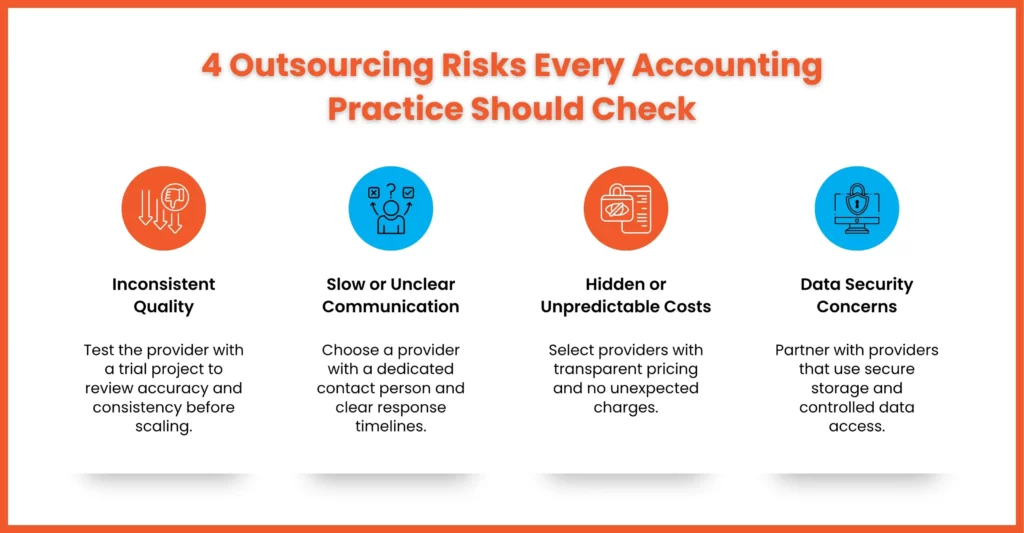
Outsourcing financial services has multiple benefits, but it has its share of risks such as inconsistent quality, poor communication, and hidden costs. However, these risks can be avoided by choosing the right provider.
Let’s understand these risks:
Inconsistent Quality
This risk can be avoided by asking for a trial from an outsourcing provider so that you can decide based on the result.
Slow or Unclear Communication
Lack of communication can be avoided by asking the outsourcing provider for a dedicated contact person to get queries resolved and for other matters before you start, along with a resolution time.
Hidden or Unpredictable Costs
Avoid selecting those providers that are known for surprising you with additional costs after the service is done. Rather, place your faith in a provider that offers fixed, pay-as-you-go services rather than vague hourly billing.
Data Security Concerns
Client data is sensitive and a target of cyber criminals; hence, choose a service provider that offers proper storage and access controls before sharing anything.
None of these risks is a reason to avoid outsourcing altogether; they’re simply reasons to choose carefully, which is exactly what the next section covers.
How to Choose an Outsourced Financial Services Provider
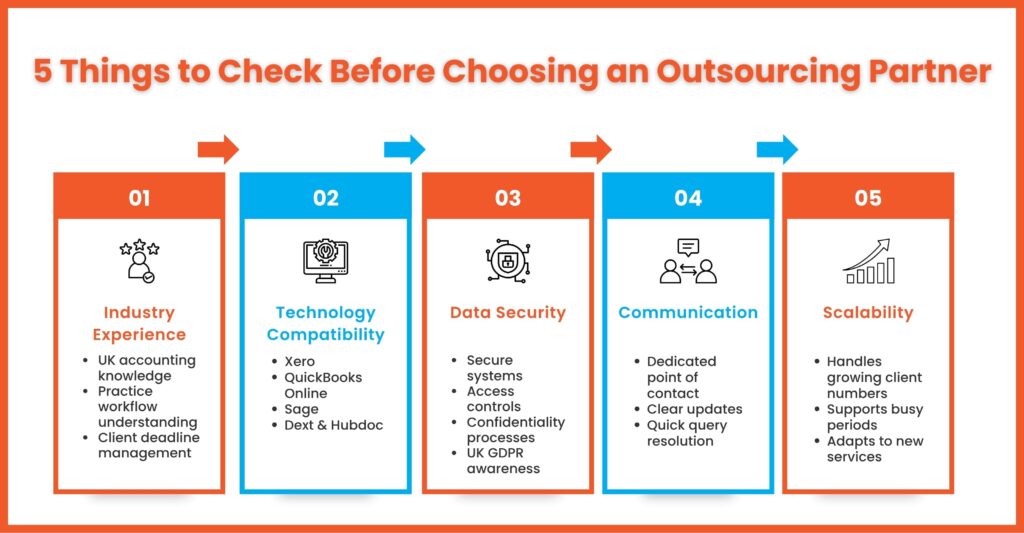
When it comes to choosing a provider, you must check their pricing model, turnaround times, software compatibility, and whether their services are ideal to support your accounting practice.
Ask these questions before signing up:
- Do they work directly within your existing software?
- Is pricing fixed per job, or vague and hourly?
- What’s their average turnaround time during busy periods?
- Do they have experience specifically with UK accounting practices?
- Is there a contract lock-in, or can you scale up and down freely?
Providers built specifically for small UK practices, rather than adapted from enterprise-level outsourcing, tend to score better across all five questions, simply because that’s the exact problem they were built to solve.
Cost of Outsourcing Financial Services for Accounting Practices
Outsourcing financial services for a small UK practice typically costs between £25 and £45 per hour for UK-based support, or a fixed per-job fee starting from around £29 with providers like Equallto, often working out cheaper than the fully loaded cost of an in-house hire.
That “fully loaded cost” matters. A single in-house bookkeeping hire doesn’t just cost a salary, it includes recruitment fees, training time, holiday cover, pension contributions, and software licences. Once those are added up, outsourcing per job often compares favourably, especially for practices without consistent, year-round workload to justify a full-time role.
Getting Started — How to Outsource Financial Services Without Disrupting Your Practice
Outsourcing should not lead to disruption; to do that, you will have to begin with a small, low-risk task before expanding, not handing over your entire workload on day one.
Step 1: Start with one task: Choose a single bookkeeping job or a small reconciliation batch as a trial.
Step 2: Review the output: Check accuracy, turnaround time, and communication and solve any teething problems before committing further.
Step 3: Expand gradually: Once all the teething issues are resolved, and the process and quality are streamlined, you can add more tasks once you’re confident in the quality and process.
Step 4: Keep sign-off in-house: Maintain final review and client communication internally, so nothing changes without yours and your client’s permission.
This gradual approach is exactly how most Equallto works: it begins with testing with a single job, then scaling up only once the process has proven itself.
Frequently Asked Questions About Outsourced Financial Services for Accounting Practices
What is financial services outsourcing for an accounting practice?
It’s the process of delegating routine financial tasks, bookkeeping, reconciliations, payroll, or reporting, to an external specialist provider, while the practice retains client relationships and final sign-off. Most practices, especially small ones, are preferring outsourcing due to rising specialisation and insight requirements from clients, complex regulations, and a high volume of accounting services needed at speed.
What are examples of financial accounting outsourcing services?
Common examples include bookkeeping and data entry, bank reconciliations, payroll processing, VAT return preparation, and management accounts preparation. These tasks are outsourced because they are time-consuming, high-volume, and repetitive, leading to diversion of resources away from high-value services that bring in more profits and business expansion.
How much does it cost to outsource financial services as a small practice?
Costs typically range from £25–£45 per hour for UK-based support, or fixed per-job pricing starting around £29 with pay-as-you-go providers often cheaper than the true cost of an in-house hire once salary, training, and overheads are included.
Is AI replacing bookkeepers?
No, AI is not replacing bookkeepers, but it is automating routine data entry and transaction coding. The core profession is shifting from manual data processing to human review, error correction, and strategic financial advising. Outsourcing providers are using AI to further speed up the accounting tasks and services so that insights and results are available to you and your clients for timely and informed decision making.
Final Thoughts — Is Outsourcing Financial Services Right for Your Practice?
If you are unable to take in new clients, working late to keep up with bookkeeping, or hesitating to hire because the workload does not justify a full-time salary, then outsourcing financial services is an option you must explore.
When you outsource financial services, you are saving time which can be utilised for expanding your services. It gives you a chance to take on bigger practices through its outsourcing provider’s flexible capacity.
That’s exactly what Equallto was built for: pay-as-you-go outsourced bookkeeping and accounting support, designed specifically for UK micro and small practices, with no contracts, no monthly minimums, and no recruitment headaches.
Ready to stop turning away clients because of capacity? Contact us today and try your first job.
