
One of the smartest moves to stay relevant in the 2026 UK accounting world will be to outsource your bookkeeping. By doing that, you will be getting an outsourcing partner who will handle all your bookkeeping workload with efficiency and accuracy, while you can dedicate your time to high-value client services.
So, what makes outsourcing bookkeeping so important? Imagine a small accounting practice with a strong team and a faithful client base. Suddenly, the team started struggling with multiple challenges every month, starting with chasing documents, reconciliations, processing transactions, and managing increasing client expectations.
The practice realised that they needed to spend more time on advising clients and growing their business, but bookkeeping work was not allowing them to do that.
This is where outsourcing changes the picture.
Rather than overloading its team or expanding it, the practice decided to partner with an outsourced bookkeeping partner. Within a few months, it smoothed the process, achieved deadlines and allowed teams to focus on higher-value work.
It’s a story of many small accounting practices across the UK today, and it’s going to get worse. Client expectations are increasing, and skilled recruitment has become more challenging, which makes outsourcing not an option but a necessity.
For practices looking to stay competitive in 2026, outsourcing your bookkeeping is no longer just a cost-saving option; it is a strategic decision that can support long-term growth.
According to OneTwoOne Proactive Accountants, outsourcing bookkeeping is approximately 50% cheaper than hiring someone in-house. For practices looking to stay competitive in 2026, outsourcing your bookkeeping is no longer just a cost-saving option; it is a strategic decision that can support long-term growth.
What Does It Mean to Outsource Your Bookkeeping?
To outsource your bookkeeping means working with an external service provider to manage part or all of your bookkeeping responsibilities instead of handling it all in-house.
The responsibilities you can outsource can include:
- Recording financial transactions
- Bank reconciliations
- Accounts payable and receivable management
- Maintaining accurate financial records
- Preparing bookkeeping reports
- Supporting month-end processes
With the advent of cloud bookkeeping technology, outsourcing teams can work alongside your team using platforms such as Xero, QuickBooks, and Sage. Also, you will get access to skilled bookkeeping professionals without the expense and commitment involved in hiring additional employees.
Outsourcing your bookkeeping allows practices to build a more flexible operating model. Instead of spending valuable internal resources on repetitive processes, your team can focus on activities that directly improve client relationships and business growth.
How Do You Know It’s Time to Outsource Your Bookkeeping?
We have found that most practices consider outsourcing only when their workload becomes unmanageable. Such a situation could have been avoided had they known the signs.
Therefore, go for outsourcing your bookkeeping if:
- Your team spends more time processing transactions than advising clients
- Difficulty in meeting bookkeeping deadlines
- Your practice is growing faster than your internal capacity
- Difficulty in getting skilled bookkeeping staff
- Wanting to expand advisory services but lack available time
- Busy periods create stress and overtime for your team
For accounting practices, outsourcing provides a practical way to access experienced support without the lengthy recruitment process.
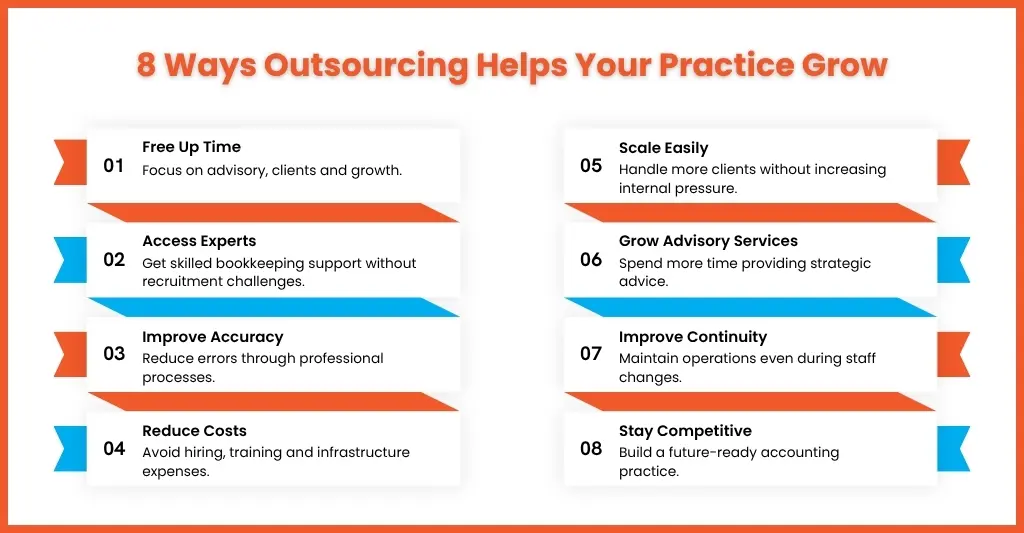
8 Reasons to Outsource Your Bookkeeping
Reason 1: Free Up Your Team’s Time
One of the major reasons to outsource your bookkeeping is the time it free’s up for your team for advisory work. Bookkeeping contains multiple essential but repetitive tasks. While these tasks are important, they do not require the direct attention of an accountant.
When you outsource your bookkeeping, you will be free to focus on advisory work, financial planning for your clients, and better client communication. It gives you the chance to strengthen relationships with your clients and increase revenues for your practice.
Reason 2. Access Experienced Bookkeeping Professionals
Getting hold of an experienced bookkeeping staff is difficult for practices operating in the UK, especially for small ones. Outsourcing gives you that option to access professionals who are experienced in the bookkeeping process, accounting tools, and accounting standards, instead of spending time and money on recruiting and then training.
Reason 3. Improve Accuracy and Reduce Errors
Accuracy in financial records is important because mistakes in bookkeeping must be avoided at all costs; otherwise, it can affect client confidence. Professional outsourced bookkeeping providers use structured processes, quality checks, and experienced teams to maintain accuracy.
The increasing adoption of digital accounting tools is also improving how businesses manage financial information. Xero’s UK small business research has highlighted the growing importance of automation and digital solutions in helping businesses work more efficiently.
Many practices have started using digital accounting tools to manage financial information, but if this technology is combined with experts who know how to operate them, it can work wonders. Outsourcing achieves that combination with ease.
Reason 4. Reduce Costs Compared to Hiring In-House
Hiring an in-house bookkeeper involves more than paying a salary.
Also, other costs need to be considered, like:
- Recruitment costs
- Employee benefits
- Training expenses
- Software costs
- Office resources
- Management time
Through outsourcing, practices can choose the level of support they need and adjust it as requirements change and pay accordingly.
Reason 5. Scale Your Practice More Easily
Growth is great, but it brings some challenges. As your client base increases, bookkeeping demands increase too. Without additional support, your existing team may struggle to maintain the same level of service.
Outsourcing your bookkeeping provides scalability, especially when additional support is needed during busy seasons. An outsourced partner can adapt to your requirements. This allows you to accept new clients confidently without worrying about operational pressure.
Reason 6. Spend More Time on Advisory Services
Client expectations of your accountants have gone up. Apart from number crunching, they want compliance support and insights so that they can make better business decisions.
However, advisory services require time and attention.
By removing routine bookkeeping responsibilities from your internal workload, your team can spend more time delivering strategic advice, improving client retention, and creating new revenue opportunities.
Reason 7. Improve Business Continuity
Small practices often depend heavily on a few key team members. If one bookkeeper resigns, takes extended leave or becomes unavailable, then critical operations get disrupted, bringing disrepute to your practice.
An outsourced bookkeeping partner provides backup. With a dedicated support team, you will be better prepared to handle unexpected changes while maintaining service quality.
Reason 8. Stay Competitive in 2026 and Beyond
UK accounting industry is going through some rapid changes due to changes in laws, automation, and client expectations. This is also changing how practices have to operate.
Practices that embrace flexible solutions will be better positioned for future growth, and outsourcing enables you to do that. It gives access to professional expertise so that you get a level playing field to compete with larger firms while maintaining your personal approach.
Outsourcing Your Bookkeeping vs. Hiring In-House: A Quick Comparison
While doing a bookkeeping outsourcing vs in-house bookkeeping, you find advantages in both. But outsourcing puts a lot more on the table for small accounting practices.
| Outsourcing Your Bookkeeping | Hiring In-House |
| Access specialist skills quickly | Requires recruitment and onboarding |
| Flexible support based on workload | Fixed staffing costs |
| Easier to scale as your practice grows | Additional hiring needed for growth |
| Less management responsibility | Requires ongoing supervision |
| No need for additional office resources | Increased operational costs |
For many small firms, outsourcing provides the balance between professional support and operational flexibility.
How Much Does It Cost to Outsource Your Bookkeeping?
For an accounting practice to outsource its clients’ bookkeeping, the cost typically ranges from £8 to £25 per hour for offshore teams or £50 to £600+ per month per client on a fixed-fee white-label basis.
Multiple factors influence the cost of outsourcing bookkeeping; some of those factors are:
- Number of clients supported
- Volume of transactions
- Complexity of bookkeeping requirements
- Frequency of reporting
- Level of assistance needed
You can choose monthly bookkeeping packages or outsource specific tasks during busy periods. But it’s important to base your choice of outsourcing partner not just on the cost but also on the value it creates.
The important consideration is not only the cost of outsourcing but the value it creates. Saving your team several hours each week can allow them to focus on activities that generate more revenue.
For many practices, outsourcing becomes an investment in efficiency rather than simply an expense.
How to Get Started Outsourcing Your Bookkeeping
Shifting your bookkeeping responsibility to a third-party service provider is easier said than done, and it must be achieved without disruptions. For that, you will need to start identifying tasks that create the biggest workload for your team. This could be anything from transaction processing, reconciliations, or regular bookkeeping maintenance.
Next, choose a partner who understands your requirements and your preferred systems.
A smooth transition usually involves:
- Reviewing your current bookkeeping processes
- Agreeing on responsibilities and workflows
- Setting communication expectations
- Providing necessary system access
- Reviewing performance regularly
The goal is to create a partnership that feels like an extension of your own team.
What to Look for When Choosing a Bookkeeping Partner
Finding an outsourcing partner in the UK is not difficult, but the tough part is finding the right bookkeeping outsourcing provider. Your choice will affect your work that’s why you must look for a provider that offers you the following things:
- Experience supporting UK accounting firms
- Strong bookkeeping knowledge
- Understanding of cloud accounting platforms
- Secure processes for handling financial information
- Clear communication
- Flexible support options
And Equallto ticks all the above boxes.
Equallto has been in the business of helping accounting practices access reliable outsourced bookkeeping support while maintaining control over quality, communication, and client service.
The right partner should not simply complete tasks; they should help you operate more efficiently and grow confidently.
Frequently Asked Questions About Outsourcing Your Bookkeeping
What’s the difference between outsourced bookkeeping and outsourced accounting?
When it comes to bookkeeping outsourcing, it includes keeping financial records correct, handling transactions, and getting routine bookkeeping tasks done. On the other hand, outsourcing accounting covers wider financial activities, including high-value services like forecasting and advisory support. Both are important and support accounting practices; you can either choose to outsource bookkeeping or the entire accounting work, depending on your needs.
Can outsourced bookkeeping work with my existing software?
Yes, it can, and most professional outsourcing service providers ensure that their team and their systems are trained and adaptable in working with popular accounting platforms like Xero, QuickBooks, and Sage. Professional outsourcing providers like Equallto have invested considerably in training and developing the expertise in handling multiple platforms. It can adapt to your systems instead of you needing to change your workflow.
How quickly can you switch to an outsourced bookkeeper?
There is no single answer for this, and it all depends on your practice size, processes, and requirements. If you have decided to outsource only part of your bookkeeping responsibility, then it will not take much time. However, if you are outsourcing fully, then agree on the responsibilities, software access, and communication process for a smooth transition. Such a structured onboarding will ensure a smooth transition.
Is AI replacing bookkeepers?
Not at all, AI is not replacing human bookkeepers; instead, it is automating routine tasks like data entry, transaction categorisation, and invoice processing. This shift allows bookkeepers to spend less time on manual work and transition into higher-value advisory and strategic planning roles.
Is outsourcing a dying concept?
Outsourcing isn’t dying; it is evolving. The traditional work of outsourcing was for cheap, manual execution, which is collapsing. In its place, practices are shifting toward strategic, capability-centric partnerships where external providers manage automated workflows and provide hard-to-find, specialised expertise.
Conclusion
Understand this: only those practices will survive and thrive that work smarter, and the decision to outsource your bookkeeping will be that smart decision. Outsourcing has created space for small accounting practices to focus on expanding their business by serving their clients better, building their advisory service capability, and tax planning.
By partnering with Equallto, your practice can gain multiple benefits from our bookkeeping outsourcing services, which can reduce the burden of routine bookkeeping while gaining access to experienced professionals who understand the needs of accounting firms.
Your clients trust you with their finances. Make sure your team has the time and support needed to deliver the value they expect.
It’s time to make the smart decision to outsource your bookkeeping. Contact us and be part of the future of accounting.
