
When we say outsourced bookkeeping London, we mean delegating your UK bookkeeping work to a specialist outsourcing provider so that your team can focus on scaling capacity and reducing workload without hiring an accountant.
For a small accounting practice in London, this might seem impossible, but that’s not the case.
Take, for instance, a small accounting practice that had built a solid reputation among SMEs, and they are recommending its services to others, leading to 18 new clients. On paper, things looked great, but in reality, the practice team was getting overwhelmed.
Within no time, bookkeeping tasks (bank reconciliations, invoice entries, VAT data preparation, and month-end clean-ups) started piling up, and senior staff had to do late-evening fixing errors instead of focusing on advisory work. Hiring was not an option due to the cost and time taken to onboard new recruits.
Then the practice explored an Equallto’s outsourced bookkeeping London provider, and within a few weeks, things started changing. Work pressure went down, and this practice was able to handle 40 new clients without hiring a single bookkeeper.
This shift is becoming increasingly common.
AAT (Association of Accounting Technicians) in its Fill in Gap skill report shows that 34% of businesses have struggled to recruit for finance and accounting positions in the last year, with employers reporting a shortage of skills in key areas.
For small accounting practices, where operating costs and salaries are significantly higher, and the accountant shortage is real, outsourcing bookkeeping is the only viable option for scalable growth.
The Real Cost of Doing Your Own Bookkeeping in London
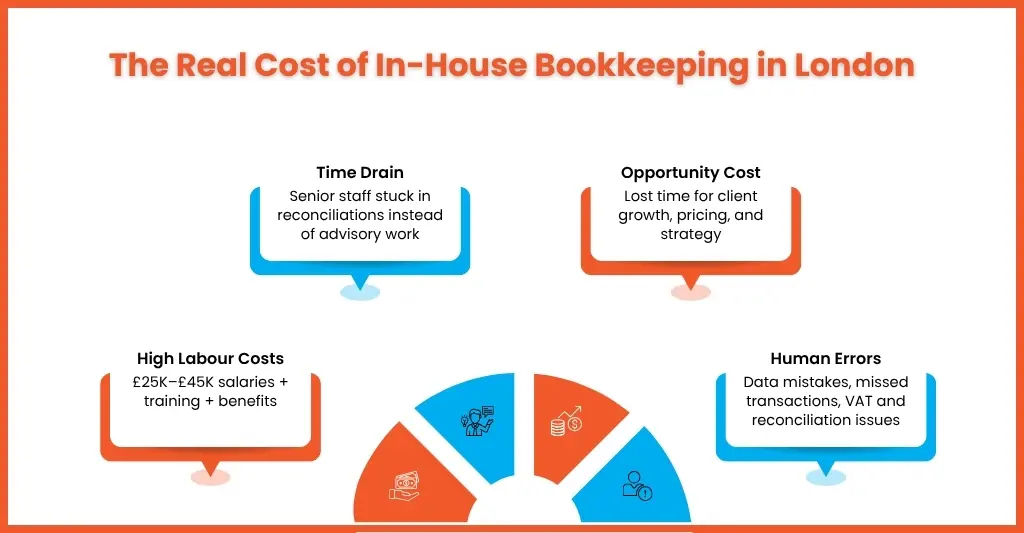
Like many accounting practices, you would prefer to do the bookkeeping in-house instead of outsourcing, but there is a cost for it like high labour costs, senior staff busy in low-value work, risk of human error, and missed growth opportunities.
On the surface, you will feel that you are in control, but when these costs come in, things get murkier.
Let’s understand the real cost of keeping bookkeeping in-house in detail.
High Labour Costs
London salaries for bookkeeping staff are among the highest in the UK. Even junior bookkeepers require competitive pay, benefits, and training investment.
The salaries of London-based bookkeeping staff from the junior level right up to the senior bookkeeper are approximately between £25,000 and £45,000 per year, the highest in the UK. Even a junior bookkeeper will need good pay, benefits, and training investments.
Time Drain on Senior Staff
Due to shortages of accountants in the accounting market, there will be a lack of recruitment of junior staff, making existing ones overworked. In such situations, your senior accountants will have to step in to fix errors, reconcile accounts, and complete VAT return preparations. This pulls them away from high-value advisory services.
Opportunity Cost of Growth
Every hour spent on manual bookkeeping is an hour not spent on:
- Acquiring new clients
- Delivering advisory services
- Improving pricing strategies
- Building scalable processes
Risk of Human Errors
Manual bookkeeping always suffers from human errors like:
- Data entry errors
- Missed transactions
- Incorrect VAT categorisation
- Reconciliation delays
What Are Outsourced Bookkeeping Services in London?
Outsourced bookkeeping London services is a partnership with a third-party service provider that will manage the delegated bookkeeping tasks on your behalf.
Instead of hiring in-house staff, you can delegate tasks such as:
- Bank reconciliations
- Purchase and sales ledger management
- VAT preparation support
- Expense categorisation
- Monthly management accounts preparation
- Data entry and clean-up work
A good outsourced bookkeeping partner works like an extension of your team, not a replacement for your accountants.
Most accounting practices partner with service providers to delegate their repetitive work so that their internal team can focus on:
- Client advisory
- Tax planning
- Business growth
- Strategic consulting
This hybrid model is becoming increasingly popular among London accounting firms looking to scale without increasing overheads.
6 Signs Your London Practice Is Ready to Outsource bookkeeping
Are you unsure about outsourcing your bookkeeping? Keep an eye on these key indicators.
Your Team Is Constantly Overloaded
If you are constantly getting reports that your staff is working overtime to complete just bookkeeping tasks, then it shows that your capacity is maxed out, and it’s time to get outside help.
You’re Turning Away New Clients
Are you turning down new clients due to a lack of capacity? If yes, then choosing an outsourcing partner is important to enhance your capacity.
Senior Staff Are Doing Junior Work
When your senior staff is forced into fixing bookkeeping errors, then it’s a sign that you must be suffering from a lack of accountants or that your structures are inefficient.
Month-End Close Takes Too Long
Delays in reconciliations or reporting indicate that something is not right in your current bookkeeping process.
Hiring Has Become Difficult
With the current shortage of accountants in the UK, recruitment of talented accountants has become difficult and expensive for small accounting firms. This has made scaling up your services difficult.
You Want to Focus on Advisory Services
If you are planning to focus on highly profitable advisory and client consultation work fully, then you will need an outsourcing partner to take over your bookkeeping responsibilities. This will free up your team for advisory services.
To understand the in-house bookkeeping and outsourced bookkeeping better we have created a comparison table.
| Factor | In-House Bookkeeping | Outsourced Bookkeeping (London Partner) |
| Cost | High fixed salary costs (£25k–£45k+ per bookkeeper in London) plus benefits, training, and overheads | Flexible pricing based on volume (often significantly lower than full-time hire cost) |
| Scalability | Limited by hiring capacity and recruitment delays | Easily scalable to handle 10 → 100+ clients without hiring |
| Turnaround Time | Often delayed due to workload peaks and staff availability | Faster and consistent due to dedicated processing teams |
| Accuracy | Higher risk of manual errors, especially under pressure | Higher accuracy through structured processes and checks |
| Staff Pressure | Senior staff often pulled into bookkeeping tasks | Internal team freed for advisory and client growth work |
| Hiring Dependency | Requires continuous recruitment and onboarding | No hiring required for growth |
| Technology Use | Varies depending on internal capability | Advanced tools, automation, and cloud-based systems |
| Cash Flow Visibility | Can be delayed due to backlog in bookkeeping | Real-time or near real-time reporting availability |
| Flexibility | Fixed internal capacity regardless of workload changes | Flexible capacity that adapts to client demand |
| Focus Area | Compliance-heavy, reactive work | Strategic, advisory-focused operations enabled |
What Changes When You Outsource Bookkeeping to a London-Capable Partner
When you move toward bookkeeping outsourcing, you will notice some gradual changes that will bring structural improvements in how your practice operates. Instead of reacting to backlog, missing data or client delays, you will be operating in a more predictable manner.
Here’s what typically changes in real operational terms:
Immediate Capacity Expansion
One of the immediate benefits of outsourcing is the sudden increase in operational capacity. That’s because your internal team will be freed from repetitive transactional tasks.
Bookkeeping tasks such as:
- Bank reconciliations
- Invoice posting
- Expense categorisation
- VAT data preparation
- Month-end clean-ups
Will be handled externally, freeing internal teams to focus on higher-value work.
Partnering with a bookkeeping outsourcing provider will feel like adding an entire bookkeeping team without going through recruitment, onboarding, or training delays.
Faster Turnaround Times Across Clients
Before outsourcing, bookkeeping work moved in cycles: work came in, built up, got processed in batches, and then cleared, only to build up again. Outsourcing has changed that cycle completely.
Dedicated bookkeeping teams operate continuously, meaning:
- Work done on a daily basis instead of monthly bottlenecks
- Queries are resolved faster
- VAT and management reports are prepared on time
- Client deadlines are easier to manage
The result is a smoother workflow where work doesn’t accumulate in the background.
Improved Accuracy and Fewer Corrections
Manual bookkeeping is prone to human errors, especially when it’s done under pressure during high transaction volumes.
Common issues in in-house setups include:
- Misclassified expenses
- Duplicate entries
- Missing receipts or invoices
- VAT coding inconsistencies
- Reconciliation mismatches
Specialist bookkeeping outsourcing teams typically follow:
- Standard chart-of-accounts mapping
- Consistent VAT treatment rules
- Multi-step review processes
- Software-driven validation checks
This reduces rework and eliminates the “endless correction cycle” your teams face during month-end close. Over time, this improved accuracy also strengthens client trust, especially during audits, HMRC reviews, or management reporting discussions.
Better Cash Flow Visibility for Clients
Another hidden benefit offered by bookkeeping outsourcing is the financial transparency it offers not just for you but even your clients.
When bookkeeping is up to date, accounting firms can provide:
- Real-time cash flow insights
- More accurate management accounts
- Faster VAT reporting
- Better forecasting data
- Clearer profit visibility
Such transparency will allow you to provide your clients with valuable insights that will help them make informed decisions, turning you from “compliance provider” to “financial advisor.”
Reduced Stress and Operational Pressure on Internal Teams
Outsourcing bookkeeping services work reduces workload pressure on your internal team.
Before outsourcing, many of your team’s experience:
- Constant deadline pressure
- Reactive working patterns
- Late nights during VAT and month-end cycles
- Senior staff fixing junior-level bookkeeping errors
This creates burnout and limits team productivity.
After outsourcing, internal teams experience a noticeable shift:
- Fewer low-value tasks
- Reduced deadline stress
- More structured workloads
- Better work-life balance
More Predictable and Structured Workflows
Outsourcing brings in predictability through its structure, which was absent when done in-house. Inconsistent arrival of work, deadlines overlap, and urgent client requests disrupt planned schedules, which is common in in-house bookkeeping, making it difficult to manage resources effectively.
Outsourcing introduces structure into this environment.
By partnering with your bookkeeping partner, you will get:
- Fixed reporting cycles
- Clear submission deadlines
- Defined turnaround times
- Standardised workflows
- Better workload forecasting
This predictability allows you to:
- Plan staffing more effectively
- Allocate resources efficiently
- Reduce last-minute firefighting
- Improve client communication
How Much Does Outsourced Bookkeeping in London Cost? (Real 2026 Pricing)
Compared to hiring in-house bookkeeping staff in London, where salaries alone can exceed £28,000–£45,000 annually per bookkeeper, pricing charged by outsourced bookkeeping London service providers ranges between £20 to£60 per hour, or £100 to £500+ per month depending on complexity and volume
This shows you that outsourcing delivers significantly better cost efficiency.
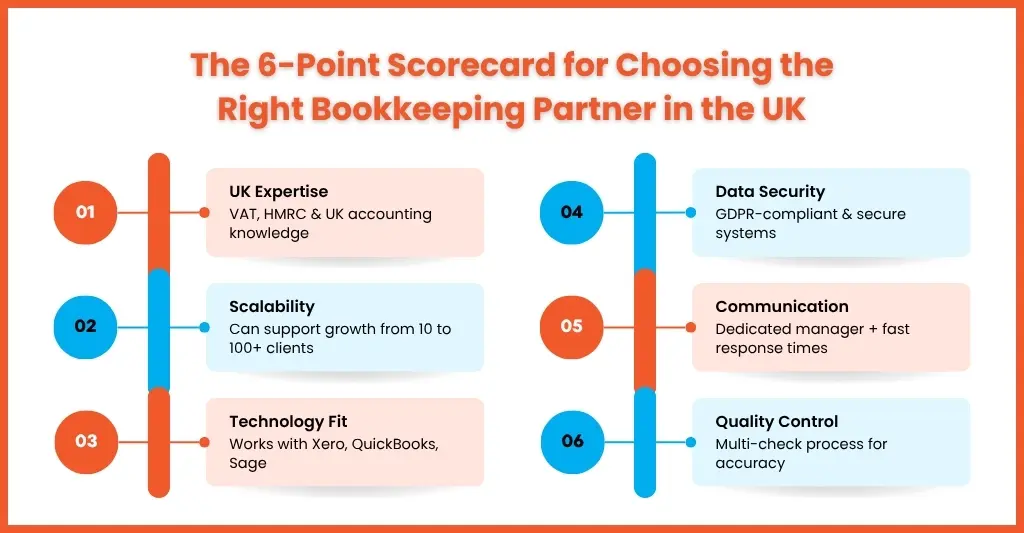
How to Choose the Right Outsourced Bookkeeping Partner in London
Focusing only on the cost while evaluating outsourced bookkeeping London providers will not be enough; there are many factors that make a bookkeeping service provider right for you.
UK Accounting Experience
Make sure the provider you select has experience in handling UK tax rules, VAT requirements and HMRC expectations.
Scalability
Before you select a service provider, ask them this question: Can they handle growth from 10 to 100 clients without any disruptions? You can frame your question as per your requirement.
Technology Stack
Ideally, you must go for a service provider that uses tools and systems which are compatible with:
- Xero
- QuickBooks
- Sage
- Cloud bookkeeping tools
Data Security
Data security is important to safeguard your clients’ bookkeeping data; that’s why you should select a provider that has GDPR-compliant systems and secure data handling protocols.
Are you worried about your client’s data safety? Choose qualified service providers like Equallto that operates GDPR-compliant, ISO-aligned processes with signed Data Processing Agreements.
Communication Structure
See if there are dedicated managers who will address your queries and check the time taken. Also, check their communication process so that you save yourself from future troubles.
Quality Control Processes
Ask what procedures and tools they use to ensure accuracy and consistency across clients. If they identify a error how to do they rectify it and timelines.
How Equallto Delivers Outsourced Bookkeeping for London Firms
For many small accounting practices, Equallto has become a scalable outsourced bookkeeping London partner designed specifically to solve capacity challenges.
It provides outsourced bookkeeping services in London that help practices:
- Handle increasing client workloads without hiring
- Improve turnaround times for bookkeeping and VAT work
- Maintain consistent quality across multiple clients
- Reduce internal team pressure
- Scale operations efficiently
It does not offer a temporary fix but Equallto integrates directly into your workflow, acting as a seamless extension of the internal team. This allows you to confidently take on more clients while maintaining service quality and compliance standards.
Frequently Asked Questions
Can you recommend reliable bookkeeping companies in London?
Reliable outsourced bookkeeping providers in London should offer UK accounting expertise, scalable support, strong data security, and experience with cloud accounting platforms. Equallto is one example of a provider supporting accounting practices with scalable bookkeeping capacity.
What should I look for when choosing bookkeeping services in London?
You should evaluate experience in UK accounting, software compatibility, pricing transparency, data security, turnaround times, and the ability to scale with your practice. Evaluate by asking questions regarding their data security procedures, what software’s they use, price plans, and quality control and redressal measures in place.
What should I expect from a professional outsourced bookkeeping service?
You should expect accurate bookkeeping, timely reporting, structured communication, secure data handling, and seamless integration with your existing accounting systems. You will also get immediate capacity expansion, faster turnaround times across clients, and reduced stress on your internal teams.
What does an outsourced bookkeeper do?
Outsourced bookkeeping is when a company hires an external individual or firm to handle its bookkeeping, recording the financial transactions of a business and preparing financial statements, such as balance sheets and profit and loss statements.
Is outsourcing a dying concept?
Far from dying it’s actual growing popular among accounting practices and is going through a massive transformation. Outsourcing service providers have the specialised talent in place who will add greater value to your practice. It’s no longer a cost-cutting mechanism, it’s a gateway for getting specialised talent, operation flexibility, and leverage to expand your practice.
Closing Section: Take the Next Step
Outsourcing bookkeeping is no longer about reducing workload; it’s about making your practice ready to handle future growth. If your accounting practice is struggling with capacity, missing growth opportunities, or spending too much time on manual bookkeeping, then outsourcing is the only way out.
With Equallto’s outsourced bookkeeping London services, you can confidently scale your client base, improve efficiency, and free your team to focus on higher-value advisory work.
Stop choosing between growth and capacity. Contact us and start building both.
