
AI in accounts payable is not a futuristic concept; your accountants must know that it is staring right at their faces in 2026. Right now, accountants of small accounting practices are making great efforts to manage invoice volumes, reconcile payments, and keep clients happy, but many are unsuccessful.
Take, for instance, A small accounting practice based in the UK that used to struggle with hundreds of supplier invoices and late payments were a frequent problem. After implementing AI in accounts payable workflow, processing time reduced by 60%, errors were cut dramatically, and client satisfaction improved.
It’s less surprising that Ardent Partners estimates that approximately 75% of AP departments worldwide are currently using some form of automation and AI tooling to streamline core AP functions. It also means it’s time for your accountants to take AI in accounts payable seriously.
In this blog, we’ll explain what AI in accounts payable is, why it matters, and what accountants need to know before integrating it into their workflows. We’ll also share real-world examples, key benefits, and a step-by-step roadmap to ensure successful adoption.
In this blog, we have made an effort to explain what AI in accounts payable is, why it’s required, and what your accountants need to know before integrating it into their workflow. We will also share its benefits and how to adopt it successfully.
What Is AI in Accounts Payable?
AI (artificial intelligence) in accounts payable (AP), which can come under AI in accounting, uses advanced technologies like machine learning (ML) and natural language processing (NLP) to automate tasks, including:
- Processing invoices
- Extracting invoice data from different formats
- Making agentic payments
- Tracking expenses
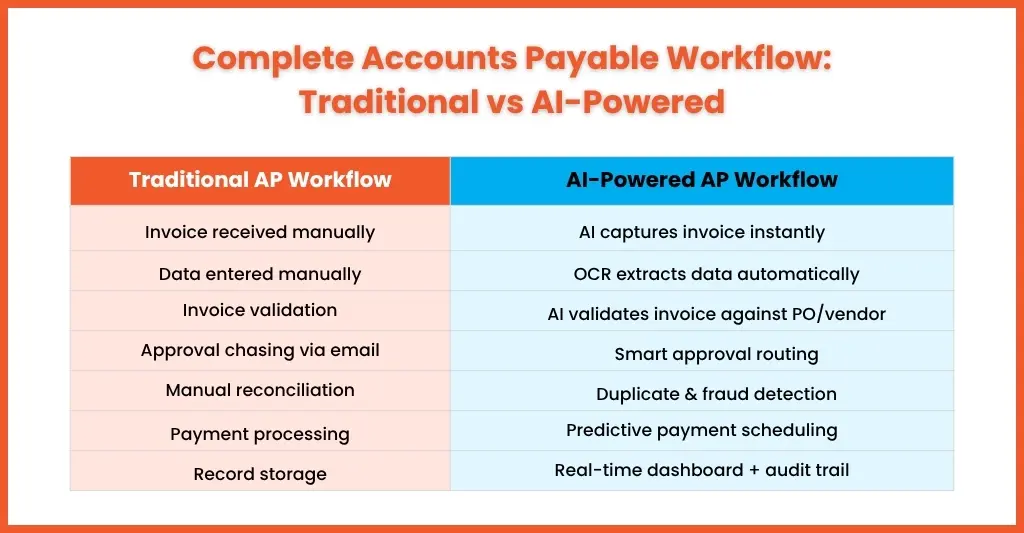
AI in accounts payable means using advanced technologies like machine learning and natural language processing to automate tasks. Unlike traditional AP automation, which follows pre-set rules, AI can learn from past data, detect anomalies, and make intelligent recommendations.
Some common AI functionalities in AP include:
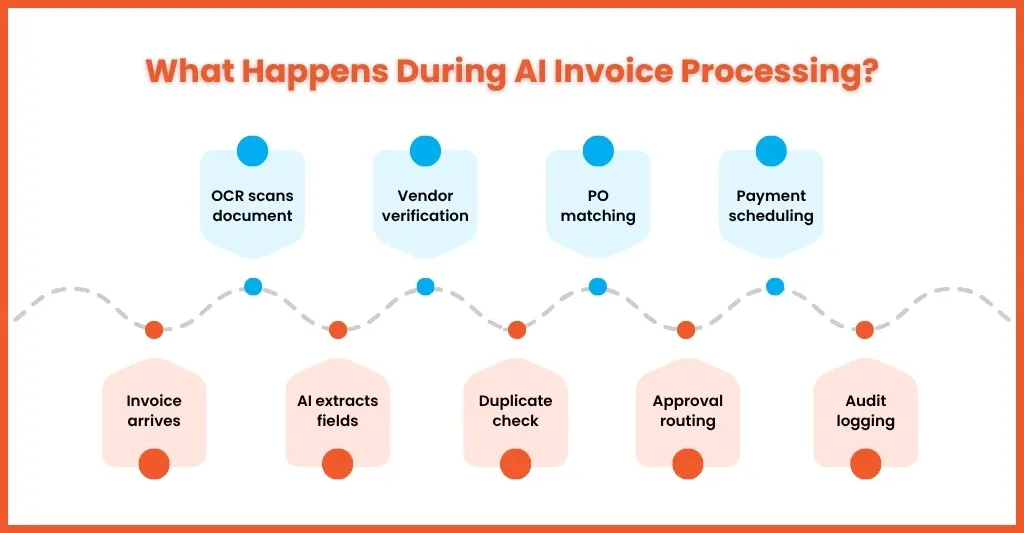
- Automated invoice data extraction
- Duplicate payment detection
- Payment prioritisation based on cash flow insights
- Predictive analytics for cash flow planning
- Intelligent approval routing
With the incorporation of AI into accounts payable, the entire manual process gets converted into a smart and self-optimising workflow.
Why AI in AP Matters for UK Accountants in 2026
According to the latest UK Government, late payments are costing the UK economy almost £11 billion per year and 14,000 businesses close each year as a result of late payments, equivalent to 38 businesses every day. Your clients would not want their business to be the next to close down due to late payments.
That’s the reason why clients are expecting their practices to provide faster, error-free financial reporting. That means your accountants must innovate or risk falling behind. Enter AI in accounts payable, which will tackle these challenges head-on by improving efficiency, accuracy, and visibility. For those practices that are managing thousands of invoices every month, AI incorporation in the accounts payable process can turn your stressed-out teams into a scalable one.
How Can AI Improve Efficiency in Accounts Payable?
For many accounting practices, accounts payable is still done manually. Tasks under accounts payable, like downloading invoices, entering data into accounting systems, chasing approvals, correcting errors, and reconciling payments, are time-consuming. When the volume of invoices increases, especially during peak VAT periods, it places unnecessary pressure on finance teams. Any errors can lead to serious bottlenecks.
To relieve the pressure on your accounting team, you will need to incorporate AI in your accounts payable process. Let’s understand how it will improve your efficiency.
Automated Data Capture
Using AI tools, you will be in a position to read and extract invoice data from thousands of invoices automatically. This reduces manual data entry and chances of human errors to a minimum.
Faster Approvals
When the entire payable workflow is automated, the invoices will reach their right owner in time, thus speeding up the payment cycle.
Predictive Payment Scheduling
AI will also learn from past data and mistakes and accordingly suggest optimal payment dates to avoid late fees while maintaining cash flow.
Duplicate Detection
AI tools will easily identify duplicate invoices before the data capture process so that costly overpayments are avoided, saving the reputation of your practice.
Anomaly Detection
AI has the powerful ability to detect errors within seconds that a human eye cannot. Machine learning systems continuously analyse transaction patterns and flag anomalies such as:
- Unusually high invoice amounts
- Unexpected supplier changes
- Duplicate bank account details
- Suspicious payment timings
- Invoices outside normal purchasing patterns
Continuous Learning
Traditional systems are based on a fixed set of rules, but not AI, which keeps adapting, learning from user behaviour and operational patterns. The more data AI processes, the more accurate and efficient it becomes.
By implementing AI, UK accounting practices can reduce processing time, minimise errors, and free staff to focus on higher-value advisory work.
Key Benefits of AI for UK Accounting Practices
There are multiple reasons for the increasing adoption of AI in accounts payable among accounting practices in the UK, and these are the benefits. AI offers a smarter and simpler way of handling repetitive accounts payable tasks, saving time and making the entire process more efficient and reliable.
Here are the five major benefits that make your accounts payable team more valuable:
Faster Invoice Processing
AI puts your workflows on high speed by speeding up time-consuming tasks like data entry and validation, through automation. This has reduced the time taken in processing considerably.
Higher Accuracy
AI in accounts payable means minimal human errors due to automatic extraction and validation of invoice details with incredible precision. Such automation has reduced the workload of the accounts payable team considerably.
Light on Your Pockets
Lack of automation and more work means expanding your AP team, which will lead to more manual work and human errors. AI will lower costs by taking over extra work without quality depreciation and without additional hiring of accountants, thus saving costs.
Fraud Prevention
It’s tough for human eyes to detect unusual patterns and potential fraud among thousands of invoices. But AI will achieve that within seconds, thus providing your clients with an additional security layer.
Enhanced Insights
AI generates a considerable amount of real-time analytics, thus giving a wealth of insights into your client’s cash flow, payment trends, and vendor performance. These insights can be shared with your clients, as it will help them make informed decisions.
What Should Accountants Know About Integrating AI Into Their Workflows?
Before going ahead with getting AI in accounts payable, you must know what your accountants should know about integrating AI into their workflows. The road of integrating AI in your accounts payable will not be full of roses; it has its share of challenges, which you must overcome.
Initial High Cost
We understand that you are price sensitive, and one of the major reasons for getting AI in your accounts payable is to reduce the costs of additional hirings, but getting an AI is not inexpensive. Think of it as an initial investment that goes into adopting AI in their automation and analytical stack. However, you can overcome that by availing AI through outsourcing on a pay-as-you-go basis.
Resistance from Employees
The majority of your accounting staff will be elated when they know that most of their repetitive tasks will be automated, yet they will be concerned about the lack of human oversight when AI is embedded into automation. You will need to create the necessary human checkpoints in the AI-enabled process and make them aware of it so that there is no resistance to it.
Need for High-Quality Data All the Time
AI needs consistent, high-quality data to make accurate predictions and pattern matching. Early phases of AI use may throw wrong analysis due to a lack of data; hence, time must be given. For example, an AI invoice processing system will perform better in data extraction when there is greater invoice volume and variety.
Need for Technical Expertise
AI/ML technology requires expert hands to operate it smoothly, and many accounting practices lack that expertise. You will either have to focus on training your accounts payable staff or turn towards outsourcing providers that offer account payable outsourcing services and are experts in using AI/ML.
Challenges of Integration
The real benefits of AI-enabled AP automation come when they are well-integrated with your accounting software. To enable that, focus must be placed on “touchless” AP processes, in which the entire invoice processing workflow is automated and requires no manual intervention. If your goal is to automate limited tasks in the payable workflow, then emphasis must be placed on possible integration challenges that might come.
Real-World Implementation Examples from UK Practices
- Manchester Accounting Firm: Integrated AI into AP, reducing errors by 70% and cutting invoice processing from 5 days to 1 day.
- London SME Advisory Practice: Used AI to detect duplicate payments and optimise cash flow, saving £50,000 annually.
- Bristol Financial Services Firm: Leveraged AI for predictive scheduling during VAT season, improving compliance and client satisfaction.
These examples show that AI adoption is not limited to large enterprises; even small practices benefit significantly.
When Not to Implement AI in Accounts Payable
AI is not a magic wand that will remove all your pains under certain situations. Implementing AI in accounts payable will do more harm than help. Those situations are:
- Your invoice volume is minimal and manually manageable
- Your data quality is poor and inconsistent
- Staff are resistant or untrained in digital systems
- Lack of integration with existing accounting software
In these cases, focusing on basic AP automation and process optimisation may provide better ROI before introducing AI.
Step-by-Step Implementation Roadmap for UK Practices
Implementation of AI in accounts payable cannot be done in haste; it requires careful planning, monitoring, and implementation. Here are a few steps to consider when embracing AI in your accounts payable:
Step 1: Planning
Identify your clients’ requirements and specific challenges or bottlenecks in the accounts payable process. This can include tasks like invoice validation, manual data entry, approval delays, etc. Set what your objectives are: improving efficiency, reducing processing time or improving decision making. Based on that, you can select your AI/ ML solutions that meet your objectives, along with looking at their scalability, integration, and user-friendliness.
Step 2: Getting Data Ready
The next step is to gather all the required data for making informed decisions. This includes invoices, payment records, purchase orders, and vendor information. For AI to give better results, you will have to provide data that is accurate and consistent. Avoid correcting or organising information, including the removal of duplicates, to prevent a negative impact on AI performance.
Step 3: Select the Software or Service Provider
The following step will be to select a reliable AI and ML solution that can be tailored to meet your AP process requirements. If you lack the expertise in operating it then identify a bookkeeping outsourcing service provider that uses and has the expertise in these solutions. Select those providers or solutions that have a track record of successful implementation and tailor them accordingly to your requirements.
Step 4: Implement the Solution
It’s to integrate the AI solution with your system, which must be done seamlessly with a smooth flow of data. Otherwise, it must be assumed that your selection of an AI solution has gone wrong, ending up costing you more. Therefore, due diligence must be followed.
To avoid such a scenario, conduct a pilot test, which will highlight the strengths and limitations. Prior to scaling up, address these limitations or issues. This will help you avoid costly mistakes.
Step 5: Training Your Staff
You will need to train your systems to recognise vendor patterns, invoice formats, approval workflows, etc. Constant monitoring of AI performance and fine-tuning algorithms is required; you will need to educate staff on AI functionality, exception handling, and reporting.
Step 6: Scale Across Clients and Teams
Once pilot project is successful and the training of your staff is done, you can decide to expand the use of AI that will cover all invoices and clients.
By following these steps, you will ensure a smooth and organised transition of your AP process towards an AI-enabled AP process.
FAQ: AI in Accounts Payable for Accountants
What is AI in accounts payable?
AI in accounts payable is a process of using machine learning (ML) and natural language processing (NLP) to automate accounts payable tasks, including:
a. Processing invoices
b. Extracting invoice data from different formats
c. Making agentic payments
d. Tracking expenses
What should accountants know about integrating AI into their workflows?
Focus on data quality, staff training, software integration, governance rules, and gradual rollout to ensure AI enhances, not disrupts, operations.
What’s the difference between AP automation and AI in AP?
Automation of accounts payable follows only predefined rules to streamline the process. On the other hand, AI keeps learning from data, makes predictions, and optimises decision-making over time.
What is the AP process?
The Accounts Payable (AP) process is the step-by-step workflow a business uses to receive, verify, approve, and pay vendor invoices for goods or services purchased on credit. It is a critical financial function that ensures accurate tracking of company liabilities and maintains healthy cash flow.
What’s the difference between AP and AR?
Accounts Payable (AP) and Accounts Receivable (AR) are two sides of a business’s cash flow. AP represents the money your business owes to suppliers (a liability), while AR is the money customers owe your business (an asset).
Conclusion
AI in accounts payable is changing the way accounting practices in the UK operate. It has allowed small accounting practices to improve their efficiency, accuracy, and visibility, making them capable of scaling up, reducing errors, and focusing on higher-value work.
Getting the right AI in AP will not only streamline the process but also improve your client’s trust in your practice. With the right strategy, staff training, and integration, AI can turn accounts payable from a time-consuming burden into a strategic advantage.
To get it right in the first place, small accounting firms are partnering with Equallto to implement AI-powered AP workflows without the headache of managing complex technology. Our team ensures smooth integration, training, and support, helping your firm benefit from the AI revolution in accounting.
Want to know more about our services? Visit our website, fill out our contact form, and see how your practice can harness AI in accounts payable in 2026.
