
AI accounting software is redefining how accounting practices in the UK are handling their bookkeeping, accounts payable, payroll, reporting, compliance, and client communication in 2026.
What used to take hours or days of work, especially in data entry, reconciliation, and spreadsheet work, can now be completed faster, more accurately, and with far less operational pressure using artificial intelligence. The best part is that this is just the beginning of an AI revolution.
Accounting teams across the UK are facing the same challenges:
- Increasing client expectations
- Staff shortages
- Rising compliance pressure
- Tighter deadlines
- Growing workloads without growing headcount
At the same time, clients expect:
- Faster reporting
- Real-time visibility
- Fewer errors
- Proactive advice
- Digital-first service delivery
According to PwC’s global CEO survey, 42% of leaders in the UK have adopted AI and machine learning technology. Yet there is a hesitation among small accounting practices to adopt AI accounting software, but accounting talent shortage and complex regulatory environment are pushing many towards it.
In this guide, we’ll break down:
- What AI accounting software actually is
- Why are UK practices adopting it rapidly
- The best AI accounting software tools in 2026
- How to choose the right solution
- Implementation strategies
- ROI expectations
- Future AI accounting trends
Because AI in accounting is the future of accounting, the practices using AI effectively won’t just work faster; they’ll compete smarter.
What Is AI Accounting Software?
AI accounting software UK uses artificial intelligence and machine learning to automate manual accounting tasks, improve financial processes, and enhance decision-making.
Unlike traditional bookkeeping accounting software, AI bookkeeping software systems can:
- Learn from previous transactions
- Automate repetitive tasks
- Identify anomalies
- Predict trends
- Improve accuracy over time
Instead of simply storing financial data, AI systems actively assist accounting teams.
Why UK Practices Are Adopting AI Accounting Software in 2026
UK accounting industry is going through rapid transformations, and without any doubt, AI is one of the biggest reasons for it. As we speak, multiple practices are incorporating AI accounting software in their daily process, and there are multiple reasons why they are adopting it.
Rising Workloads Without Larger Teams
Many accounting practices are expanding and getting many clients without proper planning for recruitment.
The result is pressure around:
- VAT deadlines
- Bookkeeping workloads
- Payroll processing
- Reporting turnaround
- Compliance management
AI accounting software UK will relieve that pressure on the accounting teams by scaling up operations in an effective manner.
Compliance Demands Are Increasing
Making Tax Digital is being increasingly pushed by HMRC to encourage digitisation of the UK tax system. It means special emphasis must be placed on accurate financial data.
Manual systems create higher risk, and AI helps improve:
- Record accuracy
- Audit readiness
- Reporting consistency
- Real-time compliance monitoring
Staff Burnout and Recruitment Challenges
Many UK practices are struggling to recruit experienced accountants, and this shortage will be persistent for a long time. AI helps reduce repetitive administrative workload so your teams can focus on:
- Client relationships
- Advisory services
- Strategic planning
- Higher-value financial analysis
Clients Expect Faster Service
The modern UK business environment has pushed clients to demand services to stay relevant, like:
- Real-time reporting
- Digital access
- Faster communication
- Proactive insights
AI enables you to deliver this level of service more efficiently.
Some smart practices are even trying to get AI accounting software without buying it through outsourcing service providers like Equallto to improve scalability without increasing fixed staffing costs.
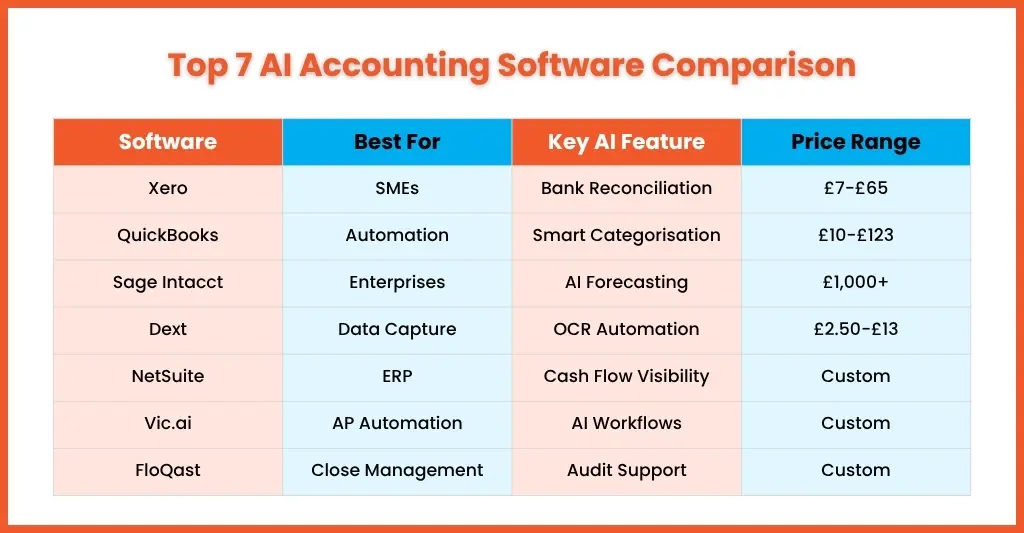
Best AI Accounting Software: Top 7 Tools Compared
1. Xero
Xero is a highly recognised and reputed accounting software which is used heavily by practices across the UK. This software is best for small and medium-sized business clients.
Key AI Features:
- Automated bank reconciliation
- AI-driven expense categorisation
- Invoice reminders
- Cash flow forecasting
Price Range: £7 to £65
2. QuickBooks Online Advanced
Through QuickBooks, you will not have to worry about books, payments, payroll, and Making Tax Digital. With AI in every plan, your clients are good to grow, making it ideal for practices and businesses that need automation.
Key AI Features:
- Smart categorisation
- Automated invoicing
- Expense tracking
- Predictive reporting
Price Range: £10 to £123 per month
3. Sage Intacct
Sage Intacct is an AI-powered finance software that delivers real-time insights through an intuitive, easy-to-use experience. It has cut manual work, sped up close, and delivers insights your finance team can act on, making it ideal for advanced financial reporting
Key AI Features:
- AI anomaly detection
- Advanced forecasting
- Automation workflows
- Multi-entity management
Price Range: £1,000 to £2,000 per month
4. Dext
Save time by automating data capture from receipts and invoices with 100% accuracy using Dext software. It integrates well with multiple accounting software and streamlines tasks that create roadblocks for your clients.
Key AI Features:
- OCR invoice capture
- Automated data extraction
- Supplier recognition
- Expense automation
Price Range: £2.50 to £13.00 per month
5. NetSuite
It is a cloud-accounting software that transforms for many practices’ general ledger, optimises AR, automates AP, and streamlines tax management.
Key AI Features:
- Streamline billing management
- Simplify financial planning processes
- Get the visibility and reporting to optimise cash flow
- Easily and quickly generate and send invoices
6. Vic.ai
Vic.ai is the truly AI-powered accounting platform that accounts payable automation and much more for accounting and audit teams.
Key AI Features:
- AI-powered workflows
- Assistants, workflows, and knowledge unified in one governed environment
- Explainable, traceable outputs
Price: Tailored as per specific requirements
7. FloQast
Leverage AI to automate accounting workflows, elevate preparers to reviewers, and reduce audit fees, all in one audit-ready FloQast platform.
Key AI Features:
- Workflow automation
- Reconciliation tracking
- Close management
- Audit support
Price Range: Tailored package available
The best AI accounting software isn’t always the most expensive. It’s the one that integrates effectively with your existing workflows.
Top 7 AI Accounting Software Comparison
| Software | Best For | Key AI Features | Price Range |
| Xero | Small & medium practices | Bank reconciliation, AI expense categorisation, invoice reminders, cash flow forecasting | £7 – £65/month |
| QuickBooks Online Advanced | Growing practices needing automation | Smart categorisation, automated invoicing, expense tracking, predictive reporting | £10 – £123/month |
| Sage Intacct | Advanced financial reporting & enterprise-level needs | AI anomaly detection, advanced forecasting, automation workflows, multi‑entity management | £1,000 – £2,000/month |
| Dext | Receipt & invoice data capture | OCR invoice capture, automated data extraction, supplier recognition, expense automation | £2.50 – £13/month |
| NetSuite | Cloud-based enterprise accounting | Streamlined billing, cash flow optimisation, financial planning insights, invoice automation | Custom pricing |
| Vic.ai | AP automation & AI‑powered workflows | AI assistants, unified workflows, explainable outputs, traceable results | Tailored pricing |
| FloQast | Close management & audit support | Workflow automation, reconciliation tracking, close management, audit support | Tailored pricing |
How to Choose AI Accounting Software for Your Practice
Are you confused when you see yourself surrounded by multiple AI accounting software UK programs? Reduce this confusion by avoiding focusing only on features; instead, focus on whether it meets your requirements.
Evaluate Your Biggest Operational Pain Points
Ask the following questions while selecting software:
- Where is the team losing time?
- Which processes create bottlenecks?
- Where do errors happen most frequently?
- Which tasks are repetitive?
This determines where AI delivers the highest ROI.
Prioritise Integration Capabilities
Your software should integrate smoothly with:
Select a software that can integrate smoothly with your:
- Best payroll software
- AP automation platforms
- CRM systems
Disconnected systems create inefficiencies.
Assess Ease of Use
Avoid selecting platforms that are very complex and difficult for your clients and accountants to understand.
Instead, choose a platform that:
- Simplify workflows
- Reduce training time
- Support collaboration
- Improve user experience
Consider Scalability
Prefer software that is future-ready and can support your clients’ future growth.
Identify tools that can handle:
- Increased transaction volumes
- Additional users
- Multiple clients
- Expanding services
Evaluate Security and Compliance
Give full attention to software’s that supports:
- GDPR compliance
- Encrypted data protection
- Audit trails
- Role-based access controls
Implementation Strategies for UK Accounting Practices
Your tasks do not end with selecting the best accounting software; it actually begins by ensuring its proper implementation. To ensure that you follow these steps:
Start Small
Start with automating one process at a time.
Examples include:
- Invoice capture
- Expense categorisation
- Reconciliation workflows
This will avoid overwhelming your teams with major system changes immediately.
Train Teams Properly
AI adoption will succeed only when your staff understand:
- How the software works
- Where automation helps
- When human oversight is still required
Training and familiarisation will improve confidence and adoption rates.
Standardise Processes Before Automation
The AI accounting software will work perfectly when workflows are consistent.
Therefore, standardise:
- Chart of accounts
- Invoice approval workflows
- Categorisation rules
- Reporting structures
Combine AI With Human Expertise
AI will never replace your accountants; instead, it will strengthen the quality of work.
The best-performing practices combine:
- Automation
- Outsourced support
- Internal expertise
- Advisory capabilities
This is where outsourcing providers like Equallto help practices scale operations while maintaining quality and compliance oversight even better than your in-house accounting team.
ROI Analysis: Is AI Accounting Software Worth It?
Most accounting practices would agree that investing in AI accounting software is worth it if it is implemented strategically.
Time Savings
AI significantly reduces manual work.
This allows your teams to:
- Handle more clients
- Improve turnaround times
- Focus on advisory work
Error Reduction
AI improves accuracy in:
- Data entry
- Categorisation
- Reconciliation
- Reporting
Fewer errors mean lower correction costs and time taken.
Improved Profitability
Automation while reducing operations costs on recruitment, it also increases your capacity in processing. Many practices have been able to achieve that without additional hiring.
Better Client Retention
Your clients value:
- Faster reporting
- Proactive communication
- Accurate financial data
- Digital accessibility
It increases their trust and develops a long-term working relationship.
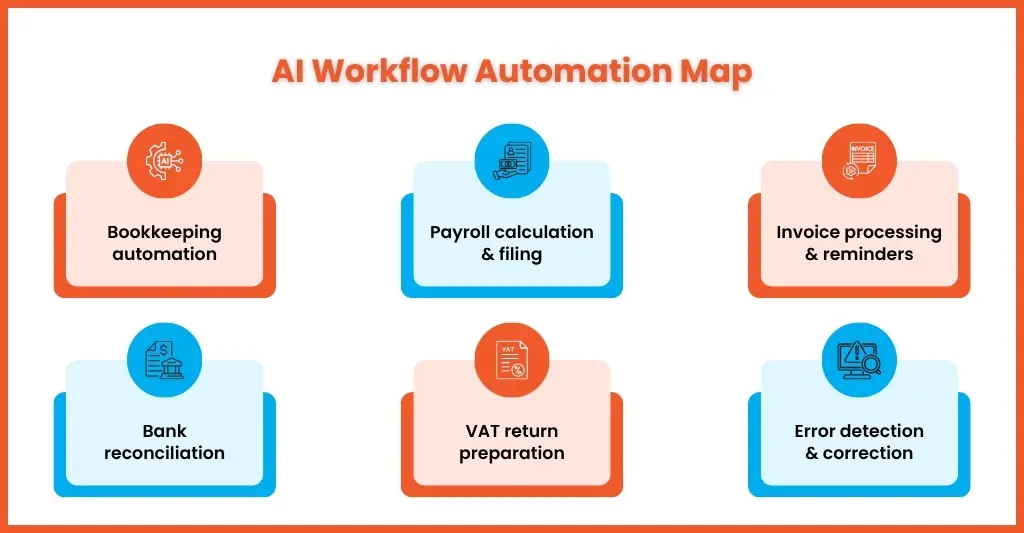
Future Trends in AI Accounting Technology
AI accounting software will be relevant even in the future of accounting because it keeps evolving.
Here’s what UK practices should expect next.
Predictive Financial Intelligence
AI systems will increasingly be able to forecast:
- Cash flow risks
- Tax liabilities
- Payment trends
- Financial anomalies
Conversational AI Reporting
Practices will soon be able to interact with financial systems using natural language queries.
Example: “Show me overdue client invoices over 60 days.”
Autonomous Workflows
AI accounting software will continuously reduce manual intervention across the accounting, including:
- Accounts payable
- Accounts receivable
- Bookkeeping
- Reconciliation
- Payroll
Enhanced Fraud Detection
Machine learning will further improve in identifying:
- Unusual transactions
- Duplicate invoices
- Suspicious payment activity
AI + Outsourcing Hybrid Models
More outsourcing providers will come up with outsourcing services that combine:
- AI automation
- Outsourced operational support
- Internal advisory teams
This creates scalable finance operations without excessive staffing costs.
FAQ: AI Accounting Software for UK Practices
What is AI accounting software?
AI accounting software uses artificial intelligence and automation to improve financial processes such as bookkeeping, invoicing, reconciliation, reporting, and forecasting. It reduces manual workload while improving efficiency and accuracy.
How much does AI accounting software cost?
Pricing varies depending on:
a.Features
b.Integrations
c.User numbers
d.Transaction volumes
Small business tools may start from £20–£100 per month, while enterprise AI accounting platforms can cost significantly more.
How accurate is AI accounting software?
Modern AI accounting systems are highly accurate when implemented correctly and supported by clean financial data.
However, human review remains important for:
a.Compliance oversight
b.Complex judgments
c.Exception handling
Conclusion
AI accounting software is no longer an exception; it has become a necessity for practices and businesses to stay relevant in today’s UK accounting and business environment.
The practices gaining the biggest advantages today are using AI to:
- Reduce manual workload
- Improve reporting accuracy
- Scale operations
- Strengthen compliance
- Deliver faster client service
But technology alone isn’t enough.
The real advantage comes from combining:
- Smart automation
- Structured workflows
- Experienced financial support
- Scalable operational processes
That’s why many UK practices now work with providers like Equallto, combining AI-enabled workflows with outsourced accounting expertise to grow efficiently without overloading internal teams.
Interested in getting support intelligently? Contact us and see the results for yourself.
