
Updating financial records manually is a thankless job and, in today’s fast-paced UK accounting environment, is outdated. No wonder why practices are adopting cloud bookkeeping to manage finances efficiently. What does it do? It allows you and your clients to access financial data from any secure online platform, no desktops, no paperwork or spreadsheets.
Let’s understand it through an example:
A small accounting practice was constantly juggling between spreadsheets and manually updating ledgers for multiple clients. In short, the scene was chaotic. But the practice switched to cloud bookkeeping; its clients got access to their accounts in real time, and remote collaboration was possible. The result was fewer errors, less stress, and more time for advisory work.
According to Xero’s comprehensive 2025 Accounting and Bookkeeping Industry Report, 87% of practices say that using cloud-based accounting software leads to increased client satisfaction. This makes cloud bookkeeping more than just a tech trend it’s a strategic tool for modern accounting firms.
What Is Cloud Bookkeeping?
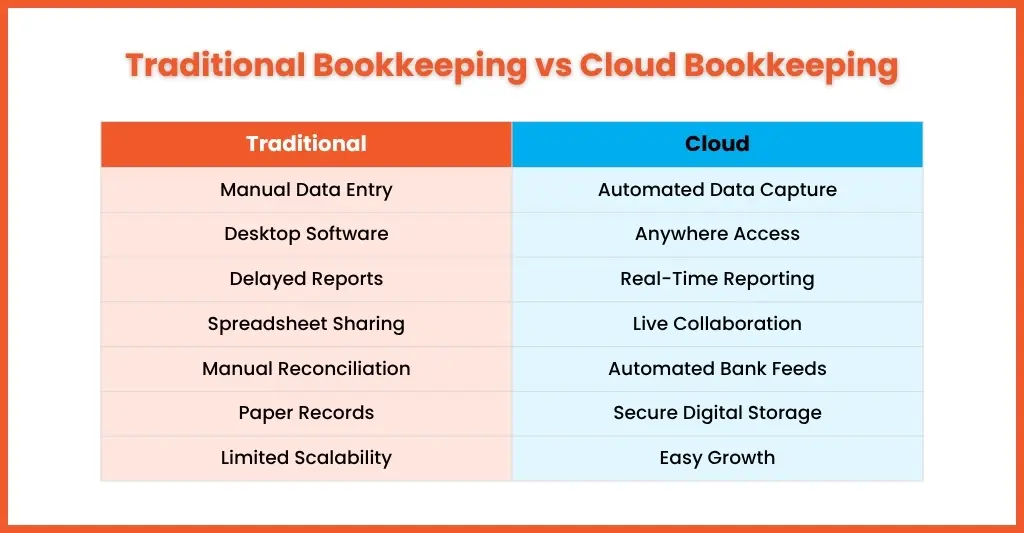
Cloud bookkeeping is a method of handling accounting records and financial transactions through online software that stores data on remote servers instead of desktops. Unlike traditional bookkeeping that involves manual entry of data and use of bookkeeping software installed on desktops, it allows:
- Real-time access to financial information
- Automated bank feeds and reconciliations
- Collaborative work between accountants and clients
- Secure storage of financial records
It is highly beneficial for small account practices because it simplifies reporting, minimises errors, and enhances teamwork across teams.
Cloud Bookkeeping Services for Accounting Practices
Cloud bookkeeping isn’t just software. It’s a bunch of professional services that are designed to help you manage the bookkeeping properly.
Typical services include:
Daily Transaction Processing
All financial transactions of your clients will be recorded accurately and consistently in real-time.
Bank Reconciliation
Under this service, all the bank feeds are automated so that reconciliations are done faster, and manual data entry is reduced to a bare minimum.
Accounts Payable and Receivable Management
In accounts payable and receivable management, invoices, supplier payments, and customer receipts are monitored and maintained in real-time.
VAT Returns and Compliance
Cloud bookkeeping software can modernise VAT reporting and compliance support with HMRC requirements.
Management Reporting
Through cloud-based bookkeeping software, you and your clients will get easy access to financial reports in real-time.
Month-End Bookkeeping Support
Cloud bookkeeping software will also ensure records are complete and ready for accounting and reporting purposes.
Key Benefits of Cloud Bookkeeping for Accountants
When compared with traditional bookkeeping, cloud bookkeeping comes on top for offering plenty of benefits. These benefits have made it even more popular among small accounting practices.
Let’s examine why so many UK accounting firms are making the transition.
Real-Time Access to Financial Information
The biggest advantage of cloud bookkeeping is getting real-time access to financial data. Instead of being at the mercy of your clients for getting access to their documents, your accountants can now get access to updated records anytime using cloud bookkeeping software.
This enables:
- Faster decision-making
- Better client support
- More accurate reporting
- Improved responsiveness
In the fast-paced UK business environment, such real-time access will bring a great competitive advantage.
Improved Productivity
Manual bookkeeping is infamous for the huge amount of time it takes. Cloud software automates many routine processes, including:
- Bank transaction imports
- Invoice generation
- Expense categorisation
- Data reconciliation
Cloud-based technology has helped practices improve their productivity by taking over repetitive tasks so that more time is spent on delivering value-adding services.
Better Collaboration Between Firms and Clients
Old bookkeeping involved exchanges between you and your clients of multiple spreadsheets, emails, and paper documents. Cloud bookkeeping software removes these inefficiencies.
Both you and your clients can access the same data at the same time.
This improves:
- Communication
- Transparency
- Accuracy
- Client satisfaction
Rather than waste time on information, your accountants can proactively support clients using live financial data.
Enhanced Security
Many clients object to cloud bookkeeping because they do not want to store their clients’ financial information online due to fear of theft.
To address this concern, many practices have started availing it through bookkeeping outsourcing services. Leading cloud bookkeeping outsourcing providers typically offer:
- Data encryption
- Multi-factor authentication
- Automated backups
- Secure hosting environments
Also, the latest versions of cloud bookkeeping software provide strong data security features
Supports Making Tax Digital (MTD)
Making Tax Digital on VAT and Income Tax has changed the way financial records are to be maintained. HMRC’s MTD initiative has pushed you to maintain digital records of your clients, and these records must be submitted to the HMRC electronically using MTD-compliant software.
Most cloud bookkeeping software is now MTD-compliant and plays an important role in maintaining MTD compliance.
Easier Scalability
Most small accounting practices are struggling with increased bookkeeping workloads from their existing clients. Cloud bookkeeping software makes scaling easier because processes are standardised, accessible, and less dependent on physical infrastructure.
Such flexibility is particularly valuable for growing practices.
Best Cloud Bookkeeping Software Comparison Table With Pricing
| Software | Approximate Starting Price (Excl. VAT) | Best For | MTD Compliant |
| Xero | £3.20 GBP per month | Accounting firms and growing SMEs | Yes |
| QuickBooks Online | £10 per month | Small and medium businesses | Yes |
| FreeAgent | £16.50 per month | Freelancers, contractors, small businesses | Yes |
| Sage Accounting | £3.00 per month | Established UK businesses | Yes |
How to Select the Right Cloud Bookkeeping Solution for Your Practice
You will find multiple cloud bookkeeping solutions flooding the UK market, but not all are the best. Careful consideration must be given while choosing the right platform.
Choosing the right platform requires careful consideration.
Consider Ease of Use
Select a software that can be easily understood and used by your accountants and your clients. Getting into a complex tool will complicate training schedules, give rise to mistakes and increase adoption resistance from your clients.
Review Integration Capabilities
The best cloud bookkeeping software is that which can integrate well with your:
- Payroll software
- CRM systems
- Expense management tools
- Payment platforms
- Practice management software
Integration reduces duplication and improves efficiency.
Evaluate Security Features
Data security cannot be compromised at any cost. Therefore, find a cloud-bookkeeping that offers:
- Multi-factor authentication
- Data encryption
- Access controls
- Regular backups
Assess Reporting Features
Look for strong reporting functionality in the software so that your accountants have better insights. These insights will help your accountants in guiding your clients or helping them make informed decisions.
Consider Support and Training
Getting this software is the easier part; implementing and training your staff and clients on it is the hard part, and many practices have faced problems in this. That’s why many practices are approaching bookkeeping outsourcing providers who use cloud-bookkeeping software and offer:
- Training resources
- Technical support
- Onboarding assistance
This helps maximise adoption and productivity.
Cloud Bookkeeping Trends UK Accountants Should Know in 2026
It will stay relevant for the foreseeable future, wondering why, because it keeps evolving rapidly.
Several trends are shaping the future of cloud bookkeeping. These trends are:
Increased Automation
Artificial intelligence and automation will play an ever-increasing role in reducing manual bookkeeping tasks.
Therefore, don’t be surprised if you find new cloud bookkeeping software featuring:
- Automated transaction categorisation
- Receipt scanning
- Predictive cash flow analysis
Greater Client Expectations
To stay competitive in the UK business environment, clients are increasingly expecting you to provide them with:
- Real-time reporting
- Instant access to financial information
- Faster response times
Cloud bookkeeping helps firms meet these expectations.
Growth of Remote and Hybrid Working
Remote working has become common among accounting practices, and cloud-based software has enabled that by supporting collaboration irrespective of the location of team members and clients. Using cloud bookkeeping software, team members and clients from any location can get access to records.
Stronger Focus on Advisory Services
With multiple bookkeeping tasks getting automated, small accounting practices are getting the chance to focus more on giving:
- Business advice
- Financial planning
- Strategic guidance
Cloud bookkeeping enables this shift by reducing administrative workloads.
Expansion of MTD Requirements
MTD has been implemented on VAT and Income Tax and will be implemented on others in future. This is influencing many small accounting practices to embrace cloud bookkeeping tools to be better prepared for future regulatory changes.
Outsourcing Cloud Bookkeeping: Hybrid Model for Accountants
Cloud bookkeeping has helped small accounting practices improve their efficiency, but they have still faced challenges. As bookkeeping volume grows, your client’s expectations will grow further, but recruitment of talent in the UK is not simple. So, how to manage this situation?
This is where outsourcing it can provide significant value.
Most outsourcing providers offer the hybrid model that combines:
- Cloud bookkeeping technology
- Internal accounting teams
- Outsourced bookkeeping specialists
This approach allows practices to leverage technology while accessing additional expertise and capacity.
Frequently Asked Questions for UK Accountants
What is cloud bookkeeping?
Cloud accounting software is accounting software delivered through the cloud, usually in a SaaS model. It gives finance teams real-time access to financial data from anywhere with the right permissions. Key benefits include accessibility, automation, collaboration, scalability, and easier maintenance.
How does cloud bookkeeping improve workflow for accounting practices?
Cloud bookkeeping provides real-time access to financial information, automates routine tasks, reduces manual data entry, and improves collaboration between accountants and clients. This leads to faster processing, improved efficiency, and better client service.
Is cloud bookkeeping MTD and HMRC compliant?
Most leading cloud bookkeeping platforms are designed to support HMRC’s Making Tax Digital requirements. However, accountants should always verify that their chosen software is recognised as MTD-compatible.
What are the benefits of outsourcing cloud bookkeeping?
Outsourcing cloud bookkeeping provides access to experienced professionals, increases capacity, reduces recruitment pressures, improves efficiency, and allows accounting firms to focus on higher-value advisory services and client growth.
What are the disadvantages of cloud accounting?
Cloud accounting presents several key drawbacks, most notably absolute reliance on an active internet connection, ongoing subscription costs, and potential data security vulnerabilities.
Conclusion
Cloud bookkeeping has completely changed the way practices manage financial information. With real-time access, automation, improved collaboration, and MTD support, it has helped firms deliver more value to their clients.
Adoption of cloud bookkeeping is no longer a technology adoption decision but a strategic one that keeps you relevant for the future of accounting.
But getting the technology is not enough; operating the software flawlessly is important to meet clients’ demands. Unfortunately, this is not happening; that’s why many practices prefer providers that have bookkeeping expertise and experience in using cloud bookkeeping software.
By partnering with Equallto, accounting practices can leverage the power of cloud bookkeeping while gaining access to experienced professionals who help improve efficiency, increase capacity, and support sustainable growth.
Want to be relevant in the future of bookkeeping? Contact us and be better positioned to compete, grow, and serve clients tomorrow.
