
AI in payroll is not a thing of the future; it has become an essential tool for practices to speed up payroll processing, improve compliance, reduce manual errors, and deliver value for their clients. While AI can do a lot of things like automating repetitive payroll tasks, it will work at its best when combined with an experienced payroll professional. That’s why small accounting practices find a blend of AI-powered technology and trusted payroll outsourcing the best strategy for them.
Let’s show you one example: a small accounting practice, and every month its team had to spend hours verifying timesheets, rectifying payroll errors, redressing queries, and ensuring HMRC submissions are accurate. Despite full efforts, payroll work is getting complicated and stressful.
To overcome this, the practice invested in AI-powered payroll tools and partnered with a payroll outsourcing provider to handle repetitive payroll tasks. Within months, its team experienced less time spent on error fixing and more time available for advising clients, turning them into strategic advisors.
It’s a story played across the board.
No wonder accounting practices of all sizes, especially small ones, are eagerly embracing AI in payroll for sustainable growth; it’s no longer optional. This guide explains how it works, how to use AI in payroll effectively, where its limitations lie, and why outsourcing remains a smart companion to AI.
What Is AI in Payroll?
AI in payroll means the use of artificial intelligence tools like machine learning (ML), natural language processing (NLP), and automation to improve payroll processing and administration.
Unlike traditional payroll software that follows predefined rules, AI-powered payroll systems can:
- Detect unusual payroll patterns before payroll is processed
- Identify possible compliance risks
- Predict payroll costs
- Categorise payroll information automatically
- Answer employee payroll queries through AI assistants
- Learn from previous payroll corrections
- Reduce repetitive manual data entry
Many practices have an unfounded fear that AI will replace accountants; to the contrary, it is supporting them by taking over high-volume repetitive work. This leaves complex payroll decisions, compliance requirements, and client communication to the accountants.
For UK accounting practices, artificial intelligence in payroll for accountants means less time spent on administrative work and more time delivering strategic advice.
How to Use AI in Payroll: A Step-by-Step Guide
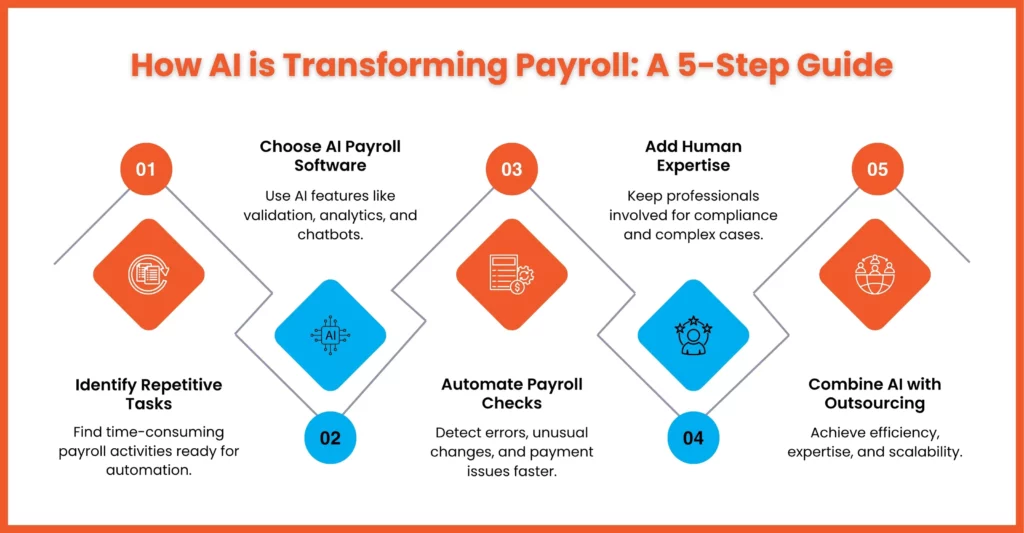
We have noticed many accounting practices are interested in AI but don’t know how to use it in a better way. Here’s how to get the maximum benefit out of it.
Identify Repetitive Payroll Processes
Start identifying payroll tasks that consume a lot of time.
Examples include:
- Data entry
- Payslip generation
- Employee onboarding
- Leave calculations
- Overtime calculations
- Payroll reporting
- Pension contribution checks
Such repetitive tasks are ideal candidates for AI automation.
Choose AI-enabled Payroll Software
The best payroll software is increasingly incorporating AI features to stay in the game. These features include:
- Automated anomaly detection
- Smart data validation
- Intelligent document processing
- Employee self-service chatbots
- Predictive payroll analytics
Look for solutions that integrate with accounting software already used by your practice.
Automate Payroll Validation
Validating payroll is a time-consuming task, and AI can achieve that in less time by comparing current payroll against previous periods and identifying unusual changes such as:
- Unexpected salary increases
- Duplicate payments
- Missing employees
- Unusual overtime
- Incorrect tax calculations
Instead of manually reviewing every payroll record, staff only investigate flagged exceptions.
Keep Humans Involved
AI does not operate in isolation; it works at its best when it is combined with experienced payroll professionals.
Experienced payroll professionals should always review:
- HMRC submissions
- Complex payroll scenarios
- Director payroll
- Statutory payments
- Pension changes
- Employee disputes
Experienced human oversight ensures compliance and protects client relationships.
Combine AI with Outsourcing
Many successful accounting practices use AI internally while outsourcing payroll operations to specialists.
This approach delivers:
- AI efficiency
- Payroll expertise
- Compliance confidence
- Scalability
- Reduced operational costs
Real Benefits of AI in Payroll for Accounting Practices
By incorporating AI in payroll, you are bound to get some real and hard benefits. Some of the important ones are:
Faster Payroll Processing
AI helps reduce the time spent on repetitive payroll tasks significantly. Rather than your team manually handling the addition of payroll data in every pay cycle, AI automatically handles the entering, validation, and processing of payroll data.
Improved Payroll Accuracy
Payroll errors will lead to penalties from HMRC and dissatisfied clients. Incorrect tax deductions, pension contributions, or salary calculations can lead to dissatisfied clients and HMRC penalties. AI helps in identifying these errors before payroll is submitted and reduces the risk of costly mistakes.
Better HMRC Compliance
Payroll compliance is becoming increasingly complex for humans to handle singlehandedly. AI will ensure that the payroll calculations are compliant with the current rules and regulations before submission. However, that requires support of professional judgement when it comes to interpreting HMRC regulations.
Increased Profitability
AI in payroll means a reduction in manual payroll work. This allows you to:
- Handle more payroll clients
- Reduce overtime
- Improve operational efficiency
- Offer higher-value advisory services
This improves both profitability and client satisfaction.
Better Employee Experience
Through AI, your client employees can now get immediate answers about their:
- Payslips
- Tax deductions
- Holiday pay
- Pension contributions
- Overtime
AI-powered payroll assistants can answer many routine questions instantly, reducing administrative burden on payroll teams.
Top AI-Enabled Payroll Tools for UK Accountants (2026)
Several payroll platforms are introducing AI-powered capabilities. These well-known platforms have understood the market requirements and incorporated AI features to stay relevant.
Some popular options include:
| Payroll Tool | AI Features | Price | Suitable For |
| BrightPay | Payroll automation, reporting | usage subscription model based on the number of active employees in the billing month. | Small accounting practices |
| Xero Payroll | Smart payroll integration | £16 to £65 per month | Firms using Xero |
| Sage Payroll | AI-assisted payroll processing | £12 to £34 per month | Growing practices |
| Employment Hero Payroll | Automation and HR integration | £4 to £7 per month (basic), plus additional charges for more services | SMEs |
Remember that software alone does not guarantee successful payroll management. Many firms still benefit from combining payroll software with outsourced payroll specialists who manage complex compliance requirements and client communication.
Risks and Limitations of AI in Payroll
AI in payroll offers multiple benefits but it has its share of limitations. These limitations are:
AI Relies on Accurate Data
AI works at its best only when it is supplied with accurate data. Incorrect payroll information will produce an inaccurate output. You need to supply high quality payroll data to get payroll accuracy.
Regulatory Changes
HMRC regulations keep changing and everyone from practices to tools must evolve with it that includes AI tools and systems. You will need to update AI systems at regular intervals so it stays compliant with the latest legislations.
Complex Payroll Scenarios
Certain payroll situations still require human judgement, including:
- Statutory payments
- Complex pension arrangements
- Employment status questions
- Payroll disputes
AI can only assist decision-making for accountants not replace it.
Cybersecurity
Payroll data includes employee’s sensitive financial details which makes it highly sensitive and lucrative for cyber criminals to get their hands on it. Data from Cyber Security Breaches Survey 2025/2026 shows it that over four in ten businesses (43%) and around three in ten charities (28%) reported having observed any kind of cyber security breach or attack in the last 12 months.
Therefore, you should ensure:
- Secure cloud infrastructure
- Multi-factor authentication
- UK GDPR compliance
- Role-based access controls
Protecting employee information remains a top priority.
AI in Payroll vs Payroll Outsourcing: Which Is Right for Your Practice?
You don’t have to choose between AI and outsourcing, this is the mistake made by many accounting practices. It must be understood that AI and outsourcing does not work against each but works better together.
| AI in Payroll | Payroll Outsourcing |
| Automates repetitive tasks | Provides experienced payroll professionals |
| Improves efficiency | Improves flexibility |
| Detects anomalies | Reviews exceptions |
| Speeds calculations | Ensures quality control |
| Supports reporting | Manages client communication |
| Assists compliance | Applies professional judgement |
The smart practices have combined both approaches.
- AI delivers automation.
- Outsourced payroll teams provide expertise.
And even smarter practices have partnered with outsourcing providers that use AI tools to deliver their services. Thus, creating a scalable payroll solution.
The Future of AI in Payroll for UK Accounting Practices
The future of accounting is increasingly influenced by AI, including payroll operations. Over the next few years, you must be prepared for:
More Intelligent Payroll Automation
Payroll automation will go beyond simple rule-based processing; AI-driven systems are increasingly able to flag anomalies, catch data entry errors before they reach a payslip, and handle routine variations (overtime, bonuses, statutory pay) with far less manual intervention.
Predictive Workforce Analytics
Firms will increasingly be able to forecast staffing costs, absence trends, and seasonal payroll fluctuations for clients, turning payroll data into a genuine advisory tool rather than just a compliance task.
Due to client’s demand, AI will be designed to be able to forecast staffing costs, absence trends, and seasonal payroll fluctuations, turning payroll data into a genuine advisory tool.
Automated Compliance Monitoring
As HMRC rules and thresholds continue to evolve, AI-powered systems will increasingly track legislative updates in real time, reducing the risk of firms relying on manual knowledge that’s gone slightly out of date.
Improved Payroll Forecasting
Clients will not be satisfied with just an accurate payslip they’ll want visibility into upcoming payroll costs, helping them plan cash flow with far greater accuracy than traditional monthly reporting allows.
Better Cloud Integrations
Payroll software will connect more seamlessly with accounting platforms, HR systems, and pension providers, cutting down on the manual re-entry of data that currently eats up so much processing time.
Real-time Payroll Reporting
Instead of waiting until month-end, both firms and clients will increasingly access live dashboards showing payroll status, costs, and compliance health as it happens.
Greater Use of AI Assistants
From answering routine client payroll queries to drafting compliance summaries, AI assistants will increasingly support (not replace) the humans doing the actual thinking.
However, one thing will not change.
Payroll will always require experienced professionals to interpret regulations, communicate with clients, and oversee quality.
Yes, AI will not replace your accountants but make them more productive
That’s why many firms are combining AI with outsourced payroll support to achieve the best of both worlds.
People Also Ask
How to use AI in payroll for a small accounting practice?
Start by automating repetitive payroll tasks such as calculations, timesheet validation, and reporting. Choose payroll software with AI capabilities, standardise your payroll processes, and maintain human oversight for compliance and quality assurance. Combining AI with outsourced payroll support can further increase efficiency without requiring additional recruitment.
Is AI for accountants reliable for HMRC compliance?
AI for accountants can improve payroll accuracy and identify potential compliance issues, but it should not replace professional judgement. HMRC regulations change regularly, so qualified payroll professionals should always review AI-generated outputs before making submissions.
Can AI in payroll reduce errors and penalties?
Yes. AI can reduce manual errors by validating payroll data, identifying anomalies, and automating repetitive calculations. When combined with experienced payroll professionals who review payroll before submission, AI helps minimise the risk of payroll errors, late filings, and potential HMRC penalties.
Will AI replace payroll professionals?
AI is not expected to replace payroll professionals, but rather to transform their roles. While artificial intelligence excels at automating repetitive, data-heavy tasks, human judgment remains essential for navigating complex tax compliance, resolving edge cases, and ensuring accuracy. AI is shifting the focus of payroll teams toward high-value and human judgement tasks client communication, resolving client queries, and advisory work.
Conclusion
AI is transforming payroll by supporting payroll professionals, not by replacing them. Due to AI, practices are now able to automate repetitive tasks, improve accuracy, and streamline workflows, allowing you to meet more client loads while maintaining high standards of quality and compliance.
However, technology will only do that much; you will still need human expertise for successful payroll management, especially when it comes to handling complex payroll situations, HMRC communication, and client queries.
That’s why many UK accounting practices are combining AI-powered payroll systems with outsourced payroll support from Equallto.
Our experienced payroll professionals work alongside your team, helping you process payroll efficiently, maintain compliance, and scale confidently without the cost and challenges of recruiting additional staff.
Whether you’re looking to modernise your payroll operation, improve turnaround times, or increase capacity during busy periods, Equallto provides the expertise and flexibility your practice needs.
Ready to future-proof your payroll?
Contact us today and take the next step towards a more efficient, scalable, and future-ready payroll operation.
