
Payroll management is the art of properly calculating employee pay, deductions, ensuring HMRC compliance, payment processing, and maintaining payment records. Through effective payroll management, you will be able to deliver reliable payroll services with a low risk of non-compliance with regulations and fully satisfy your clients.
But recently, managing payroll in-house for practices has become difficult. Let’s understand this through an example.
A small accounting practice was building a strong client base over several years. They started with bookkeeping and slowly expanded into payroll services. Things worked smoothly until more payroll clients came in and they found themselves bogged down with multiple pay frequencies, pensions schemes, statutory payments and HMRC reporting requirements. This increased their chances of making costly errors.
Hiring more accountants was out of the question due to limited funds. That’s why they invested in streamlining their payroll processes, getting modern payroll tools, and partnering with external payroll specialists to support growth. As a result, they increased capacity, reduced errors, and improved profitability, and it worked.
The UK Payslip Anxiety Report by Access PeopleHR shows that payroll errors and delays pushed 49.08% employees towards anxiety and reduced happiness.
This makes an effective payroll management for you not optional but essential.
What Is Payroll Management in an Accounting Practice?
Payroll management is a process of administering employee payments and ensuring that payroll compliance is met on time and accurately.
For accounting practices, this often includes:
- Processing employee wages
- Calculating PAYE and National Insurance
- Managing pension contributions
- Handling statutory payments
- Producing payslips
- Submitting RTI reports to HMRC
- Maintaining payroll records
- Responding to client payroll queries
In simple terms, payroll management ensures employees are paid correctly while businesses remain compliant with UK employment and tax regulations. For you, managing payroll across multiple clients, the process becomes significantly more complex, requiring robust systems and reliable workflows.
The 7-Step Payroll Management Process for UK Practices
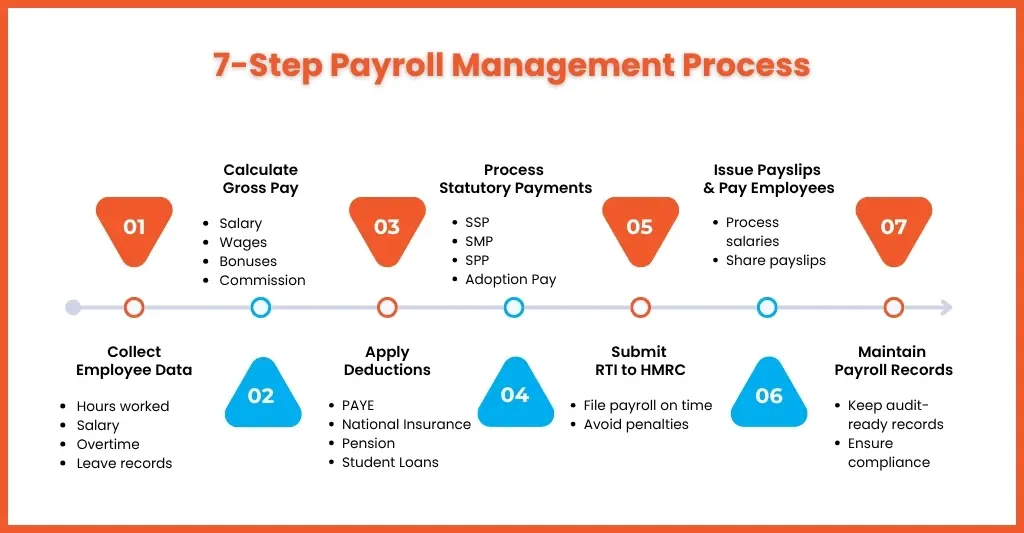
The success of your payroll management will depend on how much you invest in a structured process. Only then will you enjoy the maximum benefit.
Follow these 7 steps:
Step 1: Collect Employee Data
The payroll cycle begins with gathering accurate information, including:
- Working hours
- Salaries
- Overtime
- Bonuses
- Commissions
- Sick leave
- Holiday pay
Getting accurate data collection will reduce errors in the process.
Step 2: Calculate Gross Pay
Once the accurate data is collected, employee earnings must be calculated.
This includes:
- Basic salary
- Hourly wages
- Overtime payments
- Bonuses
- Commission earnings
Gross pay forms the basis for all subsequent payroll calculations.
Step 3: Apply Deductions
The next step involves deduction calculations like:
- PAYE income tax
- National Insurance contributions
- Student loan repayments
- Pension contributions
- Salary sacrifice arrangements
This step must be completed accurately to maintain compliance.
Step 4: Process Statutory Payments
Where applicable, payroll teams must manage:
- Statutory Sick Pay (SSP)
- Statutory Maternity Pay (SMP)
- Statutory Paternity Pay (SPP)
- Statutory Adoption Pay
These calculations require careful attention to HMRC rules.
Step 5: Submit Payroll Information to HMRC
On behalf of your clients, you will need to submit all the payroll information through RTI every time employees are paid. Missing out on the deadlines will lead to penalties and rupture of client trust.
Step 6: Issue Payslips and Make Payments
Ensure the employees get their payslips when their salaries are paid, which ensures transparency among employees.
Step 7: Maintain Payroll Records
All payroll records must be maintained in proper audit-ready order for the sake of compliance and inspection from HMRC, the pension regulator, and other regulators. Proper record-keeping also simplifies future reporting requirements.
Top Benefits of Running Payroll Well for Your Clients
Effective payroll management may look complicated, but it must be done so that efficiency is maintained. There are multiple benefits associated with running payroll well, some of the top ones are:
Improved Client Trust
Active payroll management will avoid the occurrence of payroll errors, which can damage the relations and trust of your client in your practice. By providing accurate payroll consistently, you will be building confidence and strengthening client retention.
Reduced Compliance Risk
Streamlined payroll processing will reduce the risk of:
- HMRC penalties
- Late submissions
- Incorrect deductions
- Pension compliance issues
Better Employee Experience
When your clients’ employees are paid accurately and on time, it makes them satisfied, boosts their retention, and makes your accounting practices more reliable among your clients and in the market.
Increased Practice Efficiency
When a structured payroll management process is in place, you will not have to worry about the payroll workload because it will be handled well without compromising on productivity.
Stronger Advisory Opportunities
When payroll operates efficiently, your payroll team will gain more time to focus on advisory services that generate higher margins.
Common Payroll Management Mistakes Small Firms Make
Unsurprisingly, even experienced accounting practices make mistakes while managing payroll. These mistakes are:
Relying on Manual Processes
Continuing the use of manual spreadsheets increases the risk of:
- Calculation errors
- Missed deadlines
- Duplicate entries
Focus on automation to reduce these risks significantly.
Failing to Keep Up with Legislation
UK payroll regulations keep changing each year, and many practices miss out on these and risk being non-compliant. Keep a close track of these updates by maintaining an updated checklist of compliances needed to be done.
Poor Data Management
Inaccurate employee records lead to payroll errors. To avoid such a situation, you will need to conduct regular reviews to help maintain data integrity.
Inadequate Process Documentation
When the payroll management process is not in place, you will depend more on your individual team members. This creates risk when they are absent or not available to do the job, hindering the process.
Delaying Payroll Reviews
Doing payroll checks at the last-minute creates more pressure to get the job done fast, increasing the chances of ignoring due process and reducing the quality of payroll work.
How to Choose The Right Payroll Tool For Your Practice
In order to choose the best payroll management software, you need to consider the following things during the selection process:
When evaluating payroll software, consider the following:
HMRC Recognition
Always select a payroll software that supports RTI submissions, updated as per the latest payroll regulations, thus keeping you compliant.
Automation Features
Look for tools offering:
- Automated calculations
- Payslip generation
- Pension integration
- Reporting functionality
Cloud Accessibility
Ideally, go for cloud-based payroll software so that you can support remote working, flexibility, and more collaboration between your team members and clients.
Integration Capabilities
The best payroll tools are those that integrate well with other tools and systems, further streamlining data sharing and avoiding hindrance in the payroll process.
User Experience
Select an among the best payroll software that is simple to understand, easy to train on, and use for your payroll team and your clients.
Popular Payroll Management Tools for UK Practices
| Payroll Tool | Best For | Key Strengths |
| BrightPay | Accountants and SMEs | User-friendly, auto-enrolment support |
| Sage Payroll | Established firms | Comprehensive reporting |
| Xero Payroll | Cloud-focused practices | Strong integration capabilities |
| QuickBooks Payroll | Small businesses | Automation and simplicity |
| IRIS Payroll | Larger practices | Advanced payroll functionality |
| Moneysoft Payroll Manager | Small firms | Affordable and reliable |
In-House vs Hiring vs Outsourcing — What’s Right for Your Practice?
There is always comparison made between in-house payroll vs outsourcing to find out, which one will be the best for your practices. We have created a table that shows the advantages to get and challenges.
| Option | Advantages | Challenges |
| In-House Management | Full control | Limited scalability |
| Hiring Additional Staff | More internal capacity | Recruitment and salary costs |
| Outsourcing Payroll | Scalability and expertise | Requires selecting the right partner |
Many small practices have tried hiring accountants to handle extra payroll workload. However, recruitment costs, training requirements, and ongoing payroll expertise can become expensive.
This is why many have increasingly explored outsourced payroll services. Partners such as Equallto offering pay-as-you-go accounting services help practices manage growing payroll volumes without significantly increasing overhead costs. By acting as an extension of the practice, outsourced payroll teams provide additional capacity while allowing firms to retain client relationships and service control.
UK Payroll Compliance Essentials for Accounting Firms
Without payroll compliance, payroll management is incomplete. Therefore, pay greater attention towards it.
Some of those key areas are:
- Real Time Information (RTI): All payroll data must be submitted to the HMRC at each pay period.
- PAYE Obligations: Accurate tax calculations and deductions must be made so that employees are not under- or overtaxed.
- National Insurance Contributions: NICs of employee and employer contributions must be processed accurately.
- Auto-Enrolment Pensions: Ensure your client employers comply with pension enrolment requirements as decided by the pension regulator.
- National Minimum Wage Compliance: Your payroll teams must ensure employees receive at least the legal minimum entitlement.
- GDPR and Data Security: All payroll data contains highly sensitive information and must be handled securely through data encryption, secured data storage, and access control to it.
Failure to meet compliance requirements can result in penalties and reputational damage.
The Future of Payroll Management for Small Practices
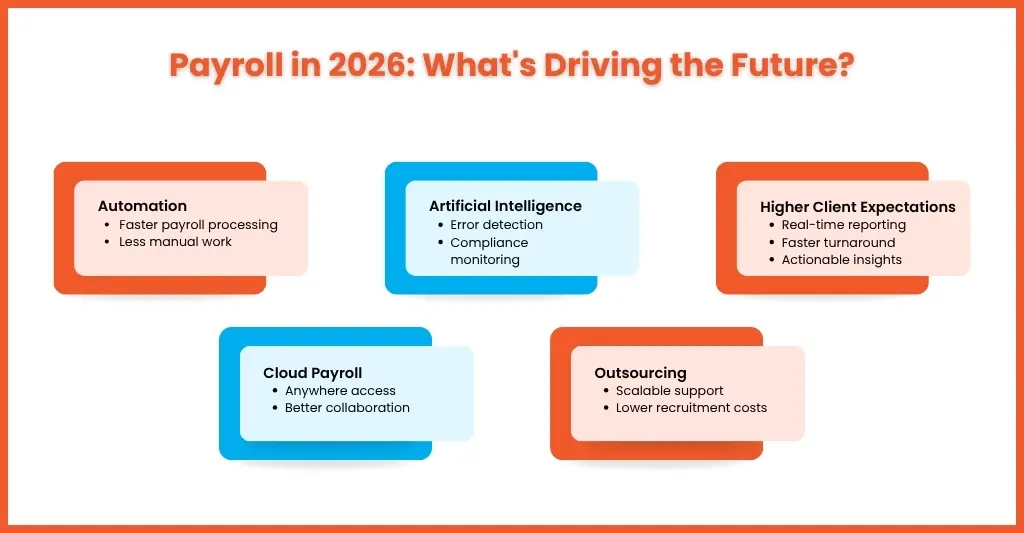
Payment management is getting influenced by multiple factors every day, and each of them is forcing it to keep evolving.
These factors are:
Increased Automation
Accounting practices are increasingly depending on payroll software for automating repetitive tasks and reducing manual workload, thus speeding up the process while maintaining accuracy.
Artificial Intelligence
AI tools or AI-enabled payroll software will increasingly become necessary for:
- Error detection
- Data validation
- Compliance monitoring
Greater Client Expectations
Thanks to the competitive UK accounting and business environment, clients will increasingly expect:
- Real-time reporting
- Faster turnaround times
- Enhanced payroll insights
To stay competitive.
Cloud-Based Payroll
For greater collaboration and sharing of information between payroll teams and clients, practices are increasingly choosing cloud-payroll software.
Outsourced Payroll Growth
Many accounting practices are adopting hybrid models that combine technology with outsourced expertise. This approach provides scalability while maintaining service quality.
For practices looking to expand without increasing recruitment costs, outsourcing is likely to remain a key growth strategy throughout 2026 and beyond.
Frequently Asked Questions
What is payroll management in simple terms?
Payroll management is the administrative process of compensating employees. It involves tracking hours, calculating wages, withholding taxes and deductions, and issuing accurate, on-time payments.
Can you recommend reliable payroll management tools?
Popular payroll tools used by UK accounting firms include BrightPay, Sage Payroll, Xero Payroll, QuickBooks Payroll, Moneysoft Payroll Manager, and IRIS Payroll. The best option depends on your firm’s size and requirements.
How much does payroll outsourcing cost in the UK?
Payroll outsourcing typically costs between £3 and £15 per employee per month, depending on service complexity, support requirements, and payroll volume.
Will payroll be replaced by AI?
AI will not fully replace payroll professionals, but it is transforming the role. Routine, repetitive, and data-heavy tasks are being automated, allowing payroll teams to shift from manual administration to oversight, compliance, and strategic business operations.
Which payroll software is Recognised by HMRC?
HMRC-recognised payroll software calculates statutory pay, records deductions, and automatically submits PAYE information online. Top choices for UK businesses include Xero, BrightPay, Sage, and Moneysoft.
Closing Thoughts on Payroll Management
Payroll management is increasingly playing a critical role in compliance, client satisfaction, operational efficiency, and growth. However, for small accounting practices like yours, the challenge is balancing growing payroll workloads with limited internal resources.
That’s why partnering with providers like Equallto makes sense.
By combining payroll expertise, scalable delivery support, and efficient workflows, Equallto can help you expand capacity without the cost and complexity of building larger internal payroll teams.
That’s the advantage Equallto delivers. Book a free consultation with Equallto today through our contact form and discover how outsourced payroll support can help your practice increase capacity, improve profitability, and confidently scale throughout 2026 and beyond.
