
Come April 2026, MTD will be expanded to Income Tax for individuals earning over £50,000, meaning more deadlines to comply with. Making Tax Digital deadlines are literally shaping how accounting practices manage compliance; missing out on even one deadline will have serious consequences.
Let us simplify for you.
A business enterprise in the UK was earning £65,000 a year, but they had time before the new MTD rules became applicable. Their accountants knew about the quarterly updates, but between client work and daily operations, it got pushed away.
After a few months, they got back-to-back reminders from HMRC, setting them in confusion.
- When do I need to submit quarterly updates?
- Do I need new software?
- What is the deadline for Making Tax Digital?
By the time they tried to act, it was too late.
Since April 2022, MTD has become applicable to all VAT-registered businesses, regardless of their turnover and with Income Tax too under its ambit, meaning more deadlines and more compliance workload.
This leads to one conclusion: MTD deadlines cannot be taken for granted. In this guide, we’ll break down every key MTD deadline for 2026, explain what they mean, and show how practices can stay ahead without last-minute stress.
What is the Deadline for Making Tax Digital for Income Tax?
Since the start of 2026, your clients must have been hammering you with one question multiple times.
“What is the deadline for Making Tax Digital on Income Tax?“
Here is the answer you must give them:
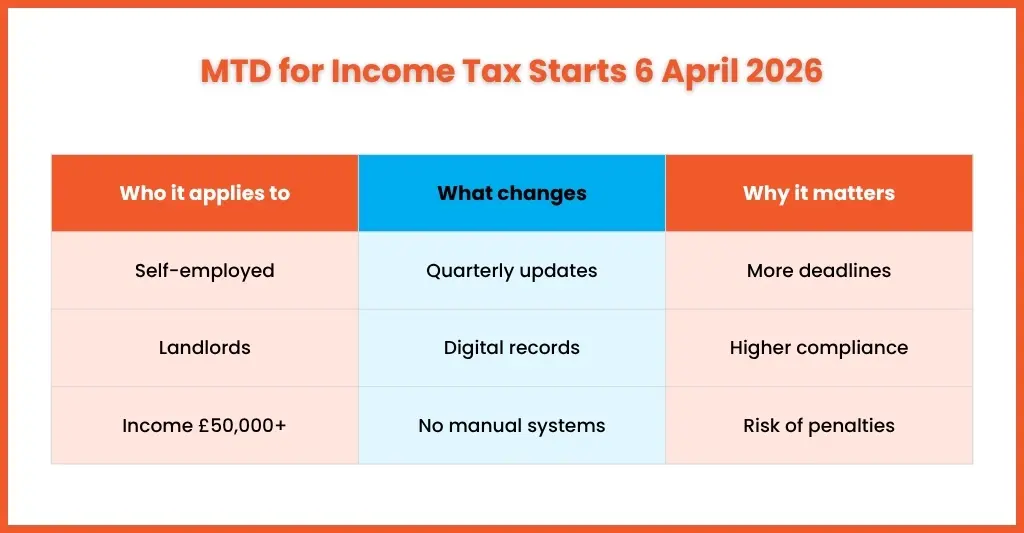
- 6 April 2026: MTD for Income Tax becomes mandatory for individuals earning over £50,000
MTD for Income Tax: Full Deadline Timeline by Income Threshold
Knowing about the timelines associated with MTD for Income Tax is important for you to plan for client onboarding and software transitions.
Here are the deadlines to keep in mind:
From April 2026
- MTD for Income Tax will apply on self-employed individuals and landlords
- Income threshold: £50,000+ annually
- Also, mandatory digital record-keeping and quarterly updates
From April 2027 (Approx)
- MTD will be applicable to those earning £30,000+ annually
Future Expansion (Expected)
- HMRC will further expand the MTD to lower income brackets
According to HMRC policy papers, MTD for Income Tax will eventually impact millions of taxpayers, making it important for you to prepare early and make your clients MTD-compliant.
Understanding the MTD Quarterly Update Deadlines
Quarterly submissions will now be a part and parcel of your life due to MTD for income tax.
Here are the standard quarterly deadlines:
| Quarter | Period Covered | Submission Deadline |
| Q1 | 6 April – 5 July | 7 August |
| Q2 | 6 July – 5 October | 7 November |
| Q3 | 6 October – 5 January | 7 February |
| Q4 | 6 January – 5 April | 7 May |
Who Does Making Tax Digital Apply To?
Making Tax Digital was started with VAT and became applicable to VAT-registered businesses in April 2019, and since then, there is no turning back.
MTD is now applicable to:
- All businesses registered for VAT
- Sole traders and landlords for income tax (over £50,000)
MTD does not currently apply to:
- Individuals earning below the £50,000 threshold
- Some digitally exempt taxpayers
MTD for VAT – Deadlines That Already Apply
Making Tax Digital has been fully implemented on VAT, and all VAT returns must be submitted only through an MTD-compatible software.
The VAT submission deadlines are on a quarterly basis:
- 1 January – 31 March 2026 Quarter: Return and payment due 7 May 2026.
- 1 April – 30 June 2026 Quarter: Return and payment due 7 August 2026.
- 1 July – 30 September 2026 Quarter: Return and payment due 7 November 2026.
- 1 October – 31 December 2026 Quarter: Return and payment due 7 February 2027.
Based on the successful implementation of MTD for VAT, HMRC is now aiming for a similar success in implementing it for Income Tax.
What Happens If You Miss an MTD Deadline?
The new penalties under the MTD for Income Tax will be applicable if you miss the deadlines for sending quarterly updates, submitting tax returns, or making payments. The new penalties will be based on the points.
The penalty point threshold is 4 points. If you reach this, you’ll get a:
- £200 penalty
- £200 penalty each time you miss another submission deadline
The new late payment penalties are more proportionate to how long it takes your client to pay what they owe. Late payment penalties apply to payments not paid in full by the relevant due date. This includes:
- A balancing payment for an outstanding amount on the tax bill
- Amounts due following an amendment or assessment on the tax return
In the first year of new penalties, your client will have 30 days from the payment due date to either:
- Make a full payment
- Contact HMRC to set up a payment plan
After 30 days, we’ll start to apply penalties.
How to Sign Up and Get Ready for MTD Before the Deadline
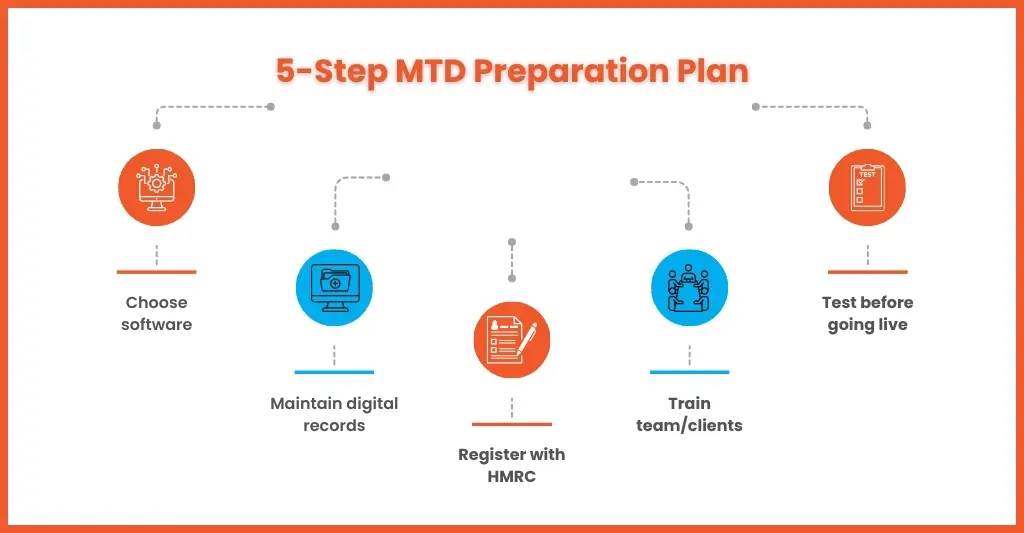
Preparing early for MTD will help you in a smooth transition and save your practice from last-minute chaos. Many practices that are already handling MTD for VAT are confident with regard to the MTD expansion on income tax, but they underestimate the amount of work that goes into MTD readiness.
Here’s a detailed, practical breakdown to help you and your clients get fully prepared.
Step 1: Choose MTD-Compatible Software
The UK market is filled with MTD-compliant accounting software, since MTD became applicable on VAT but not all are the best. Hence, it is important to choose the right one that will simplify your work.
Popular options include:
- Xero: Best for growing businesses and integrations
- QuickBooks: Strong for SMEs and reporting
- FreeAgent: Ideal for freelancers and small businesses
But before choosing, ask the following:
- Does the software integrate with your current systems (bank feeds, POS, eCommerce)?
- Can it handle multiple clients efficiently?
- Does it support real-time reporting?
- Is it easy for your clients to use?
Step 2: Maintain Digital Records
One of the major motives of HMRC to start the Making Tax Digital initiative is to eliminate manual record-keeping completely.
This means:
- No spreadsheets without bridging tools
- No paper-based receipts
- No last-minute data entry before deadlines
Your clients must maintain:
- Digital income records
- Digital expense tracking
- Real-time transaction updates
You can assist your clients in that by:
- Setting weekly or monthly bookkeeping routines
- Use tools like Dext/Hubdoc for receipt capture
- Automate bank feeds
The goal is to make bookkeeping continuous, not reactive.
Step 3: Sign Up for MTD with HMRC
Make your clients aware that they will not automatically get enrolled on the MTD initiative.
You will have to guide your clients to first:
- Register through HMRC’s MTD portal
- Link their software to HMRC
- Wait for confirmation
Avoid enrolling your clients too close to a VAT submission deadline and ensure all previous returns are up to date before registering.
Step 4: Train Your Team or Clients
The real change will come when you train your accounting team on MTD, and this is where most MTD transitions fail. Even with the best software, your accountants might get confused and cause errors.
Make sure your team and clients understand:
- Quarterly submission deadlines
- How to categorise transactions correctly
- How to review data before submission
- What triggers penalties
Therefore, focus on:
- Creating simple SOPs (Standard Operating Procedures)
- Provide short training sessions to your accountants
- Use checklists for every submission cycle
Give your clients:
- Simple instructions
- Focus on what they need to do weekly/monthly
Step 5: Test Before Going Live to Avoid Costly Mistakes
Before submitting the data to the HMRC, test the MTD setup.
This includes:
- Checking software-HMRC integration
- Reviewing sample submissions
- Validating transaction categories
- Ensuring VAT calculations are accurate
Errors during live submission can lead to:
- Rejected returns
- Incorrect tax filings
- Compliance penalties
Therefore, it is in the best interest of your practice to conduct:
- Dummy submission or test period
- Double-check reports before final submission
- Have a senior review process in place
We understand that, like other small accounting practices, you are very much overloaded with multiple accounting tasks and compliance. Handling more compliance and deadlines associated with MTD for Income Tax is an added burden for you.
To reduce that burden, many of your competitors have started offloading this responsibility to a credible outsourcing accounting service provider offering bookkeeping outsourcing services, just like Equallto.
How Equallto Helps Accountants and Clients Meet MTD Deadlines
As we mentioned, handling MTD for Income Tax deadlines will become overwhelming, especially for your small accounting practice. That’s why it’s time for you to work smarter by choosing professional outsourcing providers like Equallto as your outsourcing partner.
We help accounting practices:
- Manage client bookkeeping in real time
- Ensure MTD-compliant digital records
- Handle quarterly submissions efficiently
- Reduce last-minute workload pressure
- Scale without increasing internal costs
Our team works as an extension of your practice, ensuring your clients stay compliant without overwhelming your team. We will ensure that instead of you chasing the deadlines, you are ahead of them.
People Also Ask
What are the MTD for Income Tax quarterly submission deadlines?
Quarterly updates are due on:
a. 7 August
b. 7 November
c. 7 February
d. 7 May
Can I get an exemption from Making Tax Digital deadlines?
Yes, exemptions may apply if:
a. Digital access is not feasible
b. Age, disability, or location limits compliance
However, HMRC approval is required.
What is the penalty for missing an MTD quarterly update deadline?
Under HMRC’s points-based system:
a. Each missed deadline adds a point
b. Reaching the threshold results in a £200 fine
c. Additional penalties apply for repeated failures
How will MTD for Income Tax work?
Making Tax Digital (MTD) for Income Tax replaces annual paper tax returns with mandatory digital record-keeping and quarterly updates using MTD-compatible software. Starting April 2026, self-employed individuals and landlords with incomes over £50,000 must send digital summaries to HMRC every three months.
Who will be exempt from MTD?
Your clients will get automatic exemption from Making Tax Digital for Income Tax if their qualifying income is £20,000 or less.
Conclusion
Making Tax Digital Deadlines for Income Tax are not just simple deadlines to follow; they represent a major shift in how UK tax compliance works. For you, it represents both a risk and an opportunity.
The key is preparation by adopting the right systems, processes, and support early. Doing that will allow you:
- Reduce compliance stress
- Improve client service
- Scale efficiently
With MTD for Income Tax launching in April 2026, now is the time to act, and with the right partner like Equallto, staying compliant becomes simple, structured, and stress-free. Want to experience a smooth MTD transition? Use our contact form and stay ahead of others in MTD Income Tax compliance.