
A VAT Return is a quarterly report that VAT-registered UK businesses submit to HMRC, showing VAT charged on sales (output tax) and VAT paid on purchases (input tax). It must be filed digitally through MTD-compliant software, and the business pays HMRC the difference — or claims a refund if input tax is higher.
If there is any one compliance task that has the capability to spook even the most experienced small accounting practice in the UK, then VAT Return can claim to be one. At every quarter, it brings familiar but formidable challenges: incomplete records, last-minute client queries, software issues, and pressure of getting things right.
To top it all, HMRC will not be lenient when it comes to enforcement and with over 2 million VAT-registered businesses in the UK, comes the volume, leaving you with less room for correcting any error.
To streamline the process, we have prepared this guide, which will cut the clutter associated with VAT returns. We will guide you through what a VAT Return is, how to do a VAT Return properly, and how practices can avoid common pitfalls, without turning VAT into a time drain.
Key Takeaways
- HMRC’s Annual UK VAT Statistics show a VAT trader population of 2,178,950 in 2023–24, generating £168 billion in total VAT receipts.
- Separately, ONS recorded 2.73 million VAT and/or PAYE-registered businesses in the UK as of March 2025.
- Businesses must register for VAT once taxable turnover passes £90,000 in any rolling 12-month period.
- Since 1 January 2023, late VAT submissions earn penalty points rather than an automatic fine — a £200 penalty only applies once the points threshold is reached.
- Submitting a VAT Return late — even a nil return — still earns a penalty point; submission and payment are two separate obligations.
Outsourcing VAT return preparation to a specialist partner like equallto reduces reliance on manual follow-ups and last-minute client chasing, especially in busy quarters.
What Is a VAT Return?
A VAT Return is the quarterly report every VAT-registered UK business must submit to HMRC, showing the VAT charged on sales and the VAT paid on purchases, with the difference paid to or reclaimed from HMRC.
VAT returns are reports that every VAT-registered business has to send to HMRC every quarter. It contains details of the VAT they have charged on the sales and the VAT they have paid on the purchases.
The business has to pay the difference between the VAT on sales (output VAT) and the VAT on purchases (input VAT). If the output VAT exceeds the input VAT, the business will be liable for paying to the HMRC.
Under MTD for VAT rules, VAT returns are required to be submitted digitally using MTD-compliant accounting software. Due to the complex nature, businesses have handed over the responsibility of handling VAT returns to professional and experienced accounting practices. To know more, check out our guide on MTD for VAT.
How to Do a VAT Return (Step-by-Step)
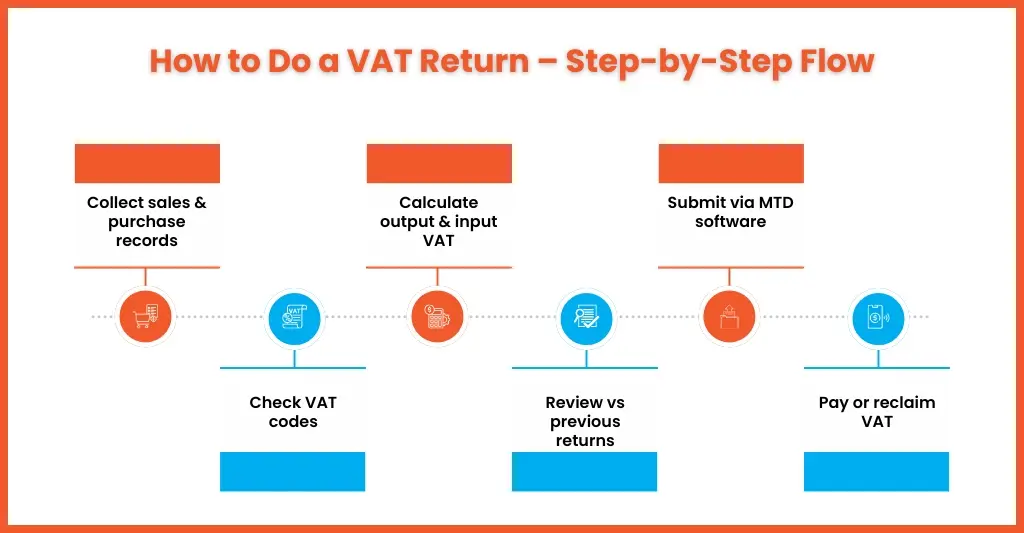
Doing a VAT Return correctly means six steps in sequence: gathering accurate records, checking VAT codes, calculating output and input VAT, reviewing figures before submission, filing via MTD-compliant software, then confirming payment or refund.
Preparing a VAT Return accurately and smoothly demands more than just pressing a submit button. You will need to have a set of steps that you follow to quicken your VAT Return process. Let’s go through those steps:
Step 1: Gather Accurate Financial Records
Connect with your clients and collect all the sales and purchase data for the quarterly VAT period, and get it verified. Missing invoices or unreconciled transactions are one of the biggest causes of errors.
Step 2: Check VAT Codes Carefully
Mistakes in VAT coding leads to overpayments, underpayments, and HMRC queries. This mistake is common with mixed-rate supplies or partially exempt clients.
Step 3: Calculate Output and Input VAT
Once you have collected all the data and verified its accuracy, the output and input VAT must be calculated.
- Output VAT: VAT charged to customers
- Input VAT: VAT reclaimable on allowable expenses
Step 4: Review Before Submission
Review the figures you have arrived at with your clients’ previous VAT Returns. Any large fluctuations will generate interest from HMRC, and you must ask about it from your clients so that you can explain it to HMRC on their behalf.
Step 5: Submit the VAT Return via MTD Software
As mandated by MTD rules for VAT, all VAT Returns must be submitted digitally to HMRC using an MTD-compliant accounting software.
Step 6: Confirm VAT Payment or Refund
Submission of the VAT return is half the job done. Ensure the VAT amount is paid or refunded correctly and on time.
Components of a VAT Return
The core components of a VAT Return are total sales, total purchases, output tax (VAT due on sales), input tax (VAT reclaimable on purchases), and net VAT — the figure that determines what’s owed to, or reclaimable from, HMRC.
A VAT return contains some key components, and understanding them is essential for accurate and compliant reporting. These components are:
- Total sales
- Total purchases
- VAT due on sales (Output tax)
- VAT reclaimable on purchases (Input tax)
- Net VAT payable or refundable
Among them, let’s focus on the important ones:
- Output tax: Adds up all the VAT charged on the sales made.
- Input tax: Adds up all the VAT paid on the purchases made.
- Net VAT due: That’s what you get when you subtract total input tax from total output tax. When your output tax is more than your input tax, your clients owe the difference to the HMRC. If it’s vice versa, then your clients can claim it from the HMRC.
Types of VAT Returns and Schemes
UK VAT return schemes fall into three main types: the Flat Rate Scheme (a fixed percentage of turnover, for businesses under £150,000), and — for businesses under £1.35 million — the Annual Accounting Scheme and Cash Accounting Scheme, each changing how often you file or when VAT becomes due.
Some of the typical UK VAT Return schemes are:
| Scheme | Eligibility | What It Changes |
| VAT Flat Rate Scheme | Annual taxable turnover of £150,000 or less (excl. VAT) | Pay a fixed % of gross turnover instead of calculating output/input VAT individually |
| VAT Annual Accounting Scheme | Annual taxable turnover of £1.35 million or less | File one VAT Return a year instead of four |
| VAT Cash Accounting Scheme | Annual taxable turnover of £1.35 million or less | Pay VAT when your customer pays you, not when you invoice them |
VAT Return Example
Here’s what a straightforward VAT calculation looks like in practice, using output tax minus input tax to reach the net amount owed.
Making it simple through an example:
- Sales: £10,000 (20% VAT)
- Purchases: £4,000 (20% VAT)
Output Tax Calculation
- Total sales: £10,000
- Output tax: £10,000 * 0.20 = £2,000
Input Tax Calculation
- Total purchases: £4,000
- Output tax: £4,000 * 0.20 = £800
Net VAT Calculation
- Output tax: £2,000
- Input tax: £800
- Net VAT: £2,000-800 = £1,200
Your client owes HMRC £1,200
Who needs to submit a VAT Return?
Any VAT-registered UK business must submit a VAT Return every period, including nil returns and voluntarily registered businesses — registration itself becomes compulsory once taxable turnover passes £90,000 in any rolling 12-month period.
Making an MTD-compliant VAT return is compulsory for all businesses in the UK if they fulfil the following points.
- VAT-registered businesses
- Businesses whose taxable turnover goes over £90,000 in a 12-month rolling period
- Businesses with zero activity during the period
- Businesses registered voluntarily
Failing to submit even a nil VAT Return will be taken by HMRC as non-compliance.
Common VAT Return Mistakes to Avoid
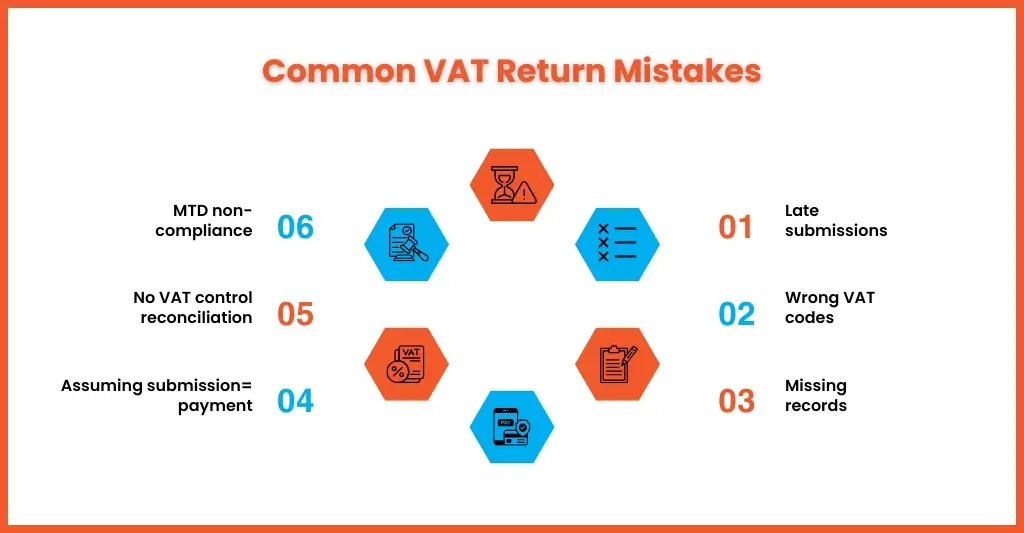
The most common VAT Return mistakes are late submissions from missing records, incorrect VAT coding, assuming submission means payment is complete, skipping VAT control account reconciliation, and missing MTD compliance requirements — each avoidable with the right process.
For an experienced small accounting practice, handling VAT returns should not be a problem, from a technical knowledge point of view. The problem starts due to timing issues and gaps in the processes. These same issues keep coming up quarter after quarter.
Let’s understand those common VAT Return mistakes and why they matter.
Submitting Late Due to Missing Information
One of the primary reasons for late VAT returns is the result of incomplete records.
Common causes include:
- Clients submitting invoices late
- Missing expense receipts
- Unreconciled bank transactions
- Delay from the client’s end to answer your queries
Often, we have noticed the clients send the requested information or answers close to the deadline, leading to rushed verification and increasing the chances of errors. Therefore, encourage your clients to provide information at the earliest, so that proper review can be done without resorting to rushing it.
Incorrect VAT Coding
Another mistake that keeps coming up is the errors made in VAT coding.
These often arise from:
- Zero-rated vs exempt confusion
- Incorrect treatment of mixed-rate supplies
- Wrong VAT treatment on imports or reverse charge transactions
Manual Coding By Clients Without VAT Knowledge
Errors in VAT coding will lead to over- or underpayment of VAT, triggering HMRC scrutiny. Such errors can reduce your clients’ trust in your practice. To avoid such mistakes, conduct regular reviews and clear coding rules before submission. Focus on automating through MTD-compliant accounting software, which is the future of accounting.
Assuming Submission Means Payment Is Complete
We have increasingly noticed clients considering that VAT return submission to payment will be sorted automatically, which is incorrect. Submission of the VAT Return must be regarded as half a job done.
It must be noted that:
- Submission and payment are separate actions
- Direct Debits require advance setup
- Manual payments can get delayed or missed
Such assumptions by clients lead to delayed VAT payments, even when VAT returns have been filed. For your practice, it means more follow-ups, client explanations, and potential penalties. Therefore, clear the confusion with your clients from the start to avoid this scenario.
Not Reconciling VAT Control Accounts
Skipping VAT control account reconciliation is a hidden but serious risk.
Without reconciliation:
- Differences between accounting records and HMRC figures go unnoticed
- Errors compound over multiple VAT periods
- Refunds or liabilities may be misstated
With time, it contributes towards confusing adjustments and challenging conversations with your clients. Hence, conduct regular VAT control reviews to ensure every VAT return aligns with the accounting records, thus reducing corrections in future.
Missing Making Tax Digital (MTD) Compliance Requirements
Compliance with MTD for VAT rules is compulsory, but it has still become a stumbling block for many.
Mistakes include:
- Using non-MTD-compatible software for submissions
- Doing manual data entry where digital records are required
Non-compliance with MTD rules will lead to HMRC rejections or penalties, even if the VAT return figures are correct. Therefore, compliance is met.
Best Practices and Tools for Easier VAT Returns
The best practices for easier VAT Returns are filing early rather than on the deadline, using submission checklists, separating the ‘filing’ and ‘payment’ conversations with clients, and reviewing VAT data monthly instead of quarterly.
The best way to handle VAT returns is to treat them like a process and not a task which comes every quarter in a year.
Some of the best practices to follow while filing VAT returns are:
- Filing VAT Returns early and not close to or on the deadline day
- Using checklists for submission and payment
- Creating awareness among your clients that filing is not payment
- Reviewing VAT data monthly, not quarterly
Equallto’s VAT team works exclusively with UK accounting practices, filing VAT returns through MTD-compliant software so practices avoid the quarterly scramble.
Start using VAT outsourcing services to handle your clients’ VAT returns through experienced accountants using MTD-compliant software. Compared with in-house accounting, outsourcing will reduce your reliance on memory and manual follow-ups, especially during busy periods.
People Also Ask
What is the minimum turnover to register for VAT?
UK VAT rules require registration once your taxable turnover exceeds £90,000 in any rolling 12-month period — not the tax year, but a continuously moving 12-month window. Businesses can also register voluntarily below this threshold, which can help reclaim input VAT on purchases. Once registered, VAT Returns must be filed digitally via MTD-compliant software, even during quarters with little or no trading activity.
How to do a VAT return online using my tax authority portal?
Since Making Tax Digital became mandatory, direct entry through the old HMRC online portal is no longer available for most VAT-registered businesses. VAT Returns must instead be submitted digitally through MTD-compliant accounting software — such as Xero, QuickBooks or Sage — that connects directly to HMRC’s systems. The software calculates output and input VAT from your digital records and files the return automatically.
Can I do a VAT return myself, or should I use an accountant?
Straightforward VAT positions — a single VAT rate, few transactions, no partial exemption — can often be handled in-house using MTD-compliant software. Once VAT coding gets more complex (mixed-rate supplies, imports, reverse charge, partial exemption), an ACCA or ICAEW-qualified accountant reduces the risk of errors, manages HMRC queries on your behalf, and ensures the return is defensible if HMRC asks questions later.
What happens if I make a mistake when doing a VAT return?
Minor errors below HMRC’s reporting threshold can usually be corrected by adjusting the figures on your next VAT Return. Larger errors, or mistakes above the threshold, need a formal disclosure to HMRC using form VAT652. Acting quickly matters — HMRC treats prompt, voluntary disclosure more favourably than errors it discovers itself during a compliance check, which can reduce any penalty applied.
Conclusion
VAT return looks simple, but it actually has many layers, making it complex. Some of those layers are tight deadlines, multiple clients, evolving rules, and zero tolerance for errors. Innovative accounting practices understand these complexities and are tackling them by investing in transparent processes, better visibility, and systems that reduce last-minute pressure. But that needs investments, which small accounting practices lack. In such situations, we consider outsourcing is a better bet than in-house accounting.
Getting VAT Returns right consistently comes down to process, not effort — the practices that build a repeatable quarterly workflow are the ones that stop firefighting.
Enter Equallto, which is making a name by supporting small accounting practices in their endeavor to offer the best VAT services to their clients. Our services are designed to bring clarity to VAT workflows, so that you have less firefighting and more high-value client advisory work.
If you need any assistance with your VAT-related work, use our contact form and see the difference.
