
Have you made a decision to not compromise on compliance, saving time, and making better financial decisions? Then don’t just hire an accountant, hire the right one. But getting one is a huge task, especially for practices based in the UK.
As we speak, practices in the UK are struggling with:
- How to hire an accountant
- What to look for
- How much should it cost
- And whether it’s actually worth it
According to the Accounting Talent Index 2025, about 48% of respondents perceive the accounting talent shortage to be moderately or significantly worse compared to three years ago and the UK accounting market is not immune from that.
But qualified accountants are the need of the hour, especially to stay compliant and make informed financial decisions. Meanwhile, HMRC continues to push digital compliance in Income Tax and other aspects through Making Tax Digital (MTD), increasing the need for professional support.
To alleviate this situation, we have created this guide where we will break down:
- What accountants actually do
- How to hire an accountant in the UK
- The cost of hiring an accountant in the UK
- And how does outsourcing help practices scale efficiently
What Does an Accountant Do in the UK?
Before you hire an accountant, understand what they actually do. The best accountants will not limit themselves to filing tax returns but will provide business advice to your clients to help them grow. It also cuts the risk to your clients by reducing the likelihood of errors in tax, financial reporting and compliance.
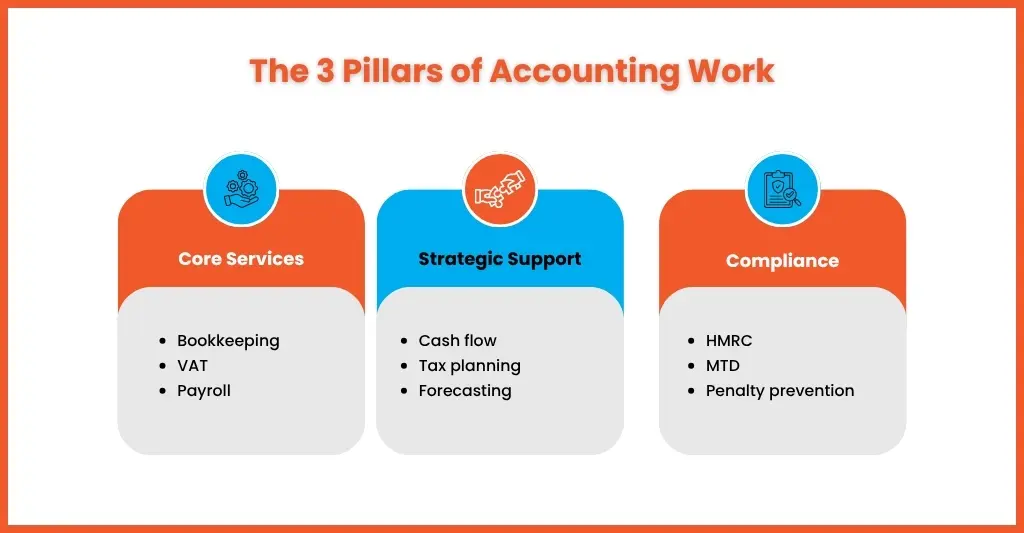
Accountants will help in offering:
Core Services
- Bookkeeping and financial record-keeping
- VAT returns and compliance
- Payroll processing
- Year-end accounts and corporation tax
Strategic Support
- Cash flow planning
- Tax efficiency strategies
- Business growth insights
- Financial forecasting
Compliance and Regulation
- Ensuring HMRC compliance
- Supporting Making Tax Digital (MTD) requirements
- Reducing the risk of penalties
An accountant doesn’t just manage numbers; they manage your clients financially and keep them compliant.
Do You Actually Need to Hire an Accountant?
Without accountants, managing your practice will be an impossible task because they do the heavy lifting. Still, if you see these signs while running your practice, then consider getting the best accountants.
- You’re missing tax deadlines
- You’re unsure about VAT or PAYE rules
- Your practice business is growing quickly
- You’re spending too much time on bookkeeping
- You’re worried about HMRC penalties
How to Hire an Accountant in the UK — Step by Step
Getting the right accountant for your practice is not only for handling the filing of returns for your clients. It’s about giving your clients more to support their growth, keeping them compliant in advance, and saving them from costly mistakes.
Many practices select accountants in a hurry and pay dearly in the long run.
Let’s break this down in a practical, real-world way so you get it right from day one.
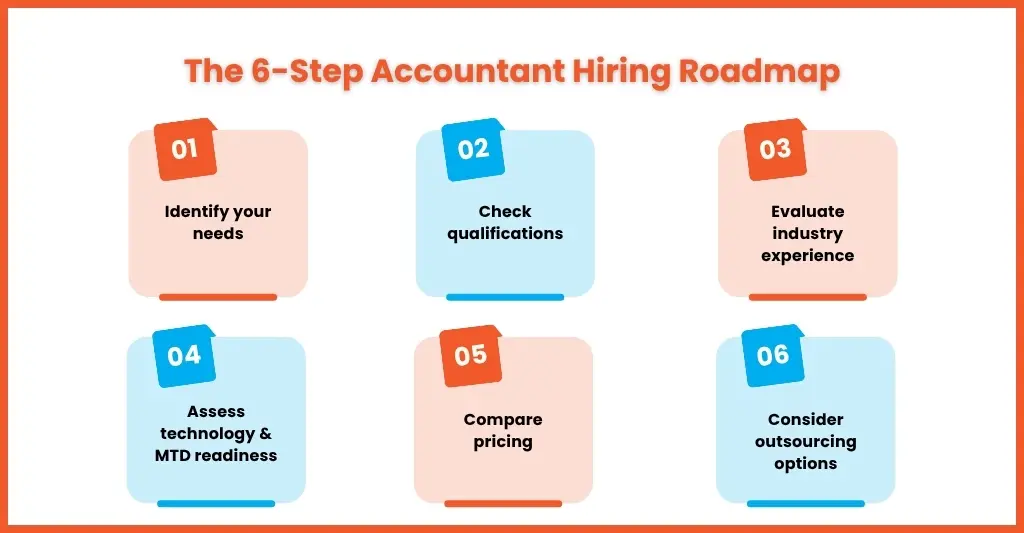
Step 1: Identify Your Needs
Before you set out to get an accountant, ask yourself a few questions.
- What exactly do I need help with right now?
- And what will I need 6–12 months from now?
Many practices need assistance in one of these categories:
Basic Support
- Bookkeeping
- VAT returns
- Payroll
Full-Service Accounting
- Year-end accounts
- Corporation tax
- Management reports
Strategic Support
- Tax planning
- Cash flow forecasting
- Business advisory
Always take your current growth, expected needs, and compliance requirements into consideration while selecting accountants.
Step 2: Check Qualifications
While learning how to hire an accountant, give full consideration towards their qualifications.
Look for professionals registered with:
- ICAEW (Institute of Chartered Accountants in England and Wales)
- ACCA (Association of Chartered Certified Accountants)
- CIMA (Chartered Institute of Management Accountants)
Getting such highly certified accountants will keep your professional standards up. Such accountants will keep your practice updated with the latest HMRC regulations and accountable to regulatory bodies.
Step 3: Evaluate Industry Experience
Along with knowledge of the latest UK accounting standards, look for an accountant with specialised industry experience. Such accountants understand the specific challenges of your clients whose businesses are in particular sectors, like:
- Ecommerce
- Construction
- Recruitment
- Healthcare
An accountant with experience in these sectors will ask the right questions, avoid common mistakes, and work faster with fewer errors.
Step 4: Assess Technology & MTD Readiness
In today’s day and age, accounting has become a real-time job, and you will need accountants who are tech-savvy and have enough experience in the Making Tax Digital initiative of the HMRC.
Therefore, select an accountant who is comfortable with:
- Cloud accounting platforms (Xero, QuickBooks, FreeAgent)
- Automated bank feeds
- Digital record-keeping
- Making Tax Digital (MTD) compliance
Step 5: Compare Pricing
Give due consideration to the cost of hiring an accountant, but do not base your decision just on that alone.
The price of accountants will be influenced by:
- Size of your client’s business
- Transaction volume
- Complexity of services
- Level of advisory
Step 6: Consider Outsourcing Options
Modern accounting practices get their accounting task done in a modern way, and outsourcing is one of those ways.
Many accounting practices are choosing the outsourcing way that combines your in-house team, which will handle client-facing services and advisory work, and outsourcing that will handle bookkeeping, compliance, and reporting.
Outsourcing is turning into a popular bet because it has helped practices in:
- Reducing overhead costs
- Increased their capacity without hiring
- Allowed them to focus on high-value services
Here’s where Equallto fits in. It helps small practices:
- Handle day-to-day accounting tasks
- Manage MTD compliance
- Support multiple clients efficiently
- Scale without increasing internal workload
Cost of Hiring an Accountant UK — What to Expect in 2026
The cost of hiring an accountant in the UK will depend on the services you want from them and the complexities involved.
Here is an approximate price you are expected to pay to an accountant:
| Service | Monthly Cost |
| Bookkeeping | £50 – £150 |
| VAT Returns | £50 – £200 |
| Payroll | £30 – £100 |
| Full Accounting Package | £150 – £500+ |
Are you thinking that getting an accountant is an extra cost? Then consider the cost of doing the accounting work yourself incorrectly, leading to:
- Penalties
- Missed tax savings
- Wasted time
Combine in-house oversight with outsourced support to reduce overall costs while maintaining quality.
How Hiring an Accountant Helps You Stay MTD-Compliant in 2026
The Making Tax Digital initiative is set for an expansion in 2026 from VAT to Income Tax, which means more complexity. HMRC is pushing this initiative to reduce errors caused by manual reporting, which previously cost billions annually.
Since you are already compliant with MTD for VAT, that does not mean that you do not need the support of an accountant for Income Tax; in fact, you will need them more.
Accountants help by:
- Maintaining digital records
- Submitting VAT and income tax updates
- Ensuring software integration
- Avoiding compliance penalties
Without an accountant, you will:
- Miss out on deadlines
- Make incorrect submissions
- Face increased penalties
When you select the right accountant, your:
- Compliance will become seamless
- Reporting will become real-time
- Compliance stress will reduce significantly
What to Watch Out for When Hiring an Accountant in the UK
All accountants are not the same in experience or capability. These capabilities or experiences are required in a good accountant and must be looked for. Mistakes are made while selecting accountants; therefore, avoid making these mistakes.
Choosing Based on Price Alone
Avoid selecting your accountant based on price alone. Low-cost services mean a lack of:
- Expertise
- Compliance knowledge
- Scalability
Lack of Communication
Avoid selecting an accountant who is slow in responding to queries or in accounting tasks. It will delay critical decision-making, especially during tax submission periods. Before selecting an accountant, ask for a demo to know their speed and capabilities.
No Digital Experience
There is no use in selecting an accountant who lacks experience in handling AI tools, data-grabbing software, and accounting software. It is important because the future of accounting is digital, and there is no running away from it, especially when MTD is expanding into Income Tax this April.
Lack of Scalability
As your client expands, so will your practice, and with that, the accountant you hire must be able to handle the increased workload.
These mistakes can easily be avoided by approaching outsourcing partners, offering bookkeeping outsourcing services. It will provide you with:
- Scalable bookkeeping support
- Cost efficiency
- Access to experienced teams
People Also Ask
Is it worth hiring an accountant in the UK?
Yes, an accountant is important to ensure compliance in accounting work, save time, reduce errors in accounting tasks, and provide important financial insights that will support your client’s growth.
What qualifications should an accountant have in the UK?
Look for certifications from ICAEW, ACCA, or CIMA. These ensure professional standards and expertise.
Do I need an accountant for Making Tax Digital (MTD)?
While it’s not necessary, having an accountant experienced in MTD compliance will make your life easier, especially when MTD is being expanded into income tax in 2026.
Will accounting be replaced by AI?
AI will not replace accountants entirely but will significantly transform their roles by automating routine tasks like data entry, reconciliation, and bookkeeping. Instead of replacing professionals, AI acts as an enabler.
How much does it cost to hire an accountant in the UK?
The cost of hiring an accountant in the UK will depend on the services you want from them and the complexities involved.
Here is an approximate price you are expected to pay to an accountant:
a. Bookkeeping : £50 to £150 per month approx
b. VAT Returns: £50 to £200 per month approx
c. Payroll: £30 to £100 per month approx
d. Full accounting package: £150 – £500+ per month approx
Conclusion: How to Make the Right Decision When You Hire an Accountant
Getting a new accountant into your practice is not only about managing tax filings for your clients, but also about building a strong financial foundation for your clients and trust. In 2026, with increasing compliance requirements and digital reporting through MTD, the right accounting support is more important than ever.
Hence, it is important that you:
- Understand your needs
- Choose qualified professionals
- Ensure digital readiness
- And consider scalable solutions
For small practices combining traditional accounting with outsourced support from Equallto offers the best of both worlds. It offers:
- Cost efficiency
- Flexibility
- Expertise on demand
Because in today’s environment, the question should not be “Should you hire an accountant?” It should be “Are you working with the right one to support your growth?” Is Equallto accountant right for you? Send your request through our contact form, get access to one, and see the difference.