
To file VAT return in the UK, you will need accurate digital records, correct VAT calculations of what your client owes or can reclaim, MTD-compliant VAT software for return submission, and payment of VAT before the deadline. Looks simple, but it’s not, especially when it involves dozens of your clients.
Let’s look at this accounting practice that is always struggling to meet multiple VAT deadlines. One day, the client uploaded its invoices late, another one mistakenly recorded duplicate expenses, and the third one changed VAT schemes midway through the quarter. Due to this, its team had to spend hours verifying figures, correcting errors, and ensuring all submissions were accurate before the HMRC deadline.
Are you facing such a situation? Because many small accounting practices are, especially when their client base expands. With VAT compliance becoming time-sensitive, a single mistake will cause unwanted stress and damage to your reputation.
According to HMRC official statistics, in the tax year 2024 to 2025, the VAT gap, the difference between the VAT expected and the amount actually collected, was £11.9 billion compared to £8.9 billion in 2023 to 2024. This has placed additional pressure on HMRC to close the gap.
However, the filing of VAT returns doesn’t have to be stressful. With the right processes, software, and support, you can streamline VAT compliance, reduce manual work, and confidently manage a growing client base.
In this guide, we’ll enlighten you on how to file VAT returns correctly, avoid common mistakes, and explore how outsourcing routine VAT bookkeeping to specialists like Equallto can help your practice scale without increasing overheads.
What Is a VAT Return and Who Needs to File One?
A VAT return is a report that has to be submitted to the HMRC, and it summarises the VAT your client charged on sales and paid on purchases during a specific accounting period.
The return tells HMRC whether your client:
- Needs to pay additional VAT
- Can reclaim VAT
- Has no VAT to pay or reclaim
All VAT-registered businesses are required to submit VAT returns. This is true regardless of:
- Your client’s business size
- How much VAT is collected or paid in that period (even if your client don’t owe any VAT)
For accounting practices, VAT returns are often one of the most recurring compliance services. As client numbers increase, managing multiple VAT periods, different VAT schemes, and varying submission deadlines becomes increasingly complex.
VAT Return Deadlines and Filing Frequency
An easy way to avoid penalties associated with missing VAT return deadlines is knowing when VAT returns are due. While most of your clients would prefer filing quarterly VAT returns, other filing frequencies are available depending on business circumstances.
VAT Return Filing Schedule
| Filing Frequency | Suitable For | Deadline |
| Quarterly | Most VAT-registered businesses | One calendar month and seven days after the VAT period ends |
| Monthly | Businesses regularly reclaim VAT | Monthly |
| Annual Accounting Scheme | Eligible smaller businesses | Annual VAT return with interim payments |
Remember that the payment deadline is usually the same as the submission deadline. Missing either could result in interest charges or penalty points under HMRC’s late submission rules.
Creating a VAT calendar or using automated reminders within your accounting software helps ensure deadlines are never missed.
How to File VAT Return Online: 7-Step Walkthrough
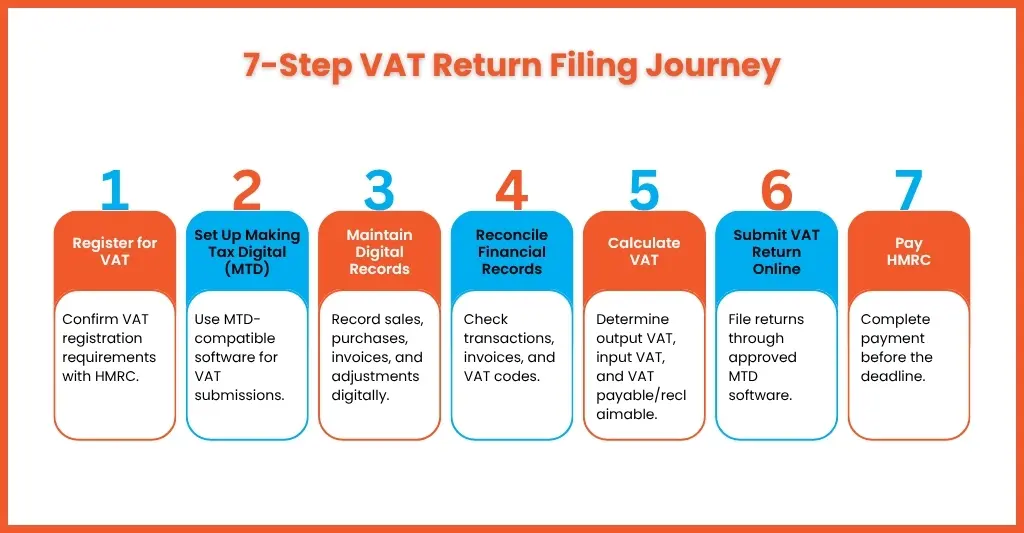
For those who are wondering how to file VAT return online, it’s a simple process when it is described in simple steps. These steps are:
Step 1: Register for VAT
Make sure your clients are registered for VAT with HMRC, especially if their taxable turnover for the previous 12 months goes over £90,000, or if you expect your turnover to exceed that limit in the next 30 days alone.
Step 2: Sign Up for Making Tax Digital
Since its first implementation on 1 April 2019, MTD on VAT has been fully implemented by 2022, and all your clients are required to be MTD-compliant. Using MTD-compliant software for generating and sending digital records to HMRC is compulsory.
Step 3: Maintain Digital Records
Use the MTD-compliant software for recording sales, purchases, VAT invoices, and adjustments digitally through the VAT period as required under the MTD initiative. These digital records will come in handy during audits and investigations.
Step 4: Reconcile Financial Records
Verify all your clients’ financial transactions, invoices, credit notes, and their VAT codes before preparing the VAT return.
Step 5: Calculate VAT
Once you have all the verified transactions and other details in hand, you can start determining
- Output VAT collected
- Input VAT paid
- Net VAT payable or reclaimable
Step 6: Submit Through MTD-Compatible Software
HMRC will accept only those VAT returns that are submitted directly using approved MTD-compatible software such as Xero, QuickBooks, Sage, or FreeAgent.
Step 7: Pay HMRC
Once the return is accepted by HMRC, you can inform your clients to make payments before the deadline using their preferred payment method.
Following a structured workflow significantly reduces the likelihood of errors and late submissions.
Making Tax Digital (MTD) for VAT: What Changed in April 2026
By 2026, the entire VAT process has become digital with regard to record-keeping and electronic submissions for all VAT-registered businesses due to the enforcement of Making Tax Digital initiative by HMRC.
Under MTD, you must ensure your clients:
- Keep digital VAT records.
- Use HMRC-compatible software.
- Maintain digital links between records.
- Submit VAT returns electronically.
For many practices, MTD has also highlighted the importance of efficient bookkeeping. Poor-quality bookkeeping often results in inaccurate VAT returns, regardless of how advanced the software may be.
This is one reason why many small but growing practices now choose to outsource routine bookkeeping and VAT preparation to specialist partners such as Equallto. By ensuring client records are accurate and up to date throughout the quarter, you can spend less time correcting errors and more time delivering valuable advisory services.
The Three Ways to File a VAT Return
When it comes to filing VAT returns, there is no single way but three ways. From that the right path for you will depend on the number of VAT-registered clients you manage, tools you use, and the size of your practice.
These three most common ways to file VAT returns in the UK are:
File Through MTD-Compatible Accounting Software
This method is encouraged by HMRC for most practices. By using HMRC-recognised software such as Xero, QuickBooks, Sage or FreeAgent, you can:
- Maintain digital VAT records
- Automatically calculate VAT
- Submit returns directly to HMRC
- Reduce manual calculations
- Keep an audit trail for compliance
For practices managing multiple clients, this is often the fastest and most efficient approach.
File Through an Accounting Practice
Many businesses depend on accounting practices like yours to prepare and submit VAT returns on their behalf in order to save their time and effort.
This option offers several advantages:
- Professional review before submission
- Reduced risk of filing errors
- Advice on VAT schemes and reliefs
- Better compliance with HMRC regulations
This means you will be responsible for ensuring client bookkeeping is accurate long before the filing deadline arrives.
File Using an Outsourced Bookkeeping Partner
When your practice grows, you will realise that VAT preparation requires time that you don’t have. Often you will face situations where quarter-end deadlines will overlap with payroll processing, management accounts and year-end work, thus putting enormous pressure on your internal teams.
That’s why many practices are moving towards outsourced VAT services while retaining full control of client relationships.
An outsourced VAT return service like Equallto can help by:
- Maintaining accurate client bookkeeping throughout the quarter
- Preparing VAT-ready records
- Reconciling bank transactions
- Reviewing purchase and sales ledgers
- Supporting MTD-compliant bookkeeping
Avoid rushing to complete records before the deadline and choose to keep your client records organised and clean in advance. IT will result in faster submission, fewer errors, and time to focus on high-value profits.
VAT Return Penalties: What Happens If You File Late
For those who file VAT return late, HMRC has introduced a points-based penalty system, encouraging businesses to file on time consistently.
If VAT return submissions are late, then your clients will face:
- Late submission penalty points
- Financial penalties once the points threshold is reached
- Late payment interest
- Additional interest on overdue VAT
- Increased HMRC scrutiny for repeated non-compliance
When you reach the threshold, your client will receive a £200 penalty and a further £200 penalty for each subsequent late submission. The penalty point threshold is set by your accounting period. The threshold is the maximum points you can receive.
| Accounting period | Penalty points threshold |
| Annually | 2 |
| Quarterly | 4 |
| Monthly | 5 |
Clients have entrusted the VAT to you because of your expertise, and late submissions at your end will break the trust of your clients and damage long-term relationships.
The easy way to deal with it is by implementing standardised bookkeeping processes throughout the quarter instead of doing reconciliation work at the end.
How to Correct a Mistake on a VAT Return
Even careful preparation is not a guarantee that mistakes will not happen. That’s why it is important to identify and correct those mistakes as soon as possible.
Common VAT return errors include:
- Incorrect VAT codes
- Duplicate invoices
- Missing purchase invoices
- Incorrect adjustments
- Posting transactions to the wrong VAT period
Therefore, before submitting every VAT return, create a simple review checklist that includes:
- Reviewing unusual transactions
- Checking VAT codes
- Reconciling bank accounts
- Matching sales invoices
- Reviewing purchase invoices
- Verifying VAT calculations
If possible, conduct a second review by another team member so that issues can be identified that may otherwise be overlooked.
What to Do After Filing Your VAT Return
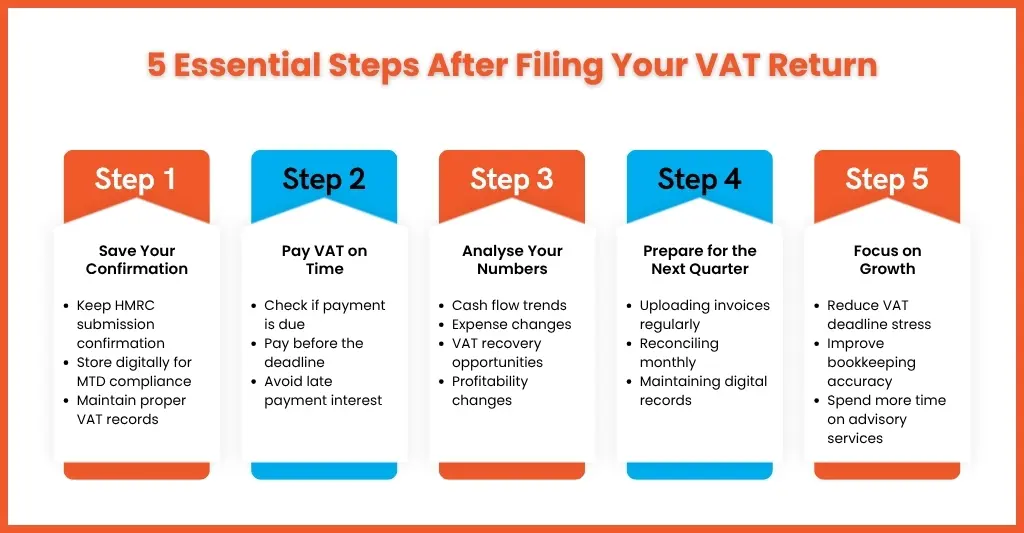
Submitting your VAT return is not the final step. There are several important actions that should follow to maintain good compliance and prepare for the next reporting period.
Save Your Submission Confirmation
Always keep HMRC confirmation of submissions made as part of your compliance records, ideally in digital format as per the Make Tax Digital requirement.
Arrange VAT Payment
If VAT is due, then make the payment well before the deadline; this will give you a buffer in case of unforeseen delays on the part of HMRC.
HMRC accepts several payment methods, including:
- Direct Debit
- Online banking
- Faster Payments
- CHAPS
- Bacs
Paying early reduces the risk of late payment interest caused by banking delays.
Review Client Performance
Each VAT period provides valuable insights into your client’s financial performance.
Look beyond compliance and identify:
- Cash flow trends
- Rising expenses
- VAT recovery opportunities
- Changes in profitability
Such analysis will create valuable advisory opportunities that strengthen client relationships.
Prepare for the Next VAT Period
Instead of waiting for the next VAT deadline, guide your clients to upload their invoices on a regular basis, conduct reconciliations on a monthly basis, and maintain digital records throughout the quarter.
This proactive approach significantly reduces quarter-end pressure.
Many small accounting practices achieve this by partnering with outsourced bookkeeping specialists like Equallto, who ensure client books remain accurate throughout the year. Instead of spending valuable time correcting bookkeeping errors before every VAT deadline, your team can focus on advisory services, business development, and client growth.
Frequently Asked Questions
Can I still file a VAT return on paper?
In most cases, no. Under Making Tax Digital (MTD), almost all VAT-registered businesses must maintain digital records and submit VAT returns electronically using compatible software. Paper submissions are only permitted in limited circumstances where HMRC has granted an exemption.
How long does it take to file a VAT return online?
If bookkeeping records are accurate and up to date, filing a VAT return online usually takes between 15 and 45 minutes. However, if records need reconciling or transactions require correction, preparation can take considerably longer.
How do I pay HMRC after filing?
HMRC offers several payment options, including Direct Debit, Online banking, Faster Payments, CHAPS, and Bacs. Always allow enough time for payments to clear before the deadline to avoid interest charges.
How hard is it to do a VAT return?
VAT returns are relatively simple if your client accounts are organised, as most bookkeeping software does the heavy lifting. The rules of Making Tax Digital (MTD) require most to use compatible accounting software, which automates the calculations, connects directly to HM Revenue and Customs (HMRC), and submits the figures with a single click.
What are common VAT mistakes to avoid?
To protect your clients from costly penalties and audits, always avoid these common VAT mistakes: These mistakes are claiming VAT on ineligible expenses, missing or backdating registration thresholds, applying the wrong tax rate, using invalid receipts, and failing to reconcile your returns.
Conclusion
Knowing how to file VAT return is not just about submitting figures to HMRC. It’s also about accurate bookkeeping, organised financial records, compliance with MTD, and process consistency that keeps every client on track throughout the year.
Now, as your practice grows, so will the complexities associated with managing multiple VAT registrations, filing dates, and client records. Handling all of this in-house is not possible for your team, especially during peak VAT filing season.
That’s why many successful UK accounting practices are rethinking how they manage VAT compliance. By combining modern accounting software with reliable outsourced bookkeeping support, firms can reduce manual work, minimise filing errors, improve turnaround times, and confidently take on more clients without increasing headcount.
Equallto helps small accounting practices across the UK prepare VAT-ready bookkeeping, maintain accurate digital records, and support Making Tax Digital compliance behind the scenes. Your clients continue working with you, while our experienced bookkeeping professionals provide the additional capacity your practice needs to grow.
Ready to handle more VAT clients without hiring more staff? Get in touch with us today to discover how our outsourced bookkeeping solutions can free up your team, strengthen client service, and help your firm grow with confidence in 2026 and beyond.
