
The VAT return deadline in the UK is one month and 7 days after the end of the VAT accounting period. The thought of missing out on the deadline gives a dreaded feeling due to penalties, interest, and unnecessary stress involved for you and your clients.
With MTD already influencing how VAT is managed, keeping a tab on the VAT return deadlines has become even more crucial. But the trick to avoid missing out on these deadlines is simple. Just know the dates, plan in advance, and let the expert’s accountant do the filing for you.
Let’s understand through an example:
A small accounting firm during quarter-end VAT season used to do manual tracking of spreadsheets and email through its accountants. One of its clients submitted incomplete records, another missed its VAT return, and its accountants had to divert their attention to fix it.
After implementing structured workflows and using VAT outsourcing services, the firm was able to streamline the VAT process and meet its payment and submission deadlines with few errors.
That’s the difference between reactive compliance and proactive VAT management.
In this complete guide, we’ll explain:
- What is a VAT return deadline
- How VAT filing schedules work
- Key VAT return deadlines in 2026
- Penalties for late filing
- How to avoid compliance risks
- What happens if you miss a deadline
- How outsourcing can simplify VAT compliance
What Is a VAT Return Deadline?
VAT return deadline is the timeline for VAT-registered businesses to submit their VAT return to HMRC. The VAT return contains VAT charged on customers (output tax) and the VAT your clients paid on business costs (input tax). The difference decides whether your clients owe HMRC money or you owe them a refund.
The deadline for submitting the VAT return is one calendar month and 7 days after the end of an accounting period. This is also the deadline for paying HMRC. Since April 2022, under the MTD initiative, the filing of returns must be done in electronic format and through MTD-compliant software.
VAT Return Deadlines for Different Filing Frequencies
Not all your clients would like to file their VAT return in the same way. That’s why HMRC allows different filing frequencies depending on the scheme or business structure.
Let’s understand these filing frequencies and their deadlines:
Monthly VAT Returns
It’s the most common filing method in the UK; under this, your clients are required to send 4 VAT returns per year.
Typical quarterly periods include:
- January–March (Quarter ending 31st March 2026 = Deadline: 7th May 2026)
- April–June (Quarter ending 30th June 2026 = Deadline: 7th August 2026)
- July–September (Quarter ending 30th September 2026 = Deadline: 7th November 2026)
- October–December (Quarter ending 31st December 2026 = Deadline: 7th February 2027)
Deadline Rule:
- Submit and pay within 1 month + 7 days after the quarter ends.
Annual VAT accounting Scheme
Under this scheme, your clients can make advance VAT payments towards your VAT bill based on your clients’ last return. They will be required to do one VAT return per year.
How HMRC Sets VAT Dates For your Clients
When you clients get registered for VAT HMRC assigns one of three stagger groups. These groups determine the end-dates of your clients VAT quarters. The purpose of HMRC for doing this is to spread out the load across the year instead of everyone filing at the same time.
Here are the standard stagger groups:
- Stagger 1: quarter-ends in March, June, September, December
- Stagger 2: quarter-ends in April, July, October, January
- Stagger 3: quarter-ends in May, August, November, February
| Stagger 1 | Stagger 2 | Stagger 3 |
| 1 Jan – 31 Mar 2026 | 1 Feb – 30 Apr 2026 | 1 Mar – 31 May 2026 |
| 1 Apr – 30 Jun 2026 | 1 May – 31 Jul 2026 | 1 Jun – 31 Aug 2026 |
| 1 Jul – 30 Sep 2026 | 1 Aug – 31 Oct 2026 | 1 Sep – 30 Nov 2026 |
| 1 Oct – 31 Dec 2026 | 1 Nov 2026 – 31 Jan 2027 | 1 Dec 2026 – 28 Feb 2027 |
Making Tax Digital (MTD) Requirements for VAT Returns
Making Tax Digital (MTD) is an HMRC initiative to digitise the entire UK tax system. MTD on VAT was implemented in 2019, and by 2022, all VAT-registered businesses are required to be MTD compliant.
Under MTD rules, VAT-registered businesses must:
- Keep their VAT records in digital format
- Must use MTD-compatible software
- Submit VAT returns digitally to HMRC using MTD-compliant software
This means the days of manual spreadsheets and disconnected systems are long gone
MTD-Compatible Software Examples
After compulsion by HMRC and MTD implementation, many accounting practices and businesses have started using MTD-compliant software like:
- Xero
- QuickBooks
- Sage
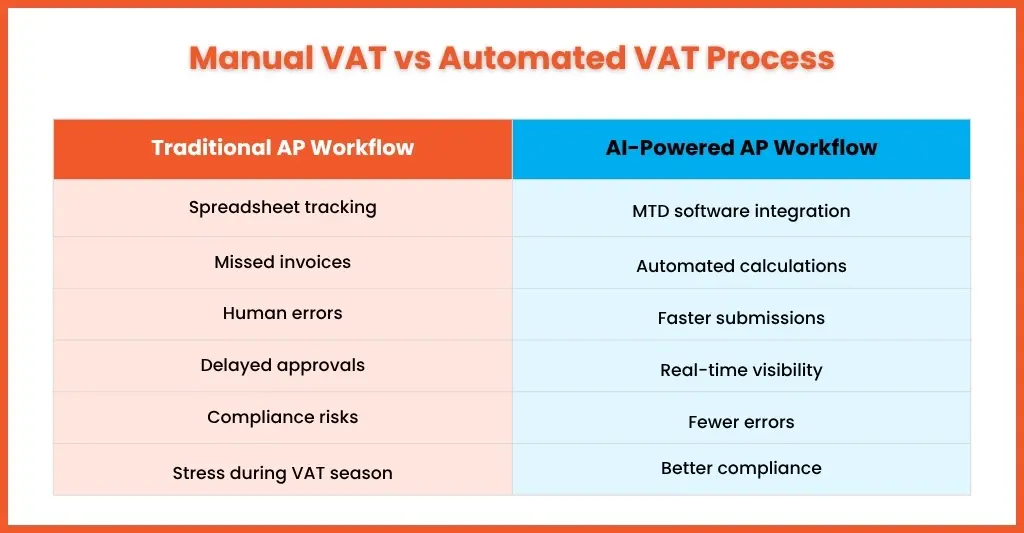
These systems have helped:
- Automate VAT calculations
- Reduce manual errors
- Improve reporting visibility
- Streamline submissions
The aim of HMRC’s introduction of MTD was to reduce the VAT gap, which, according to HMRC, fell from £ 13.1 billion in 2022 to 2023 to £ 11.4 billion in 2024 to 2025.
VAT Return Example
If you’re unfamiliar with VAT reporting, here’s a simplified VAT return example.
Example Scenario
A business report:
| Description | Amount |
| VAT charged on sales | £12,000 |
| VAT paid on purchases | £7,000 |
VAT owed to HMRC: £12,000 – £7,000 = £5,000
This amount must be:
- Reported accurately
- Submitted digitally
- Paid before the VAT return deadline
Modern accounting software automates much of this process.
Without automation, however, your clients will often face:
- Manual calculation errors
- Duplicate entries
- Incorrect VAT coding
- Missing invoices
VAT Return Deadlines and Penalties
HMRC is now strictly applying penalties for late VAT submissions and payments
Late Submission Penalties
The penalties for late submission are based on a penalty points system; once you cross that, the £200 penalty is applicable. The penalty point threshold is set by your accounting period. They are:
| Accounting period | Penalty points threshold |
| Annually | 2 |
| Quarterly | 4 |
| Monthly | 5 |
Every additional late return trigger another £200 penalty.
Late Payment Penalties
- No penalty if payment is made within 15 days.
- The first penalty is a fall when your client’s payment is delayed by 16 days and is calculated at 3% on the VAT you owe at day 15.
- Once the payment delay crosses day 31, an additional 3% of what is still outstanding at day 30 is applied.
This creates additional financial pressure for your clients already managing cash flow challenges.
Late Payment Interest
HMRC also charges interest on outstanding VAT from the due date until payment is made in full. The rate changes periodically and is linked to the Bank of England base rate.
Worked Example: Late VAT Payment Penalty
Imagine a client owes:
VAT Due: £10,000
Scenario A: Paid on Day 20
- Penalty: £10,000 × 3% = £300
Scenario B: Paid on Day 40
- First Penalty: £10,000 × 3% = £300
- Second Penalty: £10,000 × 3% = £300
Total Penalty: £600
Plus
- late payment interest
- Any submission penalties already incurred
This is why proactive VAT management is far cheaper than reactive compliance.
How Can You Pay HMRC VAT?
HMRC offers several payment methods for VAT liabilities.
Direct Debit (Recommended)
This is a highly recommended way of payment where you can set up for your client an active Direct Debit instruction via their VAT online account. This allows HMRC to automatically collect the amount due 3 working days after your return deadline.
Online or Telephone Banking
Your clients can also pay directly through:
- Faster Payments
- CHAPS
- BACS
Debit or Corporate Credit Card
Your clients can use a debit card or corporate credit card via the HMRC BillPay online portal.
How to Avoid Missing Your VAT Return Deadline
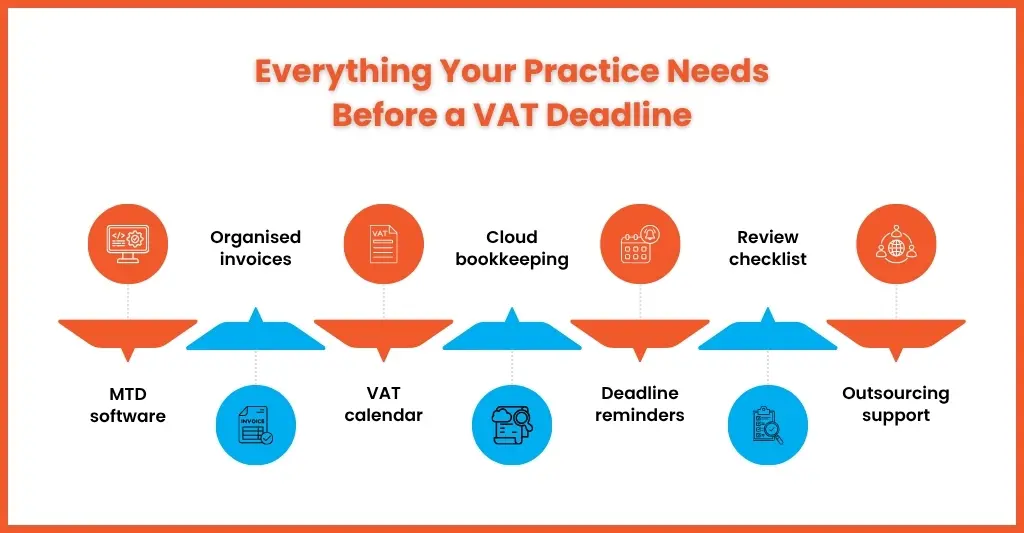
Avoiding VAT issues requires investment in structured systems, not last-minute panic.
Here’s what you need to do:
Set Reminders and Organise Records
It must be admitted that keeping track of VAT filing deadlines is important to avoid late submission penalties, but tough. But setting calendar reminders or using digital tools to manage VAT records will help you achieve deadlines. They will keep the records organised and ready when the VAT deadline arrives.
Using MTD-compliant Accounting Software
Using MTD-compliant VAT software is compulsory as per the HMRC; it simplifies the filing process by automating calculations, thus reducing errors and ensuring timely submissions.
Reviewing Returns for Accuracy
Before submitting your client’s VAT return, recheck it to avoid mistakes. Any errors could lead to penalties, especially if deemed careless or deliberate by HMRC.
Outsource VAT Work During Peak Periods
Busy VAT quarters often overload internal teams. But consulting a specialist outsourcing provider offering VAT outsourcing services can be beneficial.
Outsourcing provides:
- Additional processing capacity
- Faster turnaround
- Reduced compliance risk
Many UK accounting firms now combine internal teams with outsourced support models.
What to Do If You Miss a VAT Return Deadline
There is always a possibility of mistakes taking place, like missing out on VAT deadlines, once or twice in your clients’ lifetime. When that happens, you will need to act quickly and do the following things.
Contact HMRC Immediately
Prioritise informing HMRC immediately and tell them about the issue you face. Any delay in this will cost your clients dearly.
Provide a Rational Excuse
Provide a rational excuse for the mistake or delay in VAT filing, such as illness or system failure. This way, HMRC will consider giving an excuse on a special case basis, thus avoiding penalties for your clients.
Make Full Payment Quickly
Even if the VAT return is late, do the outstanding payments as soon as possible, thus reducing the penalties and preventing interest charges.
Set Up a Payment Plan
If you are not able to pay the full amount for your clients immediately, then HMRC will make a payment plan. This will help your clients manage their cash flow while being compliant.
Taking action and moving quickly can prevent further financial consequences and help maintain your business’s good standing with HMRC.
VAT Return Deadlines and Outsourcing: How Equallto Helps
It would be unfair to expect your small accounting practice to handle VAT returns of multiple clients, especially when you lack staff and resources to handle the volumes.
Things get even worse during:
- Quarter-end peaks
- Staff shortages
- Rapid client growth
In such situations, you will need expert assistance that will work like your extended team, like Equallto. We have made our name by supporting UK accounting practices through scalable outsourcing services designed to simplify VAT compliance workflows.
Equallto will help you with:
- Bookkeeping support
- VAT reconciliations
- MTD-compliant workflows
- Cloud accounting integration
- Deadline management support
- Scalable seasonal capacity
Instead of constantly firefighting VAT deadlines, start building a more structured, scalable compliance operations through outsourcing.
This allows your internal teams to focus more on:
- Advisory work
- Client relationships
- Practice growth
FAQ: VAT Return Deadlines UK
How do I find my specific VAT return deadline?
Your VAT deadline is usually shown:
a. In your HMRC online account
b. Within your accounting software
c. On VAT correspondence from HMRC
Most follow the 1 month + 7 days rule.
Do I need to file a VAT return if I have no VAT to pay?
Yes, even if no VAT is due, businesses must still submit a VAT return unless HMRC states otherwise. This is known as a nil VAT return.
What happens if I submit late but pay on time?
You may still receive:
a. Penalty points
b. Late submission penalties
What is a VAT return?
A VAT return is a financial document submitted to the tax authority (like HMRC in the UK) that calculates the difference between the Value Added Tax (VAT) a business charges customers and the VAT it pays on business expenses.
Does HMRC automatically refund VAT?
HMRC processes the repayment automatically when you submit your clients VAT Return. The repayment will go direct to the bank account if you have given HMRC bank details for your repayment. Otherwise HMRC will send a cheque.
Conclusion
Keep a close eye on VAT return deadlines it’s a critical operational responsibility for your accounting practice. If you find yourself worrying about sticking to deadlines, reach out to an outsourcing provider that knows how to operate it.
Only those practices will succeed that are building:
- Standardised workflows
- Cloud bookkeeping systems
- Automated VAT processes
- Scalable support structures
By combining:
- MTD-compatible software
- Strong bookkeeping practices
- Structured reporting systems
- Outsourced support when needed
You can reduce stress, improve accuracy, and manage VAT deadlines far more efficiently. That’s exactly where Equallto helps by providing scalable finance and bookkeeping support designed to simplify VAT compliance while supporting long-term growth.
Contact us for VAT support and make the upcoming VAT season hurdle-free.
