
Automate VAT compliance means using digital tools, cloud accounting software, and automated workflows to handle VAT calculations, record-keeping, submissions, and compliance monitoring without human interference.
Why should I should automate VAT compliance? That’s the question we get every time. Let us explain it to you through an example.
A small accounting practice handling 60 SME clients was always in a race against time every quarter. It’s staff spent countless hours gathering records, reconciling transactions, checking VAT codes, correcting errors, and ensuring submissions met HMRC deadlines.
Things got murkier when its client base expanded. The practice had to make a difficult choice: hire accountants or find a better way to handle the pressure. The practice should be the smarter way by investing in the automation of VAT compliance. It worked wonders: data entry repetition was reduced, filing accuracy improved, and the accounting team got more time to focus on advisory work and client relationships.
This story reflects what many UK accounting practices are experiencing today.
For your small accounting practice facing staff shortages, rising client expectations, and increasing compliance complexity, the decision to automate VAT compliance is becoming less about convenience and more about competitiveness.
What Does It Mean to Automate VAT Compliance?
VAT compliance automation means the use of software and integrated systems to handle VAT-related tasks automatically instead of human intervention. Using automation tools, you can:
- Capture transaction data
- Apply VAT rules automatically
- Categorise expenses
- Validate VAT treatment
- Generate VAT reports
- Submit returns through HMRC-compatible software
- Maintain digital audit trails
These tools have helped in improving consistency and compliance.
Modern VAT automation solutions integrate well with platforms such as:
- Xero
- QuickBooks
- Sage
- FreeAgent
- ERP systems
Resulting in a streamlined VAT process that requires less manual effort and delivers greater accuracy.
VAT Compliance Automation for Accountants: Why Small Practices Can No Longer Wait
Ideally, accounting practices would love to handle VAT tasks on their own, but factors/circumstances are pushing many to automate VAT compliance. These factors are:
Making Tax Digital Requirements
With the implementation of the Making Tax Digital initiative on VAT, rules on how VAT records must be recorded, maintained and submitted in digital format only. Manual spreadsheets and disconnected systems increase the chances of error, which gave rise to MTD.
However, many practices are not confident in following the MTD rules, leading to compliance risks pushing them towards VAT compliance automation.
Growing Client Expectations
The demanding UK business and accounting environment has made clients increasingly demanding for:
- Faster reporting
- Real-time visibility
- Fewer compliance issues
- Proactive advice
To stay competitive in the market. Manual VAT processing often struggles to meet these expectations.
Staff Shortages Across the Profession
UK accounting sector is still suffering from an accountant shortage, and the recruitment of experienced and skilled talent has become a challenge. Also, hiring accountants continually is not feasible for small accounting practices. That’s why many are shifting toward automation to improve productivity and scalability.
Increasing Regulatory Complexity
Cross-border transactions, digital services, reverse charge rules, and changing VAT regulations all add complexity. Many practices find these rules overwhelming and will need a little help through automation to handle them better.
Automation on VAT helps standardise processes and reduce risk.
7 Benefits of Automating VAT Compliance for Small Practices
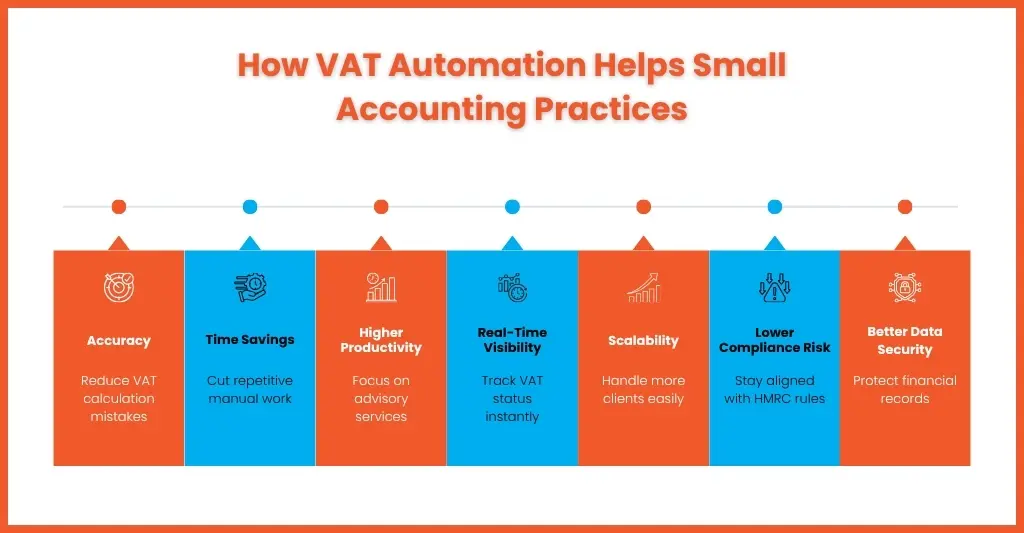
With changing regulations, varying rates, and complex reporting requirements, VAT compliance management has become increasingly difficult, increasing the chances of errors, inefficiencies, and penalties. However, by embracing automation, you can streamline VAT calculations and the VAT reporting process.
Here are the 7 major benefits of automating VAT return compliance:
1. More Accuracy and Compliance
One of the major benefits of automating VAT compliance is more accuracy in VAT calculations, thus reducing the risk of human errors. Using VAT software, you can ensure accuracy and compliance with the latest VAT regulations and VAT schemes, reducing the chances of costly mistakes that may result in penalties or audits.
2. Saving Time and Cost
Manual VAT consumes a lot of time and effort, especially when there are high volumes involved. VAT automation simplifies the process by automating and finishing the tasks in seconds, thus saving time and resources, which can be diverted towards other important tasks. The Return On Investment (ROI) of Intelligent Automation Report shows that automation reduces processing time by 75%.
3. Improved Efficiency and Productivity
VAT return software will automate repetitive tasks, thus improving your efficiency. It frees your team to focus on more value-adding activities like advisory work, analysing financial data and identifying trends, thus transforming your practice into an advisor for your clients.
4. Real-time Visibility
Automated VAT compliance through VAT software will give you real-time visibility on the status of amounts due and VAT return deadlines. Such visibility will help in making informed decisions and avoiding potential risks.
5. Scalability
When your practice grows bigger, your client base will get bigger, and each client will have different VAT requirements, which can be satisfied only through automation. VAT software can easily handle the workload without compromising accuracy or speed.
6. Reducing Risk of Non-Compliance
UK VAT regulations keep changing, and keeping up with them is challenging. Automated VAT compliance software ensures that your clients remain compliant at all times. By minimising the risk of non-compliance, VAT return software provides peace of mind and safeguards your clients from potential financial and reputational damage.
7. Data Security
Data security is very important, especially when digital records of VAT is compulsory. VAT return software has strong security measures in place, like encrypted data storage, user access controls, and regular backups. By safeguarding sensitive financial information, you can minimise the risk of data breaches and unauthorised access.
How to Automate VAT Compliance: A 7-Step Implementation Roadmap
Step 1: Assess Current Processes
Find all the bottlenecks in your current VAT workflow. Start with examining:
- Data collection
- VAT coding
- Reconciliations
- Submission procedures
Step 2: Choose Compatible Software
Based on the gaps in your current VAT workflow, select VAT automation software that integrates well with your existing accounting system and addresses the bottlenecks in your workflow.
Step 3: Standardise Client Data
Get all your client records verified and organised in proper order before implementation. Poor data quality will generate wrong results in the future and create more problems than benefits.
Step 4: Configure VAT Rules
Carefully select a VAT software that incorporates the latest:
- UK VAT rates
- Industry-specific requirements
- Reverse charge rules
- Cross-border transactions
Step 5: Train Your Team
Your team may resist the adoption of automation due to fear of losing their jobs or the operational complexity of the software. Therefore, for a successful adoption, you will have to train your staff and address all their concerns.
Provide training on:
- Workflow management
- Exception handling
- Compliance monitoring
Step 6: Run Parallel Testing
Run a test between your current processes and the outputs of automation, and see for any discrepancies before full deployment.
Step 7: Monitor and Optimise
Once implemented, maintain regular monitoring to ensure that compliance is being maintained and there is no drop in efficiency.
The Real Cost & ROI of VAT Automation for a Small Firm
Many accounting practices raise a fair question with regard to the cost of automating VAT, which is on the higher side. But many miss out on the real cost of not doing so and the potential savings it creates.
Potential savings include:
- Reduced labour costs
- Fewer compliance errors
- Faster processing
- Improved staff productivity
- Reduced rework
VAT Automation ROI Comparison
| Area | Manual VAT Process | Automated VAT Process |
| Data Entry | High manual effort | Mostly automated |
| Error Risk | Higher | Significantly reduced |
| VAT Return Preparation | Several hours or days | Minutes to hours |
| Compliance Monitoring | Manual reviews | Automated checks |
| Scalability | Limited by staff | Easily scalable |
| Cost Per Client | Increases with growth | More predictable |
| Audit Trail | Often fragmented | Automatically maintained |
For many small practices, automation has delivered measurable ROI within the first year.
Best VAT Automation Software for Small Accounting Practices
Several solutions are popular among UK accounting firms.
Xero
One of the best cloud-based accounting solutions, it is ideal for cloud-based accounting practices with strong VAT functionality and MTD compatibility.
QuickBooks Online
Offers VAT tracking, automated calculations, and HMRC submission capabilities.
Sage Accounting
Widely used by UK firms requiring integrated accounting and VAT management.
FreeAgent
Popular among smaller businesses and accounting firms serving freelancers and contractors.
Avalara
Designed for more complex VAT environments, including international transactions.
Taxually
Provides specialist VAT compliance automation and cross-border VAT support.
The right choice depends on client complexity, transaction volume, and existing technology.
Common Pitfalls When You Automate VAT Compliance (and How to Avoid Them)
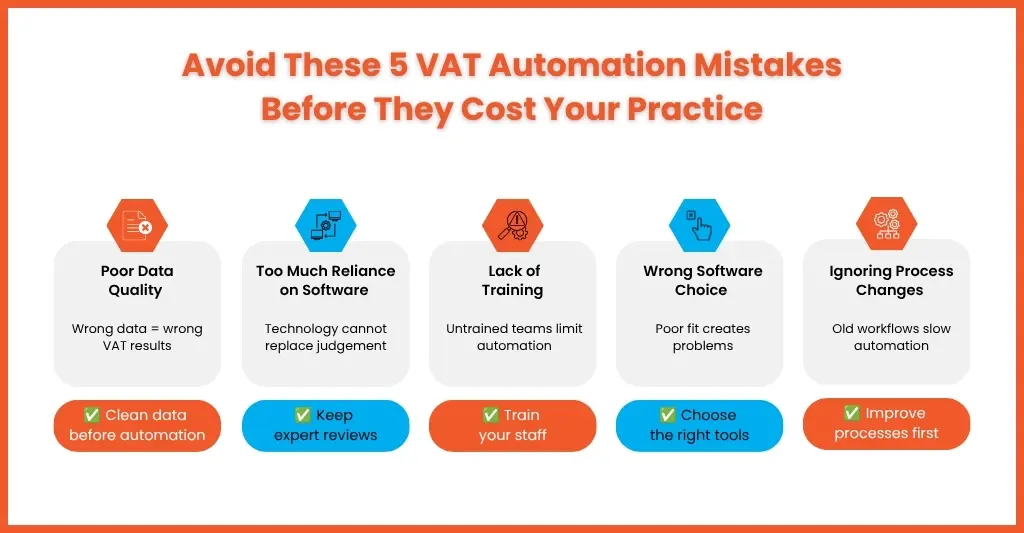
With all the good things that come with the automation of VAT, there are some pitfalls. This shows you that if you don’t take these pitfalls seriously, challenges will come up. Let’s understand some of the common pitfalls.
Poor Data Quality
Automation will work well only when the data is clean and in order. Without accurate data, you will get wrong calculations and results.
Solution: Clean historical data before implementation.
Over-Reliance on Technology
VAT software can automate tasks but cannot replace specialised human judgment, which is necessary for complex transactions.
Solution: Maintain review procedures for complex transactions.
Inadequate Staff Training
Without a team properly trained in automation, it will not work to its full potential.
Solution: Invest in ongoing training and process documentation.
Choosing the Wrong Software
Not all VAT software is the best; selecting the wrong software will backfire terribly.
Solution: Evaluate software based on client needs, integrations, and compliance requirements.
Ignoring Process Changes
Automation requires workflow redesign.
Solution: Review and optimise processes alongside technology implementation.
Handling these challenges requires internal resources, which your small accounting practice lacks. This is where Equallto provides additional value.
By acting as an extension of your accounting practice, Equallto supports firms with:
- Cloud bookkeeping
- VAT return preparation
- Transaction processing
- Reconciliations
- Management reporting
- Software-assisted workflows
This allows you to enjoy the benefits of automation while maintaining service quality and compliance standards.
Frequently Asked Questions
What is VAT automation?
The Automated VAT Compliance solution automatically processes data and prepares VAT compliance reports with just a few clicks, significantly reducing manual adjustments. The Automated VAT Compliance is tailored to your data and files, it automatically processes data exported from your ERP without manual adjustment.
How much does it cost to automate VAT compliance?
Costs vary depending on software selection, transaction volume, and implementation complexity. Small practices typically spend anywhere from a few hundred pounds annually for basic software to several thousand pounds for advanced automation solutions.
How long does it take to implement VAT automation in an accounting practice?
Implementation timelines typically range from a few weeks to several months, depending on the size of the practice, data quality, and system complexity.
Will VAT automation replace accountants?
No. VAT automation removes repetitive administrative tasks but does not replace professional expertise. Accountants remain essential for advisory work, tax planning, compliance oversight, and client support.
What triggers a VAT compliance check?
A VAT compliance check is triggered by anomalies in your tax filings, data analytics, or third-party intelligence. Common triggers include:
a. Unusual Repayment Claims
b. Discrepancies:
c. Filing History
d. High-Risk Sectors
e. Data Matching
f. External Factors
g. Random Selection
Conclusion
VAT compliance will get complex, and days will go by, and your clients will keep demanding faster service, more accuracy, and proactive insights. For a small practice to fulfil these demands solely through manual processes is not humanly possible.
By deciding to automate VAT compliance, you can improve efficiency, reduce compliance risk, increase scalability, and create more time for high-value client work. Your success will depend on your team size, but you will need to decide on the smartest combination of technology, processes, and specialist support, and Equallto can help in this.
Our experienced bookkeeping and accounting professionals support UK firms with scalable finance operations, cloud-based workflows, and efficient VAT processes that help practices grow confidently.
Ready to scale smarter? Contact Equallto today and discover how outsourcing and automation can transform your firm’s capacity, profitability, and client service.
