

Yes, a one-person accounting firm can compete with top 20 practices in certain areas by specialising, using the latest technology, building efficient processes, and accessing flexible external capacity. A solo accountant does not need to match the size of a large practice to compete. Instead, it must focus on delivering personalised high-quality services that a larger practice may struggle to provide.
Picture in 2 accounting practices: the first one has hundreds of accountants, specialist departments, impressive offices and a long list of services. The second has one accountant.
At first glance, it seems like an unfair competition. How can one person possibly compete with a Top 20 accounting practice? The answer is simple: a one-person firm should not try to compete by becoming a smaller version of a large firm, and that’s where many solo practitioners go wrong.
Many single-accountant practices look at the resources of larger practices and assume they need more employees, more overheads and more complicated systems before they can grow. But the modern accounting profession is changing.
Technology has reduced a lot of routine manual work, and automation software has changed how services are delivered. Plus, outsourcing has given small practices a chance to gain additional capacity without in-house recruitment and specialist knowledge, which clients increasingly value.
So, the better question is not: “Can I build a firm as big as the Top 20?”
It is “Can I build a small practice that delivers a better experience for the right clients?”
The answer to that question is absolutely yes.
How a One-Person Firm Can Compete: A Practical Comparison
| Area | Top 20 Practice Advantage | One-Person Firm Advantage |
| Resources | Large teams and specialist departments | Flexible external capacity |
| Client relationships | Broad service coverage | Direct personal contact |
| Decision-making | Formal governance structures | Faster decisions |
| Specialisation | Multiple specialist teams | Deep focus on a specific niche |
| Technology | Larger technology budgets | Faster adoption of suitable tools |
| Pricing | Established service structures | Greater flexibility |
| Client service | Multiple points of contact | One consistent relationship |
| Growth | Acquisition and recruitment | Technology, partnerships and outsourcing |
Specialisation Can Make a Small Firm Look Much Bigger
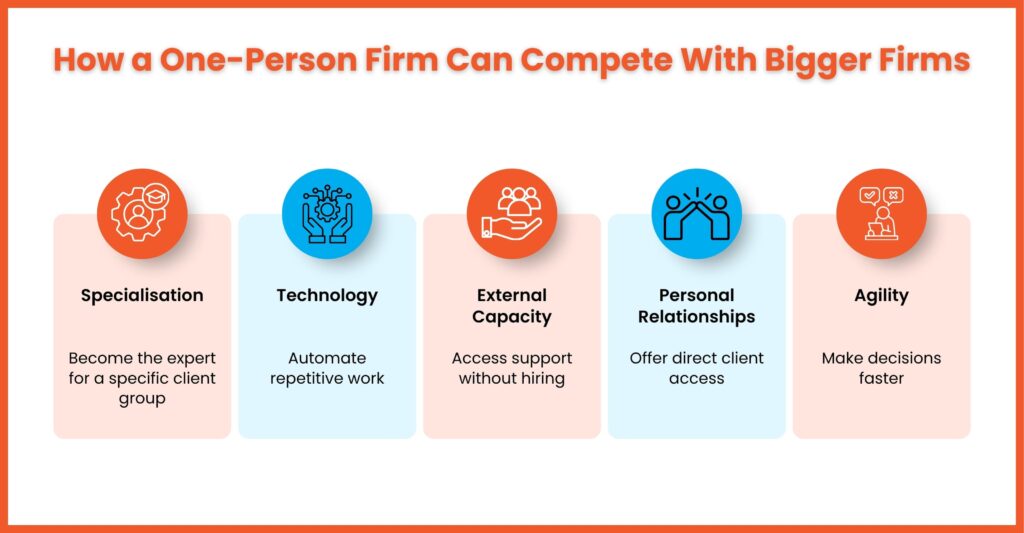
One of the ways in which you can compete against large UK practices is through specialisation. A large practice will serve thousands of clients across dozens of industries. However, a one-person practice can develop deep specialisation in certain accounting tasks or types of clients.
For example:
- E-commerce businesses
- Contractors
- Property investors
- Dental practices
- Recruitment companies
- Creative agencies
- Consultants
- Restaurants
- Technology businesses
When you work repeatedly with one type of business, then you are identifying common problems immediately. Your onboarding becomes more repeatable. Your processes improve. Your marketing becomes clearer.
You are no longer trying to know everything about every industry. You are becoming exceptionally useful to a particular group of clients. That is a powerful way for a one-person firm to compete.
Technology Has Reduced the Importance of Headcount
A few years back, a practice with a large team had an advantage over small or one-person practices because it had more people to manage the paperwork process. However, that has changed due to technology.
Bank feeds, cloud accounting platforms, document capture, workflow automation and connected applications can remove significant amounts of repetitive work. ICAEW’s 2026 research found that 91% said that tech plays a key role in delivering strategic objectives, while the majority (86%) noted that their tech strategy explicitly includes AI adoption. Technology is clearly becoming central to how accountancy firms of all sizes deliver services.
For a solo practitioner, this creates an opportunity.
You might not have 20 employees. But you can use systems that allow one person to manage work that previously required considerably more manual effort. The key is to automate carefully.
Start by looking at tasks that happen repeatedly:
- Client reminders
- Document collection
- Bank transaction processing
- Invoice capture
- Workflow updates
- Recurring reports
- Appointment scheduling
- Client onboarding
Every repetitive task can be automated using technology (MTD-compliant accounting software’s), leaving you with additional capacity, which is a valuable asset for a one-person practice.
Your Personal Relationship Can Be a Competitive Advantage
Large UK practices have strong brands for attracting new clients, but solo accounting practices have something more valuable: the ability to access their clients directly.
For your clients, it can be frustrating to move between different contacts. One person handles bookkeeping, other handles accounts, someone else manages tax, and the relationship manager changes.
A solo practice can offer continuity. The client knows who to contact. You understand their business history and know what happened last year and why certain decisions were made. That level of familiarity can create stronger relationships.
Of course, personal service should not mean being available 24 hours a day. A sustainable practice still needs boundaries. But being responsive, informed and easy to deal with can become a genuine competitive advantage.
Small Firms Can Often Move Faster
Large accounting practices have too many processes to follow, which are important for managing risks and creating consistency. But processes can also slow things down.
A one-person UK accounting practice can often make decisions much faster.
You can:
- Change your pricing
- Introduce a new service
- Choose a specialist niche
- Adopt useful technology
- Change your marketing message
- Improve your client onboarding
There may be no committee meeting required, no multiple management layers and no lengthy approval process. That agility can be particularly valuable in a profession that is changing rapidly. You can utilise your small size as an advantage by experimenting and adapting faster.
You Can Access Big-Firm Resources Without Building a Big Firm
For small or one-person accounting practices, growth meant new hires and building new internal teams. However, according to AAT’s Filing the Gap Survey 2025, 34% of employers struggled to recruit for finance and accounting positions in the last year. Outsourcing allows a one-person practice to access additional capacity without immediately building a permanent internal team.
For a solo accountant, this can be particularly important.
You might keep:
- Client relationships
- Final review
- Advisory conversations
- Business development
- Complex accounting decisions
While accessing external capacity for suitable routine work, such as:
- Bookkeeping
- Bank reconciliations
- Transaction processing
- Accounts preparation
- VAT support
- Payroll processing
- Management accounts preparation
This does not mean giving away control of your practice. It means you are operating faster.
This is where Equallto fits naturally.
Equallto is designed around solo practitioners and micro accounting firms based in the UK that want access to additional resources without automatically taking on the fixed costs of expanding an internal team. Its model includes bookkeeping, accounts preparation, payroll and management accounting support with flexible, output-based capacity. In other words, a one-person practice can remain small internally while becoming stronger operationally.
Focus on the Work Clients Actually Value
Your clients are not interested in your accountant but want their accounting work done and want value for their money.
They want:
- Accurate information
- Fewer financial surprises
- Better cash flow
- Tax clarity
- Faster answers
- Confidence in their numbers
- Advice about important decisions
This creates an opportunity for you. The more routine work you can standardise, automate or delegate, the more time you can spend discussing what the numbers actually mean. That is where your professional expertise becomes more valuable.
The Biggest Mistake a Solo Accountant Can Make
The biggest mistake that every small or one-person accounting practice makes is trying to do everything personally. At the beginning, that may feel necessary.
This includes:
- Answering every email
- Processing every transaction
- Preparing every account
- Chasing every document
- Keeping an eye on every VAT deadlines and HMRC updates
- Handling every administrative task
But eventually, the practice reaches a limit. You must decide which activities genuinely require your expertise.
Ask yourself:
- What work only I can do?
- What work could be automated?
- What work could be standardised?
- What work could be delegated?
- What work could be outsourced?
- Which clients are most profitable?
- Which services create the most value?
Those questions can completely change how a solo practice operates.
A Simple Growth Model for One-Person Accounting Firms
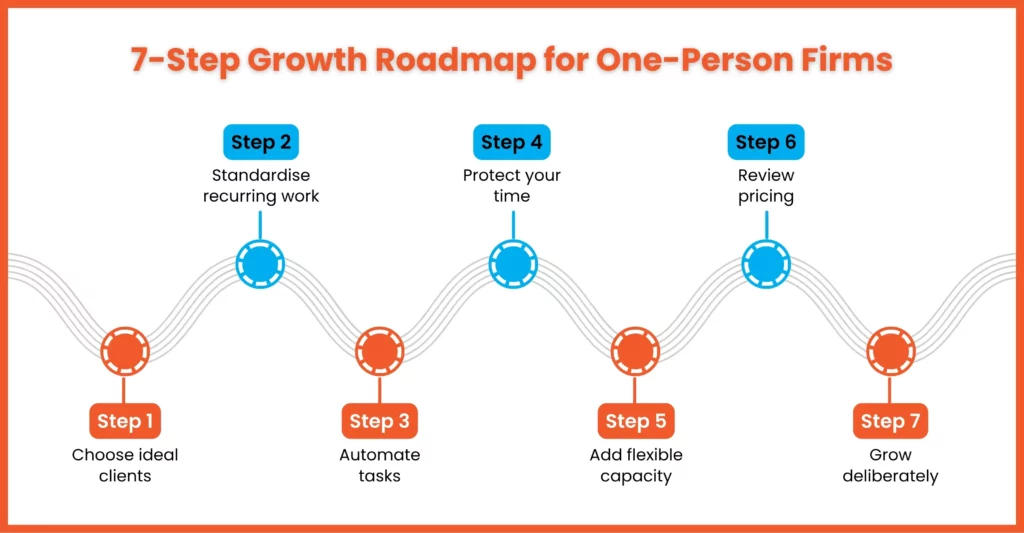
As a one-accountant UK accounting practice that wants to grow, we are giving you a simple growth model
Step 1: Choose Your Ideal Clients
Choose clients who understand your services and their requirements well.
Step 2: Standardise Recurring Work
Focus on identifying repeatable work like onboarding, bookkeeping, and month-end delivery and create standardised processes to streamline it.
Step 3: Automate Repetitive Tasks
Select accounting tasks that can be automated to reduce unnecessary manual work.
Step 4: Protect Your Time
Through streamlining of processes and automation, you can save time for client relationships, advisory work and business development.
Step 5: Add Flexible Capacity
Your outsourced bookkeeping team can handle extra workload for you during peak seasons. Choose the one that has excellent knowledge of UK accounting standards, MTD initiative, latest HMRC updates, and deadlines related to UK VAT and payroll.
Step 6: Review Your Pricing
Be transparent about your pricing, which must be based on the time it takes to do the job, complexity, and value created.
Step 7: Grow Deliberately
Be selective about the clients you accept. Prefer those whom you can satisfy and avoid taking in clients just because you have the capacity.
Frequently Asked Questions
Can a one-person accounting firm really compete with a Top 20 practice?
Yes, particularly within a specialist market. A solo practice does not need to match a Top 20 firm’s size or service range. It can compete through specialisation, personal client relationships, technology, faster decision-making and efficient delivery. To gain specialisation, many small practices have started partnering with outsourcing service providers for easy access to expertise and technology.
How can a solo accountant handle more clients without hiring staff?
A solo accountant can increase capacity by automating repetitive tasks, standardising workflows and using flexible external accounting resources for suitable work. This allows the practice owner to focus on review, advisory services and client relationships.
Should a one-person accounting firm specialise?
Specialisation can make a solo practice more efficient and easier to market. Working repeatedly with similar clients allows the accountant to develop stronger industry knowledge, improve processes and create more relevant advisory services.
Is outsourcing suitable for a one-person accounting practice?
Yes. Outsourcing can provide flexible capacity for bookkeeping, accounts preparation, payroll and other routine work. The practice can retain client relationships and professional oversight while using external resources for agreed delivery tasks.
How can Equallto help a solo accounting firm grow?
Equallto provides flexible outsourcing services designed for solo practitioners and micro accounting practices. Firms can access bookkeeping, payroll, accounts preparation and management accounting capacity without automatically building a larger permanent team.
Conclusion: You Don’t Need a Bigger Firm to Build a Bigger Business
Can a UK-based one-person accounting firm compete with a Top 20 practice? The answer is yes, and this can be achieved not by copying the large practices. Smart solo practices understand that their size can be an advantage.
- They can be closer to their clients.
- They can move faster.
- They can specialise more deeply.
- They can adopt technology without navigating multiple layers of approval.
- And today, they can access capabilities that were once available only to much larger firms.
The future of a successful small accounting practice does not necessarily depend on building a huge internal team. It involves:
- Building the right operating model
- Using technology where technology makes sense
- Preserving your expertise focused on high-value work.
- Building strong client relationships.
- And when more capacity is needed, access it flexibly.
That is how a one-person accounting firm can punch far above its weight.
If you want to grow your practice without immediately taking on another permanent employee, contact Equallto’s services for micro accounting firms. You can build a practice that stays personal, independent and focused, while gaining access to the resources needed to compete with much larger firms.
